Contextual Intelligence in Presentation AI: Reading Emotion and Intent
Contextual Intelligence in Presentation AI: Reading Emotion and Intent
Let's be honest: most AI-generated presentations feel like they were written by a robot that read your outline but never met your audience. The slides are clean. The grammar is flawless. The colors match. And yet, something is missing. That something is context.
Generic AI tools generate slides based on patterns in large datasets. Contextual intelligence generates presentations based on who you're talking to, what they care about, and what you want them to do next. That's the difference between a deck that gets skimmed and a deck that gets remembered.
This isn't a distant future. It's happening now — and it's changing what "good presentation software" means.
01 What "Contextual Intelligence" Actually Means in Presentation AI
The term comes from a simple observation: most AI presentation tools treat every prompt the same way. You type "pitch deck for investors," and the AI pulls from the same pool of templates, layouts, and phrasing it would use for a sales training or a quarterly review.
Contextual intelligence flips that. Instead of pattern-matching, the AI builds a model of your specific situation — your industry, your brand guidelines, your audience's preferences, even the emotional tone that will land best.
Prezent's research paper on Contextual Intelligence puts it plainly: most AI tools "fail to incorporate the nuanced needs of a particular industry or company." By feeding the AI with relevant context — industry-specific terminology, brand guidelines, individual preferences — generated presentations become "precise and compelling," enabling more effective business communication.
The core idea: context is the missing layer between a generic, vague AI response and a presentation that feels like it was made for one specific room of people.
Think about how you'd prepare a presentation without AI. You'd research the audience. You'd check what they already know. You'd adjust your tone based on whether you're talking to engineers or executives. Contextual intelligence is simply teaching AI to do the same thing.
02 Why Generic AI Presentations Fall Flat
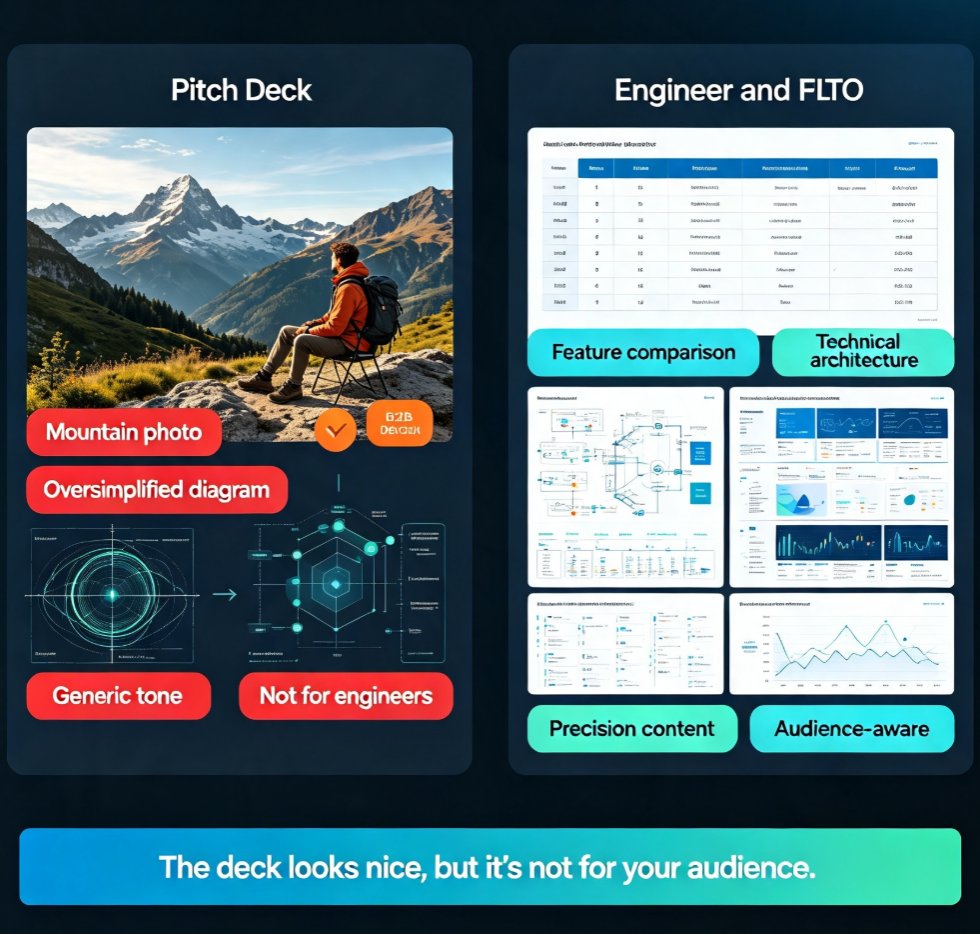
Let's say you're a tech company preparing a product pitch. Your audience is a room of engineers and CTOs. They want to see a Feature Comparison slide and a Technical Architecture diagram. They don't need a flashy lifestyle photo of someone holding a laptop on a mountain.
A generic AI tool will give you the mountain photo. It will clutter the technical diagram into a simplified graphic that loses all the detail your audience actually cares about.
Prezent's research describes exactly this failure mode: "A generic AI tool misaligns these layouts, cluttering information and simplifying complex diagrams. These errors dilute the presentation's impact and risk losing interest."
Sound familiar? If you've ever opened an AI-generated deck and thought, "This looks nice but it's not for my audience," you've experienced the gap firsthand. The problem isn't the AI's design skills. It's that the AI doesn't know who's watching.
This is also why so many teams end up spending hours reworking AI output. The deck looks polished, but the content doesn't fit the room. You end up deleting slides, rewriting copy, and swapping layouts — which defeats the purpose of using AI in the first place. If this sounds like your experience, you're not alone. It's the most common complaint about AI-generated slides.
03 The Three Layers: Data, Emotion, and Intent
Contextual intelligence works on three layers. Think of them as a stack:
Layer 1: Data. The facts, figures, and content of your presentation. This is what most AI tools already handle well — pulling your outline, organizing your points, structuring your narrative. If you're importing a research report or a Word outline, the AI can already turn that into a structured deck.
Layer 2: Emotion. How you want your audience to feel. A data scientist needs a different emotional register than a sales team. A board of directors needs confidence; a new hire needs clarity. Emotion-aware AI adjusts tone, phrasing, and even visual density based on who's in the room. Prezent's approach uses "user fingerprint prompts that guide emotional tone and audience targeting" — essentially teaching the AI to be empathetic to the audience.
Layer 3: Intent. What you want the audience to do after the presentation. Approve the budget? Sign the contract? Complete the training? Intent-aware AI structures the deck to drive toward that specific action. Every slide, every call-to-action, every piece of evidence is chosen to move the audience one step closer to that outcome.
The most effective presentations align all three layers. Most AI tools only handle the first.
Here's what that stack looks like:
When all three layers align, something interesting happens: the presentation stops being a document and starts being a conversation. It anticipates questions. It addresses objections. It guides the audience toward a conclusion — not because the AI is clever, but because it understands the context.
04 What Changes When AI Understands Context
When an AI tool understands context, the output changes in measurable ways. Here's a side-by-side look:
| Dimension | Generic AI | Contextual Intelligence |
|---|---|---|
| Audience understanding | Assumes a generic viewer | Builds a profile of your specific audience |
| Emotional tone | Neutral, uniform | Adjusted to audience and scenario |
| Layout selection | Random or template-based | Guided by best practices for visual communication |
| Brand alignment | Loose, often off-brand | Tightly follows brand guidelines |
| Content relevance | Surface-level | Industry-specific terminology and examples |
| Time to usable deck | 30-60 minutes of editing | "80% complete in minutes" (per Prezent) |
| Final outcome | Looks fine, feels generic | Feels tailored, drives action |
The last row is the one that matters. Prezent's research claims that with contextual intelligence, users are "80% complete in minutes rather than starting from zero." That's not just faster — it's better, because the 20% you spend polishing is about nuance, not fixing fundamental mismatches.
For teams, this changes the economics of presentation creation. When a consultant can produce a data-rich case study deck in 10 minutes, or an HR team can automate onboarding presentations, the bottleneck shifts from production to strategy.
05 What This Means for Your Workflow
You don't need to wait for the future. You can start feeding context into your AI presentation tools today. Here's how:
Give the AI your audience profile. Before generating, write two sentences about who's watching: their role, their familiarity with the topic, their likely objections. That's cheap context that changes everything.
Feed it your brand guidelines. If your tool supports brand kits, use them. Consistent fonts, colors, and layout aren't vanity — they're trust signals. Your audience reads visual consistency as competence. Zendeck's brand kit setup makes this straightforward.
Tell the AI what you want the outcome to be. "Persuade the CFO to approve the budget" is a different prompt than "Explain Q3 results." The AI can't read your mind, but it can read your prompt.
Review the emotional register. After generation, ask yourself: does this deck feel like it was written for this specific room? If not, adjust the tone in your next prompt.
Use templates as a starting point, not a destination. A good template library gives you a foundation, but contextual intelligence is what makes the final deck feel yours. Zendeck's template library offers 500+ options, but the real magic is in how the AI adapts them to your context.
This is where tools like Zendeck come in. Zendeck's approach to AI presentations focuses on exactly this gap — moving beyond raw generation toward decks that actually fit your audience and brand. If you've ever opened an AI deck and thought "this looks nice but it's not us," you'll want to understand how memory-rich AI personalization is changing what presentation tools can do.
06 Why Contextual Intelligence Is the Next Battleground
Here's the thing: the design quality of AI presentations has already plateaued. Every major tool can generate a clean, well-structured deck. The differentiator now is relevance.
The next competitive advantage in presentation software isn't prettier slides — it's smarter context.
That's why we're seeing tools invest in "memory" features, audience profiling, and emotional tone control. It's why memory-rich AI personalization is becoming a headline feature for 2026. It's why AI transparency and trust matter more as these systems become more sophisticated.
For you, the practical takeaway is simple: when you choose a presentation tool, ask what it knows about your audience. If the answer is "nothing," you're leaving engagement on the table.
Zendeck is building toward this — combining smart layout, brand consistency, and data-driven design so your decks don't just look good — they land.
The bottom line: your audience doesn't need more information. They need information that's relevant to them. Contextual intelligence is how AI learns to deliver that relevance — and it's the difference between a presentation that's seen and a presentation that's felt.
FAQ
Q: What is contextual intelligence in presentation AI? A: Contextual intelligence is an AI approach that goes beyond pattern-matching to understand the specific audience, industry, brand guidelines, and emotional tone of a presentation. Instead of generating generic slides, it tailors content, layout, and phrasing to the exact context of your communication.
Q: How is contextual intelligence different from regular AI presentation tools? A: Regular AI tools generate based on large dataset patterns, treating every prompt similarly. Contextual intelligence builds a model of your specific situation — audience preferences, industry terminology, brand guidelines — and generates presentations that are precise and compelling for that specific context.
Q: Does contextual intelligence actually improve engagement? A: Yes. According to Prezent's research, contextual intelligence enables presentations that are "80% complete in minutes" and avoids the common failure of generic AI tools that "dilute the presentation's impact and risk losing interest." When content aligns with audience expectations, engagement follows.
Q: Can I get contextual intelligence from Zendeck? A: Zendeck's approach to AI presentations focuses on audience fit and brand consistency — using brand kits, smart layout, and template personalization to ensure your decks feel tailored rather than generic. It's the practical application of contextual intelligence principles.
Q: What should I look for in an AI presentation tool? A: Look for tools that let you input audience context (who's watching, what they care about), support brand guidelines, and offer emotional tone control. The more context the tool can use, the more relevant your final deck will be.