AI Slides 2026: Why Contextual Intelligence Beats Raw Generation
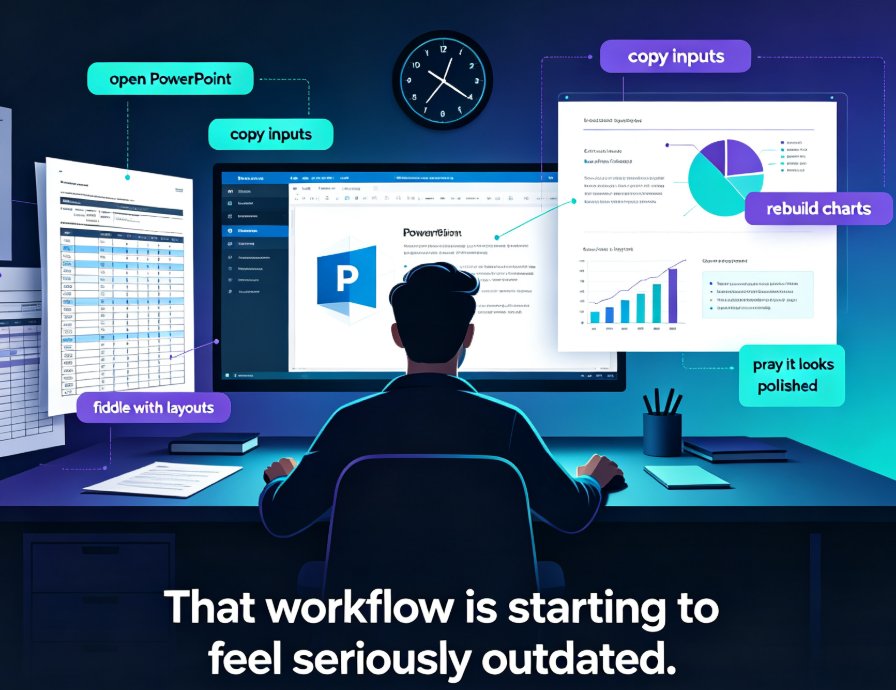
Let's be honest about how most late-night decks get made. You have a strategy doc, a messy spreadsheet, and a meeting that starts tomorrow morning. The old workflow goes something like this: open PowerPoint, copy the inputs over, rebuild charts, fiddle with layouts, and pray the result looks polished before the clock runs out.
That workflow is starting to feel seriously outdated.
By 2026, the AI presentation space has shifted from "tools that build slides" to "tools that understand what you're trying to communicate." Raw generation was the first wave. Contextual intelligence is the second — and it's the one that actually changes how you work.
Here's what that shift means for educators, HR teams, and anyone who builds decks on a deadline.
01 The Problem With Raw Generation
Let's be real: automatic slide generation was a miracle when it landed. You pasted in an outline, clicked generate, and got a deck that didn't look like a ransom note. That alone saved hours.
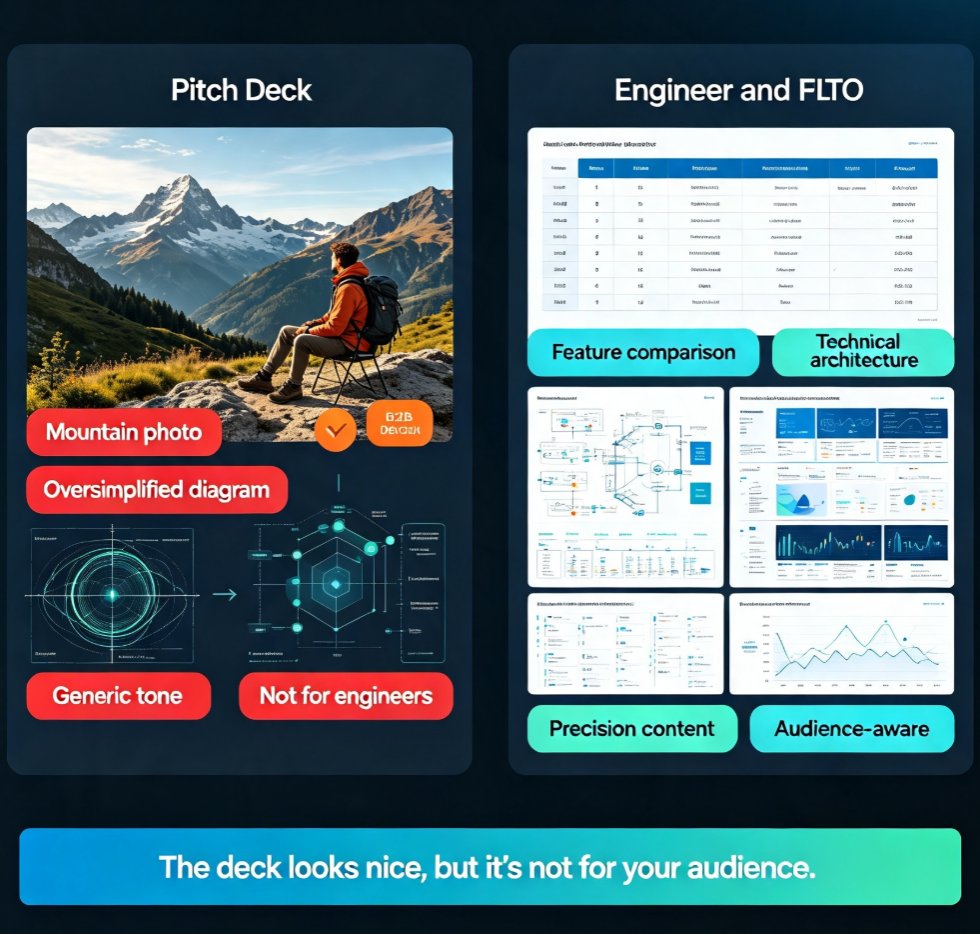
But raw generation has a ceiling. It treats every input the same way. A business proposal, a training module, and a course lecture all get the same template treatment. The output looks clean, but it doesn't feel right. It doesn't understand that a board deck needs restraint while a classroom deck needs energy.
That's the gap everyone hit by mid-2024: fast output without contextual judgment. You still had to rework the deck so it actually matched your audience, your brand, and your intent. The tool saved you from the blank page, but it didn't save you from the editing loop.
02 What Contextual Intelligence Actually Means
Contextual intelligence in AI deck tools means the software understands more than the words on the page. It reads the structure of your content, detects the purpose behind it, and makes design decisions based on who will see it and why.
That includes several layers of awareness:
- Structural awareness — knowing whether an outline section is a chapter, a key takeaway, or a supporting data point, and treating each one differently.
- Audience awareness — adapting tone, density, and visual rhythm to a boardroom versus a classroom versus a training session.
- Brand awareness — applying your color system, fonts, and asset style automatically, without you asking twice.
- Emotional intent — recognizing when a slide should persuade, teach, or summarize, and shaping the design accordingly.
The distinction matters because it changes the kind of output you get. A generation tool gives you a deck. A context-aware tool gives you your deck.
03 The Evolution: 2023 to 2026
The market evolution is clear if you trace the capability milestones. The industry moved from basic layout assistance in 2023 to full generation in 2024, then to content-adaptive design in 2025, and now to intelligent creation in 2026 — where tools increasingly understand audience and impact before rendering a single slide.
Each stage added a layer of judgment. The first generation filled templates. The current generation understands context — what your content is for, who it's for, and what impact it needs to make. If you want the deeper story on this shift, our look at AI decks in 2026: from template picking to fully automated generation walks through the same arc from the workflow side.
04 Why Contextual Intelligence Wins in 2026
Here's the number that matters: 83% of consumers now expect dramatically better experiences from the tools they use — and that expectation applies to the decks you produce, not just the software you run. Audiences have seen thousands of slides. They can feel when one was assembled by a script versus designed with intent.
Speed became table stakes. Every credible AI deck tool in 2026 can generate a complete presentation in minutes. When everyone is fast, the only differentiator left is judgment — how well the tool adapts to your specific scenario.
That's exactly why context-aware design is replacing template-picking as the core capability of leading tools. A template is a starting guess. Contextual awareness is an informed decision.
The bar for presentations has risen because the tools have raised it. A poorly structured deck now reflects on you, not on the software — and audiences have seen what well-designed, context-aware decks look like.
05 What Context-Aware Tools Do Differently
Let's make this concrete. A context-aware deck tool doesn't just ask "what content?" — it asks "what's this for?"
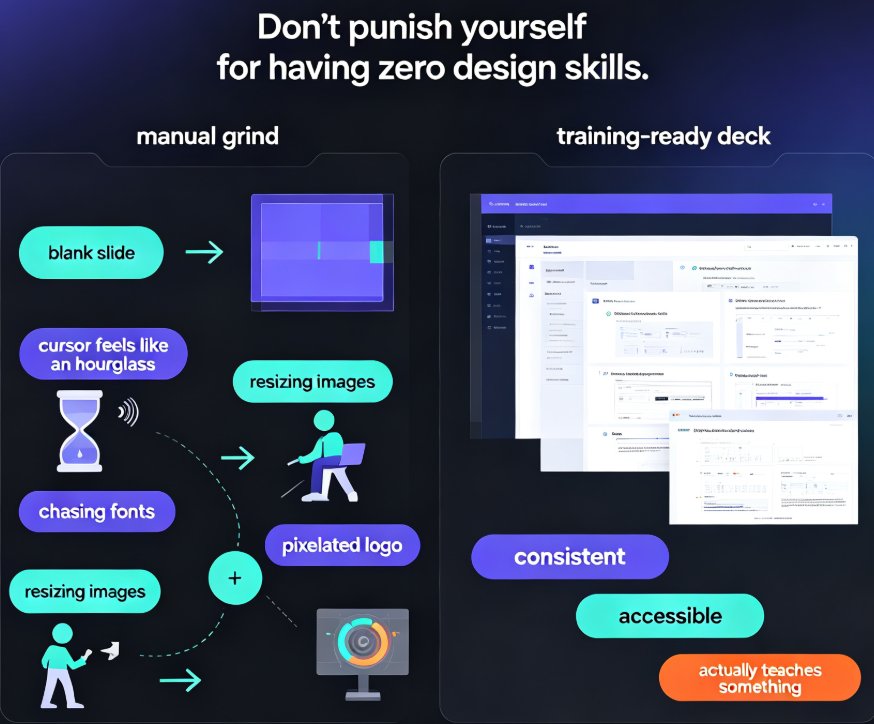
Scenario 1: A corporate training deck. The tool needs to break dense material into digestible modules, add visual breathing room, and keep a consistent brand look across forty slides. A raw generator produces forty text-heavy slides in one style. A context-aware tool recognizes training material and adjusts pacing, chunking, and visual variety accordingly.
Scenario 2: A product pitch. The tool needs narrative momentum — problem, solution, proof, ask. It should emphasize the narrative arc rather than listing features in a grid. The difference between a pitch that lands and one that gets skimmed is often structural, and context-aware tools handle that structure for you.
Scenario 3: A university lecture. The tool needs visual variety to hold attention, plus clear hierarchy for note-taking. A lecture deck with the same density as a financial report is a recipe for lost students. Teaching contexts demand different spacing, more visuals, and slower information reveal.
Tools like Zendeck build this contextual awareness directly into the pipeline. When you upload a Word outline or paste Markdown, Zendeck analyzes the structure and applies smart layout and style decisions — the design adapts to the content's purpose, not the other way around. That's a fundamentally different starting point from "pick a template and fill it." If you're curious how that plays out inside the product, our guide on AI deck template selection explains the logic Zendeck uses to match content to visual treatment.
06 How This Changes Workflows for Educators and Teams
For anyone building decks week after week, contextual intelligence changes what "preparing a presentation" actually means.
Instead of copying content into slides, manually adjusting layouts, rebuilding charts, aligning fonts, and hoping it holds together, you now write or upload your content, let the tool interpret structure and intent, then review and refine.
That's not a minor time saving — it's a different workflow. And it opens up room for the parts of presentation work that machines can't do: reading the room, shaping the argument, deciding what to leave out.
Teams that adopt context-aware tools also report more consistent on-brand output, because the design system is applied automatically rather than depending on each teammate's PowerPoint discipline. Your brand kit becomes a guardrail, not a hope. We've covered the team-side benefits elsewhere in our piece on hidden AI features that boost team productivity, and the same theme runs through the broader AI presentation trends for 2026.
The shift also pairs naturally with the move toward agentic workflows, where the tool doesn't just generate but actively manages the path from outline to finished, on-brand deck — a direction we explored in agentic AI in presentation tools.
07 Choosing Your Tool: A Practical Comparison
Not all AI presentation tools approach context the same way. Here's how the main approaches stack up in 2026:
| Approach | Representative Tools | Strength | Weakness | Contextual Intelligence |
|---|---|---|---|---|
| Full AI generation | Gamma, Tome | Speed, full automation | Limited control, one-size-fits-all design | Medium |
| Smart templates | Beautiful.ai | Predictable business output | Still template-centric | Low-Medium |
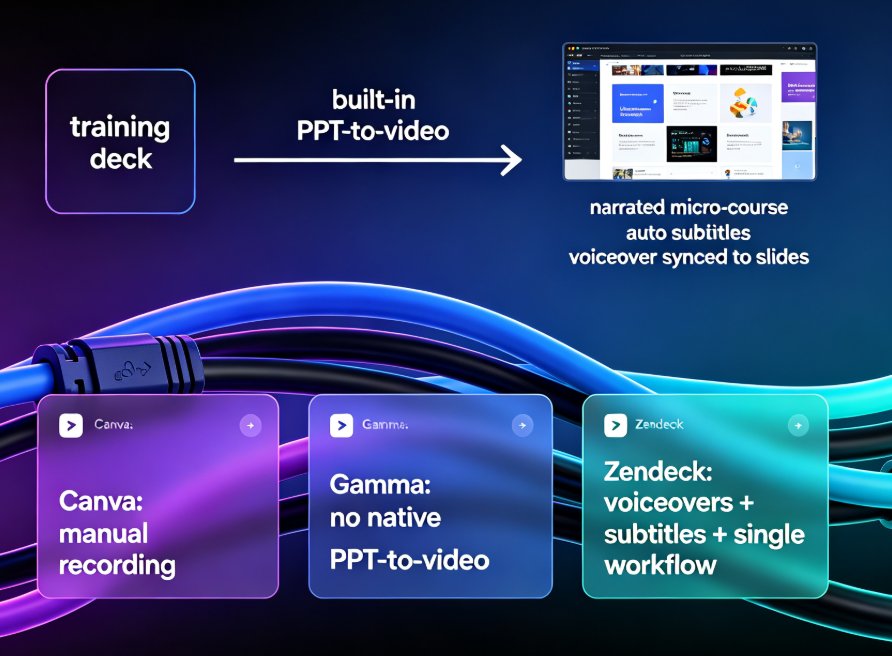
| AI-assisted design | Canva | User control, brand kits | Requires more manual effort | Medium |
| Context-aware creation | Zendeck | Structure-aware layouts, brand governance, courseware focus | Newer category, smaller ecosystem | High |
The practical takeaway: if your work involves many different audiences — courses, training, pitches, internal updates — you want a tool that adapts to context, not one that forces your content into a fixed mold.
Zendeck's approach to layout automation matters here. Instead of applying a generic template, it reads the structure of your outline and matches it to an appropriate visual treatment — which is the difference between "a deck" and "the right deck for this situation." If you want to see how that works in action, our guide on how Smart Layout cuts design time breaks down the specific mechanics.
08 The Bottom Line
The next competitive battleground for AI deck tools is not output speed — it's contextual intelligence. Understanding the audience, the emotion, and the intent behind every slide.
Tools that understand context will replace tools that merely generate content — not because generation is useless, but because generation without judgment leaves you with the same editing burden it promised to remove.
If you're still picking a template and hoping it works, 2026 is the year to change that habit. The tools have grown up. Your workflow can too.
FAQ
What is contextual intelligence in AI presentation tools?
Contextual intelligence means the AI understands the structure, audience, and purpose of your content — not just the words — and makes design decisions based on that understanding. It adapts layout, brand style, and visual treatment to your specific scenario rather than applying a one-size-fits-all template. Zendeck does this by analyzing your outline structure and applying smart layouts matched to the content type.
How is 2026 different from earlier AI presentation tools?
Earlier tools (2023-2024) filled templates or generated slides from prompts with limited judgment. By 2026, leading tools analyze content structure and intent, producing decks tailored to audience and purpose. The shift is from "generate anything" to "understand and adapt." This is why AI decks moved from template picking to fully automated, context-aware generation.
Is raw generation going away?
No — raw generation remains a fast starting point, but it's becoming table stakes. When every tool can generate a deck in minutes, the differentiator becomes contextual judgment: brand consistency, audience awareness, and structural logic. Tools that only generate content without understanding it leave you with the same editing burden they promised to remove.
What should I look for when choosing an AI deck tool in 2026?
Look for tools that understand content structure, enforce brand consistency automatically, and adapt layouts to different scenarios — courses, pitches, training, internal updates. A tool like Zendeck that builds contextual awareness into smart layout and brand kit features will save you more time than a pure generator, especially if you create decks for many different audiences.
Can contextual intelligence really save me time?
Yes, because it reduces the editing loop. If the tool already understands your content type and brand, you spend less time fixing layouts and more time refining the message. Most teams find the biggest time savings come from fewer manual adjustments — not faster initial generation, but fewer rounds of cleanup afterward.