Agentic AI in Course Creation: Autonomous Workflows Reshape Education
The Tuesday Night Problem
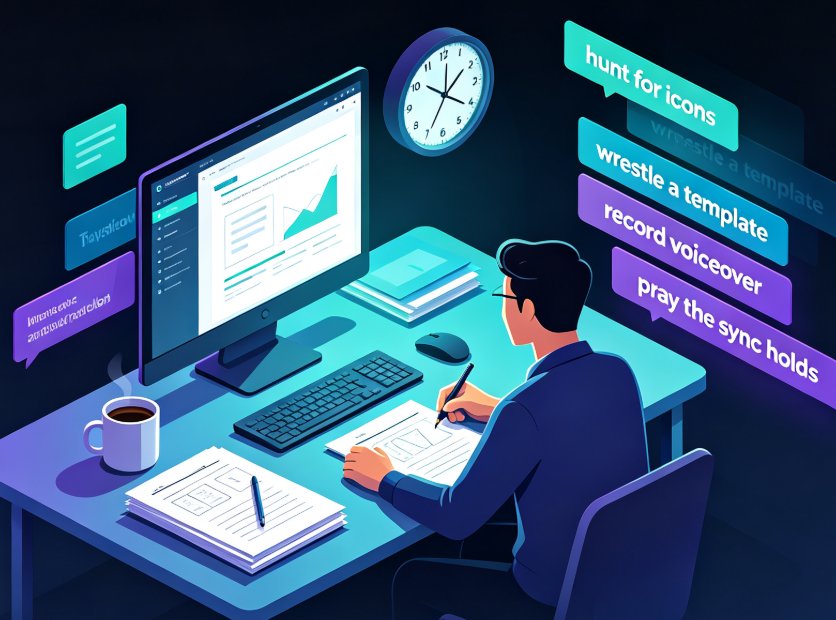
It's 11:40 PM on a Tuesday. You've just finished grading, and now you're staring at a half-built deck for Thursday's session. The outline is solid. The research is done. But you still have to hunt for icons, wrestle a template, record a voiceover, and pray the sync holds. Sound familiar?
Here's the uncomfortable truth: most educators and trainers don't have a content problem. They have a production problem. The ideas are there. The pipeline that turns ideas into polished micro-courses is the bottleneck.
That's exactly why agentic AI matters for education in 2026.
01 | What Agentic AI Actually Means (and What It Doesn't)
Let's get the definition right, because the marketing jargon is already drowning us.
Agentic AI describes systems that don't just answer prompts — they observe, decide, and act autonomously and purposefully. As researchers put it, these are self-contained, goal-based entities designed to operate with minimal human intervention, dynamically reasoning and adapting as context changes (ResearchGate, "Agentic AI in Education: State of the Art and Future Directions," 2025).
This is the shift that matters: instead of you driving every step, an agent owns a goal and drives itself toward it.
Compare that to what you use today. A standard AI chat tool generates a block of text when you type. A presentation generator produces slides when you click. Both are reactive — they wait for your command at every step. An agentic system, by contrast, takes a whole outcome — "build a 20-minute micro-course on data privacy for our onboarding cohort" — and breaks it into sub-tasks: research, outline, design, narration, subtitles, QA. Then it executes, checks its own work, and re-runs until the goal is met.
That's not a faster version of the old workflow. That's a different kind of workflow.
02 | The Workflow Problem: Why Course Creation Eats Your Week
Let's be real about the current state. A typical 60-minute micro-course, built the traditional way, quietly consumes a full working week:
- Research and structuring: 8+ hours bouncing between sources
- Deck design: 6+ hours fighting templates, fonts, and alignment
- Narration and video production: 5+ hours recording, editing, syncing
- QA and accessibility fixes: 4+ hours checking captions, alt text, broken layouts
That's roughly 23 hours for a single hour of learning content. Multiply it across three courses, and you've lost a month.
The pain isn't just time. It's the context switching. You're a subject expert one minute, a designer the next, then a video editor, then an accessibility auditor. Every switch costs focus, and focus is the scarcest resource in education.
03 | The Big Shift: From Operating Tools to Supervising Agents
Here's the mental model to carry into 2026: educators will stop operating tools and start supervising AI agents.
Think of it like moving from driving a car to being a flight controller. In the old model, you grip the wheel at every mile marker — you choose the template, click the button, fix the kerning, re-record the flubbed line. In the agentic model, you file a flight plan, monitor the instruments, and intervene when something looks off.
The research already points in this direction. In higher education, agentic systems are being deployed as teaching assistants that answer routine questions, retrieve materials, track learner progress, and escalate unresolved cases to human instructors (The Ohio State University, "Agentic AI in Higher Education," 2025). The same autonomy that lets an agent handle student queries lets another agent assemble lecture materials, author worked examples, and generate practice exercises tailored to course objectives and individual student aptitude (Acharya et al., 2025, cited by OSU).
The endpoint is a coordination layer where different agents own different tasks — lesson planning, assessment generation, predictive risk detection — and you manage the system, not the steps. Hosseini and Seilani (2025) call this the "hierarchical multi-agent system," and it's already moving from academic papers into tools you can use this year.
04 | Inside an Autonomous Pipeline: From Outline to Published Micro-Course
Let's ground this in a concrete example, because abstraction is the enemy of action.
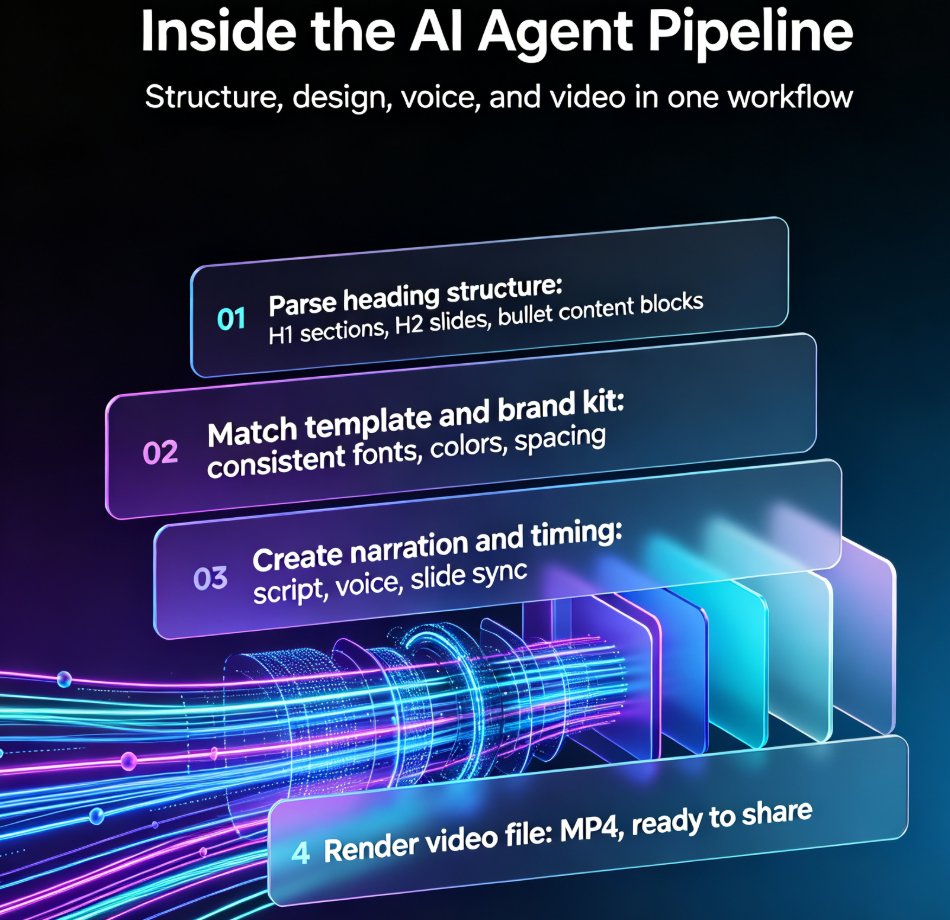
Imagine you need a 15-minute micro-course on customer data privacy for a new product launch. Here's what an agentic pipeline looks like in practice — and what Zendeck's AI Agent flow is already doing along these lines:
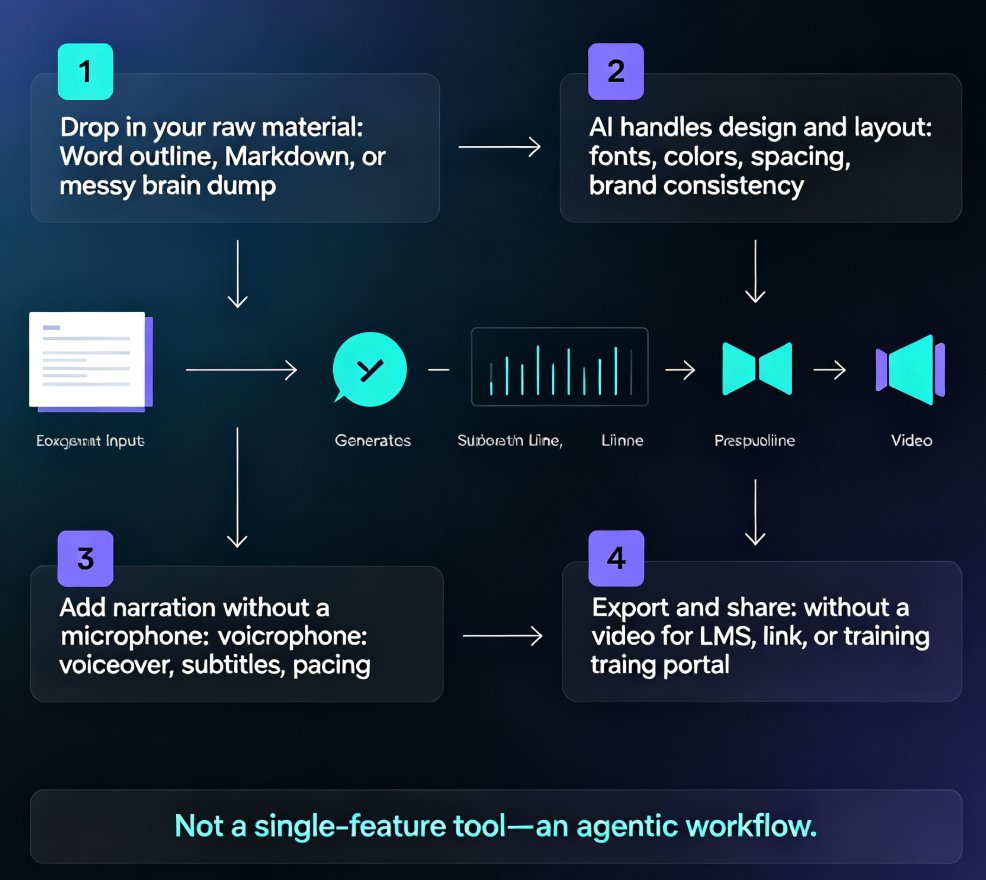
Step 1 — Brief the agent. You upload a Word outline or paste Markdown. This is your one creative act: deciding what needs to be taught.
Step 2 — The agent researches and structures. It pulls relevant context, organizes your outline into a logical flow, and flags gaps you didn't think of. Goal-oriented and context-aware, it adapts the structure as it goes (LinkedIn, "How Agentic AI Will Reshape Teaching and Learning," 2025).
Step 3 — Design and layout. Instead of hand-placing every element, the agent generates a visually consistent deck, applying your brand kit and smart layouts automatically. No template roulette. No font drift.
Step 4 — Production. The deck gets turned into a narrated micro-course with synchronization, subtitles, and accessibility features like auto-generated alt text — all in one pass.
Step 5 — Review and iterate. You don't rebuild. You supervise: watch the preview, tweak the script, adjust the pacing, ship.
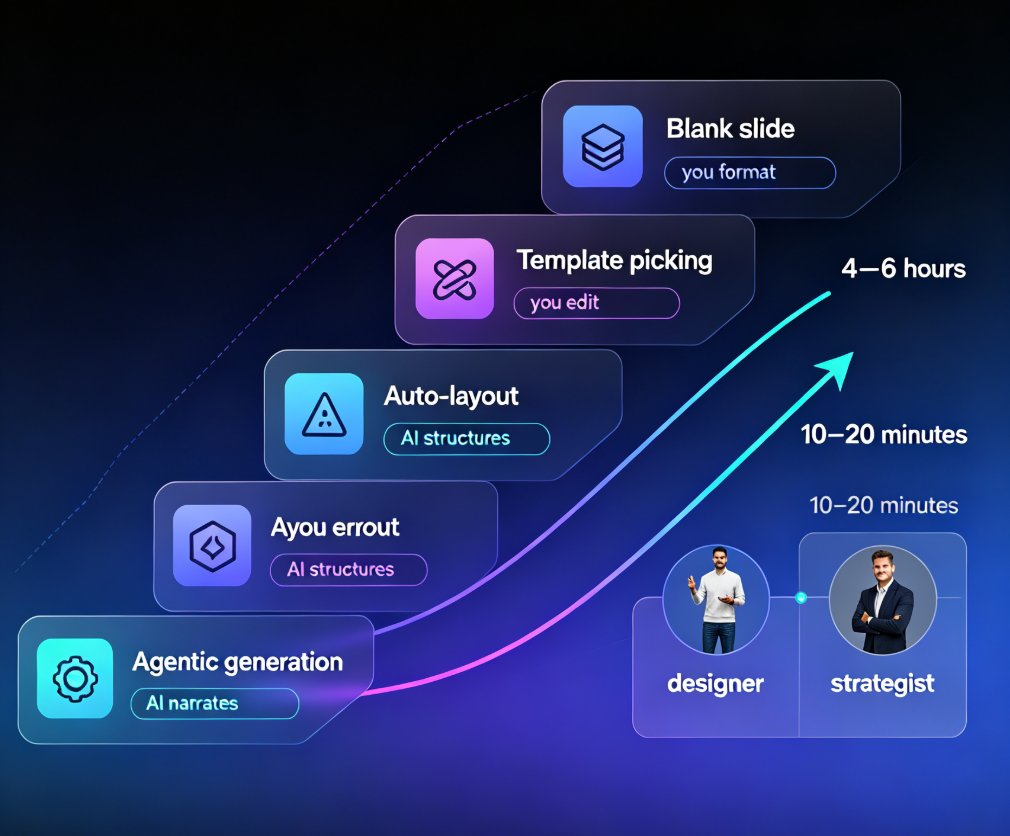
The numbers speak for themselves:
The same educational output drops from roughly 23 hours of manual production to about 5 hours of supervised work — and the quality bar, from brand consistency to accessibility, is enforced by the system, not your willpower.
This is what Zendeck's agent-driven approach is built for: take your outline, and run it through design, narration, and delivery as one continuous flow. You can see more about how Zendeck's 2026 automation trend positions agents inside presentation tools in our deep dive on agentic AI in presentation tools, or walk through the outline-to-micro-course pipeline step by step.
05 | The New Skills: You're a Supervisor Now
This shift redefines the educator's job description. The premium skill is no longer software mastery — it's brief-writing, evaluation, and judgment.
Three capabilities will separate educators who thrive from those who burn out:
1. Writing tight, testable briefs. An agent is only as good as the goal you give it. "Make a deck" produces mediocrity; "Create a 12-slide micro-course on phishing awareness for junior analysts, with one interactive quiz per section and WCAG-compliant alt text" produces something you can ship. If you want to get better at this, start with the discipline of a custom brand kit so the agent inherits your visual rules — check our guide to building a Zendeck brand kit.
2. Reviewing work like an editor, not a creator. You're not looking for what you would have written. You're checking whether the agent met the goal: Is the logic sound? Is the data current? Is the tone right for the audience? Then you iterate on the brief, not the slides.
3. Designing the learning outcome first. Agentic tools handle production, which frees you to obsess over what actually matters: learning objectives, assessment design, and whether the course changes behavior. That's the part automation can't fake.
06 | What to Watch Out For: Supervision Is Not Optional
Let's not romanticize this. Agentic AI in education is still an emerging field with significant research gaps (ResearchGate, 2025). Three risks deserve your attention:
Hallucinated content dressed as confident design. An agent that can't find a source may invent one — and it'll lay it out beautifully. Your review pass must include fact-checking, not just aesthetics.
Bias baked into the pipeline. If your agent draws from biased materials, your course inherits the bias. Diversify your source inputs and audit examples for fairness, especially in assessment generation.
Accessibility can't be an afterthought. Auto-generated subtitles and alt text are a start, but you still need to verify captions against audio and check color contrast. We covered the practical side in our accessible micro-course guide.
The mental rule to keep: agents multiply your intent. Garbage brief in, garbage course out. Supervision isn't a safety net — it's the whole job now.
07 | What This Means for Your 2026
Here's the honest prediction. By 2026, the institutions and teams that win won't be the ones with the most design tools — they'll be the ones whose educators know how to brief, check, and refine an AI agent's work.
You'll spend less time fighting software and more time making pedagogical decisions. You'll ship courses in days instead of weeks. And your role shifts from production line worker to quality control lead — which, let's be honest, is a much better use of a human brain.
If you want to experience the agentic flow instead of reading about it, start small: paste one existing outline into Zendeck and let the full text-to-video agent pipeline run. Watch what it produces, edit the brief, run it again. That feedback loop — brief, generate, review, refine — is the new muscle you'll be using all year.
The tools are ready. The question is whether your workflow is.
FAQ
What is agentic AI in education? Agentic AI in education refers to goal-based AI systems that observe, decide, and act autonomously — for example, generating course materials, answering student questions, and assembling assessments with minimal human intervention. Unlike reactive chatbots, these agents reason, adapt, and execute multi-step workflows on their own.
How is agentic AI different from regular AI presentation tools? Regular AI tools generate output only when you prompt them, step by step. Agentic AI owns a whole outcome — like "produce a narrated micro-course" — and breaks it into research, design, production, and QA tasks, executing them autonomously before reporting back for your review.
Will agentic AI replace instructional designers and teachers? No, but it will rebalance their work. The research consensus is that educators shift from operating tools to supervising agents — writing briefs, reviewing output, and making judgment calls. The creative and pedagogical decisions remain human; the production grind becomes automated.
What can Zendeck's AI Agent pipeline do from outline to video? Zendeck's agent-driven flow takes a Word outline or Markdown and handles deck generation, smart layout, narration, subtitles, and accessibility features in one continuous pipeline. Your role is to brief the agent, review the output, and iterate — turning weeks of production into hours of supervision.
What skills should educators develop for the agentic era? Focus on three: writing tight, testable briefs; reviewing agent output like an editor; and designing learning outcomes before production begins. Software mastery matters less than judgment, fact-checking, and the discipline to verify accessibility and data accuracy.