Data Privacy in AI Presentation Tools: The 2026 Compliance Shift
The Question Nobody Asks Before Signing Up
You've just spent 40 minutes building a killer pitch deck in an AI presentation tool. The numbers are confidential — your Q4 revenue projections, the acquisition target, the compensation plan for the new executive team. Now ask yourself: where is that deck actually stored? Who has access to it? And if you delete it, is it really gone?
Most people can't answer those questions. And in 2026, that's a problem.
Data privacy has quietly become the most important purchase criterion for AI presentation tools — ahead of template quality, ahead of speed, ahead of price.
For schools handling student records and enterprises managing sensitive financial data, the stakes are no longer theoretical. Regulators are enforcing GDPR, HIPAA, and FERPA with increasing rigor, and the cost of a data breach — financial, legal, reputational — far exceeds whatever you saved by choosing the cheapest tool.
This guide walks through the compliance shift reshaping the AI presentation market, compares deployment models, and shows what a genuinely secure AI deck platform looks like. If you're evaluating tools for your organization, this is the checklist you need.
I. Why Data Privacy Became the New Purchase Criterion
Five years ago, teams chose presentation tools the way they chose coffee shops — based on vibe. Nice templates, smooth animations, a clean interface. Security was an afterthought, something the IT department handled.
That era is over.
In 2026, procurement teams are rejecting AI presentation tools that can't demonstrate data residency, encryption standards, and clear deletion policies. The shift is driven by three forces:
-
Regulatory pressure. GDPR fines can reach 4% of global annual turnover. FERPA violations can cost schools federal funding. HIPAA breaches carry penalties up to $1.5 million per violation. These aren't abstract risks; they're line items on a balance sheet.
-
The rise of sensitive content in decks. Presentation tools are no longer just for sales pitches. Teams use them for board reports, employee performance reviews, patient education materials, and student assessments. The content inside these decks is often more sensitive than what lives in a CRM.
-
AI's data appetite. AI-powered tools need data to function — your outlines, your notes, your images. That raises uncomfortable questions: Is my content being used to train models? Can the vendor's employees see my decks? What happens when I cancel my subscription?
The outcome? Organizations are demanding answers before they sign. And vendors that can't provide them are losing deals. If you want to understand how this trend is reshaping the broader market, our deep dive on 2026 data security trends in AI presentation tools covers the full picture.
II. The Compliance Landscape: GDPR, HIPAA, FERPA, and Beyond
Let's be real: compliance isn't one rule. It's a patchwork of regulations that vary by industry and geography. Here's what matters for AI presentation tools:
GDPR (Europe): Applies to any organization processing personal data of EU residents. Key requirements include data minimization, purpose limitation, and the right to erasure. For AI presentation tools, this means users must be able to delete their content permanently, and vendors must document exactly what data is processed and why.
HIPAA (US healthcare): Covers protected health information. If your organization handles patient data, your presentation tool must support business associate agreements, encryption, and access controls. A deck containing patient outcomes is subject to the same rules as an electronic health record.
FERPA (US education): Protects student education records. Schools using AI presentation tools for courseware, assessments, or administrative decks must ensure the vendor doesn't misuse student data. This includes restrictions on using student content for model training.
CCPA/CPRA (California): Gives consumers rights over their personal data, including the right to know what's collected and the right to opt out of sale.
The common thread? Every major regulation requires three things: data residency control, encryption, and the ability to delete data on demand. If a tool can't offer all three, it's a compliance risk. For a closer look at how transparency factors into trust, check out our piece on AI transparency in presentation tools.
III. On-Premise vs. Private Cloud vs. Public Cloud: A Comparison
This is where the rubber meets the road. When evaluating AI presentation tools, the deployment model determines your level of control. Here's how the three options stack up:
| Criterion | Public Cloud | Private Cloud | On-Premise |
|---|---|---|---|
| Data location | Vendor's shared servers, often multi-region | Dedicated environment, region can be specified | Your own servers, full control |
| Control over access | Limited; vendor staff may access | High; restricted to your organization | Complete; you manage all access |
| Encryption | Vendor-managed | Vendor-managed, configurable | Your responsibility, full control |
| Compliance fit | Basic; may not meet strict rules | Strong; meets most institutional requirements | Strongest; meets even the strictest rules |
| Setup effort | Minimal — sign up and go | Moderate — vendor configures | High — your IT team deploys |
| Cost | Lowest | Medium | Highest (infrastructure + maintenance) |
| AI features | Full access | Full access | Depends on vendor's on-premise offering |
| Best for | Individuals, small teams | Enterprises, schools with data governance policies | Government, healthcare, regulated industries |
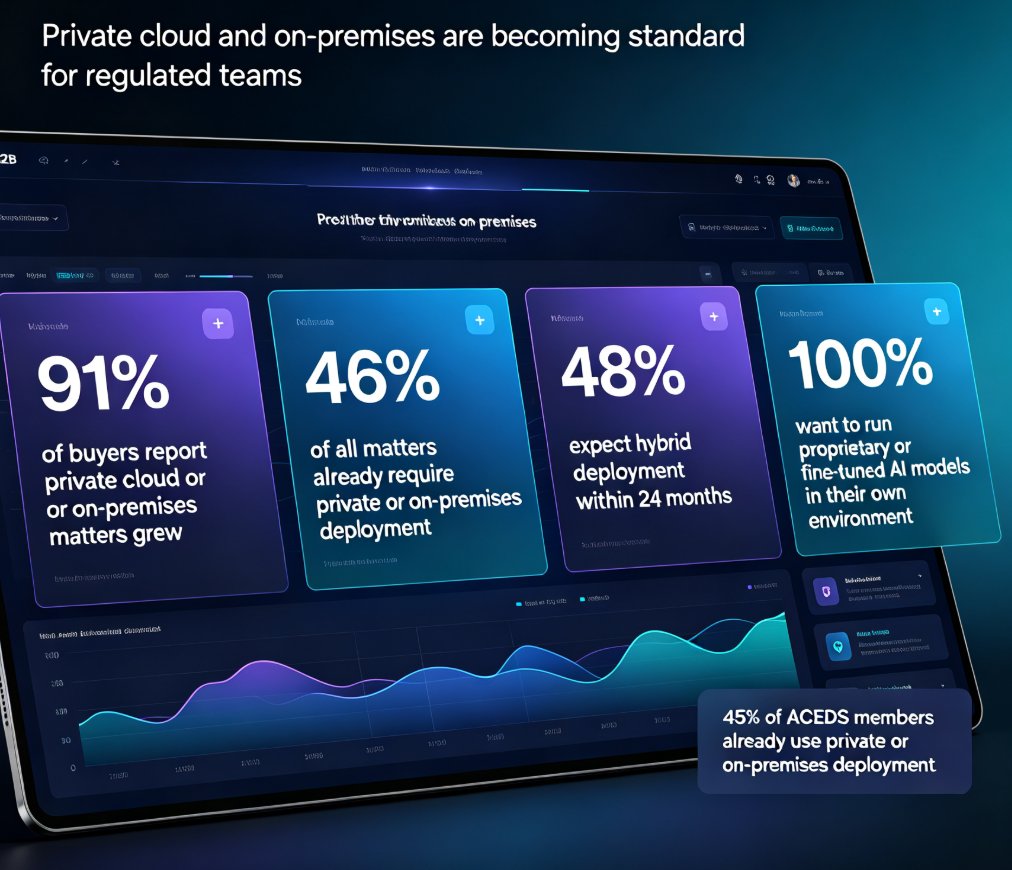
The pattern is clear: the stricter your compliance requirements, the more control you need over where your data lives. Public cloud is fine for a freelancer making client pitches. But a university handling student records or a hospital creating patient education decks needs private cloud or on-premise. The private deployment trend is accelerating across industries — we've covered why in our analysis of private deployment for AI presentation tools.
IV. What to Look for in a Secure AI Presentation Platform
Beyond the deployment model, there are specific features that separate genuinely secure tools from those that just claim to be. Here's your checklist:
1. Data residency options. Can you specify where your data is stored? Some vendors offer regional data centers; others don't. If your compliance officer needs data to stay within a specific country or region, this is non-negotiable.
2. Encryption at rest and in transit. Your content should be encrypted both while stored and while being transmitted. Look for AES-256 for data at rest and TLS 1.2+ for data in transit.
3. No training on your data. Many AI tools reserve the right to use your content to improve their models. For sensitive material, that's a dealbreaker. Look for tools that explicitly commit to not training on customer data, or that offer an opt-out.
4. Role-based access control. Can you restrict who sees which decks? Enterprise-grade tools should support granular permissions — editors, viewers, commenters — with audit trails.
5. Data deletion guarantees. When you delete a deck, is it actually gone? Some tools keep backups for years. Look for clear deletion policies and the ability to purge data on demand.
6. Audit logs. If a compliance auditor asks who accessed a deck and when, can your tool answer? Audit logs are becoming a standard requirement in regulated industries.
7. Business associate agreements (BAAs). For healthcare, the vendor must sign a BAA. For education, they should be willing to sign data protection agreements aligned with FERPA.
V. How Zendeck Handles the Compliance Shift
Here's where Zendeck fits into the picture. We've watched the compliance conversation evolve from a footnote to a headline, and we've built our platform accordingly.
Zendeck offers secure deployment options — including private cloud and on-premise configurations — designed for institutions with strict data governance policies. That means your outlines, your decks, and your courseware stay within your controlled infrastructure, while you still get the full benefit of AI-powered slide generation, smart layouts, and template libraries.
For schools, this is particularly relevant. Student data is protected under FERPA, and using a public cloud tool that trains on student content is a risk no responsible institution should take. With Zendeck's private deployment, your student-facing courseware never leaves your environment.
For enterprises, the value is equally clear. Board decks, M&A materials, and internal training content are often confidential. Knowing that your AI presentation tool doesn't retain, train on, or expose that content is worth more than any template library.
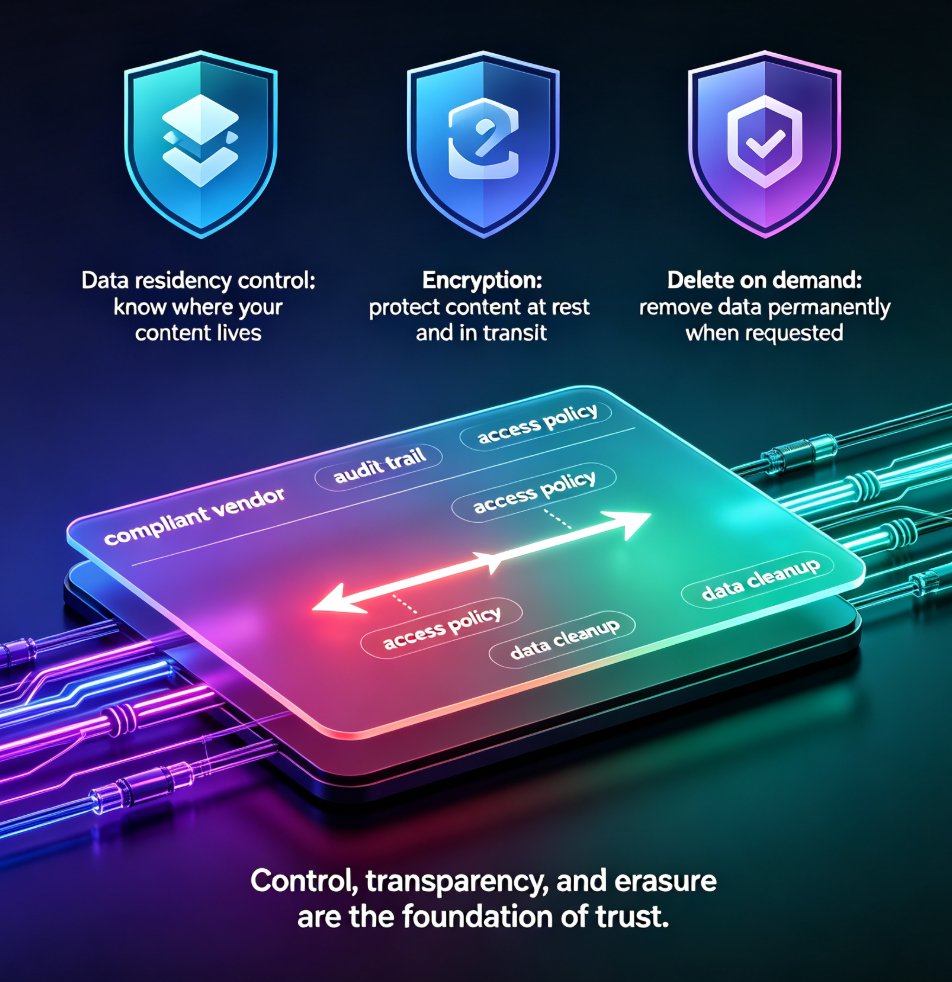
The broader point: security is no longer a feature you hope a tool has — it's a requirement you verify before you commit. Zendeck's approach is to make compliance verifiable, not just claimed. If you're exploring how AI presentation tools fit into your broader workflow, our AI courseware hub has more resources.
VI. A Practical Migration Checklist
If you're ready to move to a compliant AI presentation setup, here's a step-by-step approach:
Step 1: Audit your current tool. Review the privacy policy, data processing agreement, and terms of service. Look for clauses about model training, data retention, and third-party sharing. If anything is vague, ask the vendor directly — in writing.
Step 2: Map your data flows. What types of content do you create in presentation tools? Who has access? Where does it need to stay? This determines which deployment model you need.
Step 3: Define your compliance requirements. Which regulations apply to your organization? List the specific requirements — data residency, encryption, deletion, audit trails — and use them as your evaluation criteria.
Step 4: Evaluate vendors against your checklist. Don't be swayed by marketing claims. Ask for documentation, security whitepapers, and references from organizations in your industry.
Step 5: Plan the migration. Moving from a public cloud tool to a private deployment takes time. Export your existing decks, map your template library, and train your team on the new workflow.
Step 6: Document everything. For compliance purposes, keep records of your vendor evaluations, data processing agreements, and security configurations. If an auditor asks, you'll have answers.
FAQ
Q: What is the difference between on-premise and private cloud deployment for AI presentation tools?
A: On-premise means the software runs entirely on your own servers, giving you full control over data storage and access. Private cloud means the vendor hosts the solution in a dedicated environment reserved for your organization, often in a specific region. Both offer stronger data governance than public cloud, where resources are shared across customers.
Q: Which compliance regulations apply to AI presentation tools in education?
A: In the US, FERPA protects student education records, while HIPAA applies to health-related data. In Europe, GDPR governs all personal data processing. Schools and enterprises must ensure their AI presentation tools support data residency, encryption, and audit trails to stay compliant.
Q: Does Zendeck support on-premise deployment?
A: Yes, Zendeck offers secure deployment options including on-premise and private cloud configurations, designed for institutions with strict data governance policies. This means your content stays within your controlled infrastructure while still benefiting from AI-powered slide generation.
Q: How can I audit whether my current AI presentation tool is compliant?
A: Start by reviewing the vendor's data processing agreement, checking where data is stored, whether encryption is used at rest and in transit, and whether you can export or delete your data on demand. Also verify if the vendor offers audit logs and role-based access control.
Q: What data does an AI presentation tool typically process?
A: Most tools process the content you upload (text, outlines, images), your account information, and usage metadata. Some also train models on user data unless explicitly opted out. Always check the privacy policy for data retention and training clauses.