Thesis to Slides: Turning a Research Outline into a Defense Deck
If you've spent months on a thesis, the last thing you want is to fumble the presentation. But turning years of research into a 15-minute deck is its own ordeal. Let's be real: your committee doesn't want to read your thesis on screen. They want to see the question, the method, the evidence, and the contribution — clearly and fast.
That's why a tool like Zendeck exists: it takes your existing Word thesis outline and turns it into a structured, defense-ready presentation in minutes — not hours. In this guide, I'll show you the exact workflow I recommend to graduate students and researchers who need to present their work without the design panic.
01 The Thesis Defense Crunch: Why Your Slides Matter
A thesis defense is not a summary of your document. It's a performance. You need to show that you understand your research deeply, can explain why it matters, and can defend every methodological choice. Slides are your supporting cast — they should make your argument visible, not distract from it.
But here's the problem: most students spend their pre-defense hours wrestling with PowerPoint layouts, aligning boxes, and picking fonts instead of rehearsing their narrative. A 2019 survey found that graduate students spend an average of 8-12 hours building a defense deck from scratch — and that's before they even start practicing. (That's from a study on student presentation habits, and while the number may vary, the pain is universal.)
The fix is to let AI handle the mechanical part so you can focus on the intellectual part. When you generate slides from your outline, you preserve the logical structure of your research while getting a clean, professional design — no design skills required.

02 What a Defense Deck Needs (and What a Thesis Draft Doesn't)
Before you feed your thesis into any AI tool, you need to understand the difference between a thesis chapter and a slide. A thesis paragraph is dense, nuanced, and full of caveats. A slide is a single idea, expressed in a few lines, supported by a visual.
Here's the mental model I use with students: each slide should answer one question the committee might ask. Start with the research problem, then the gap, then your question, then your method, then your results, then your contribution. That's the classic structure.
Here's a quick breakdown of what a defense deck typically includes:
- Title slide – Your name, advisor, department, and the thesis title.
- Motivation or problem – Why should anyone care?
- Research question – What exactly are you investigating?
- Literature review – Only the key debates, shown as a map or timeline.
- Methodology – The design, sample, and data analysis approach.
- Results – The core findings, usually with charts or tables.
- Discussion – What do the results mean? Any limitations?
- Conclusion – The takeaway and future work.
- Backup slides – For anticipated questions.
Your thesis draft has all this — but it's buried in paragraphs. The job of an AI presentation tool is to extract that structure and present it cleanly.
03 Step 1: Prepare Your Outline for Conversion
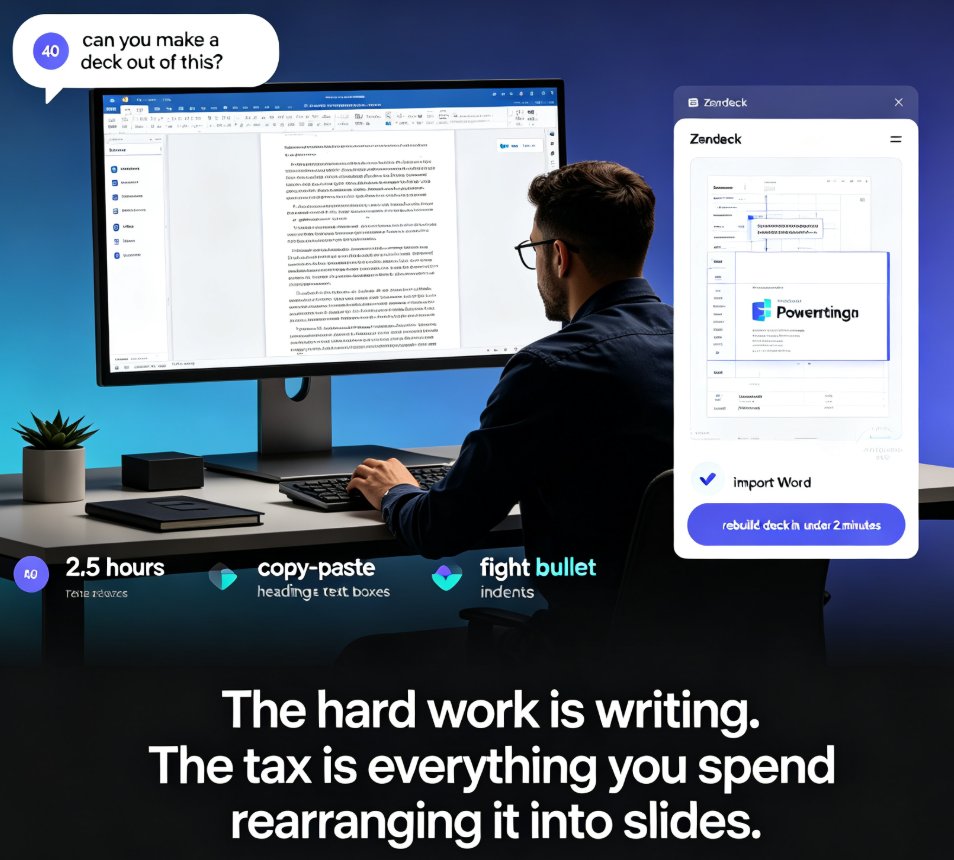
The best way to start is not with a blank deck — it's with your outline. If you have a Word document with headings (like 1. Introduction, 2. Methods, 3. Results), you're already 80% of the way there.
Why? Because most AI presentation tools, including Zendeck, parse document headings into slide titles and the text under each heading into bullet lines. The cleaner your outline, the better the output.
Here's what I tell my students to do before uploading:
- Strip out long paragraphs – Replace them with short, declarative sentences that capture the key point.
- Use heading styles – Make sure your main sections are
Heading 1orHeading 2in Word, not just bold text. - Add a short abstract – If your tool asks for an outline, a condensed version of your abstract helps it prioritize the essential arguments.
- Include key numbers – Write down your main stats or findings as they appear. For example: "Response rate: 72%" or "p < 0.01".
Once your outline is clean, you're ready to import.
04 Step 2: Choose the Right Template and Structure
Here's where many students get stuck: which template? Do you go for a blue gradient? A minimalist black-and-white? A themed template with your university logo?
The good news: Zendeck's template library is built for this. It includes academic and conference-ready designs with proper spacing, serif fonts for headings, and muted palettes that don't scream "corporate." You don't need to design anything from scratch.
But the real power is in Zendeck's AI deck template selection. Instead of you guessing, Zendeck analyzes your content and suggests a template that matches the tone of your research — formal, data-heavy, or exploratory. You can always override, but the suggestion saves you a decision.
Think about the visual hierarchy of your deck. Your title slide should be bold but simple. Method slides benefit from diagrams. Results slides need charts. Zendeck's smart layout will adjust the size of text boxes and charts automatically, so nothing looks cramped or orphaned.
05 Step 3: Generate Slides from Your Outline with Zendeck
This is the moment that changes everything. Instead of manually creating 25 slides, you upload your outline and let Zendeck do the heavy lifting.
Here's the exact workflow I use:
- Go to Zendeck and sign in (or create a free account).
- Upload your Word outline or paste your Markdown/TXT content.
- Choose an academic template — or let Zendeck suggest one.
- Click generate.
What comes out is a fully editable deck with slides that follow your outline's structure. Each section of your thesis becomes a series of slides. Zendeck's AI will condense long paragraphs into bullet points and even suggest where to put a diagram or chart.
A quick tip: if you have a very long thesis, don't upload the whole thing at once. Upload your abstract, introduction, and methods sections first to get the core narrative. Then add results and discussion as a second batch. This keeps the AI focused on what matters.
06 Step 4: Refine, Add Visuals, and Rehearse
The generated deck is a starting point, not the finish line. You'll still want to tweak a few things, but the heavy lifting is done.
Add visuals without breaking a sweat. Zendeck's asset library gives you access to icons, charts, and diagrams that are vector-based and scalable. If your results include a table, you can either import a screenshot or use Zendeck's chart tool to create a clean bar or line graph. The AI-generated icons can help you illustrate abstract concepts like "framework" or "correlation" without hunting for stock images.
One-click reskin. If you decide your template isn't working halfway through, Zendeck lets you apply a new template globally. All your content stays, but the look changes instantly. No more manually updating 30 slides.
Rehearse with speaker notes. Zendeck can generate speaker notes for each slide based on the deck's content. These notes are a great starting point for your script. Then you can use the presenter view or even export to video to practice your timing.
Side note: If you're nervous about questions, create a backup slide for each likely question. Zendeck's smart layout will keep them hidden until you need them — just like a professional deck.
07 Common Mistakes to Avoid (and How Zendeck Helps)
Let's be honest: even with AI, you can still mess up a defense deck. Here are the top mistakes I see, and the simple fixes you can make in Zendeck.
Mistake 1: Too much text on a slide. Your committee can't read a paragraph while listening to you. Zendeck's smart layout automatically truncates long bullets, but you should also manually trim. Aim for no more than 5 lines per slide.
Mistake 2: Walls of numbers. Instead of dumping a full results table, highlight the key stats and use a chart. Zendeck's chart tool lets you pick the right visualization in seconds.
Mistake 3: Inconsistent fonts and colors. If you've ever had a slide with Calibri and another with Times New Roman, you know the pain. Zendeck's brand kit feature ensures every slide uses the same typography and color palette. It's like having a design rulebook built-in.
Mistake 4: Ignoring the flow. Your deck should tell a story. Zendeck's outline view lets you drag and drop entire sections, so you can move your methods before your literature review if needed.
Mistake 5: Forgetting backup slides. The committee will ask about robustness checks or theoretical assumptions. Prepare backup slides — Zendeck makes it easy to add extra slides that aren't in the main flow.
08 Why This Workflow Beats Manual Deck Building
If you're still on the fence, consider the time trade-off. I've seen students spend a full weekend adjusting slide master and fiddling with alignment. With Zendeck, the first draft is ready in 10 minutes. That's not an exaggeration.
Here's a simple comparison to make it concrete:
| Task | Manual Process | With Zendeck | Outcome |
|---|---|---|---|
| Create slide structure | Manually copy headings, add bullets | Import outline, auto-generate slides | Faster first draft, fewer typos |
| Design template | Pick a generic theme, adjust all elements | Choose an academic template, one-click apply | Consistent, professional look |
| Add charts and graphics | Search for images, paste, fight with placement | Insert vector icons or generate charts from data | High-quality visuals without design skill |
| Reorder content | Cut and paste slides, fix formatting | Drag sections in outline view, auto-refresh layout | Easy, clean restructure |
| Update formatting across deck | Do it slide by slide, pray | One-click reskin for entire deck | Uniform style, no wasted effort |
| Rehearse | Write notes separately, lose them | Generate speaker notes, export to video | Ready for practice in minutes |
The bottom line: a defense deck is not about your design skills; it's about your research. Let Zendeck handle the formatting so you can spend your energy on the argument.
FAQ
Can Zendeck import a Word thesis outline directly? Yes, Zendeck supports importing Word documents, Markdown, or TXT files. You upload your thesis outline, and Zendeck parses the structure into slide titles and bullet points, preserving the logical flow of your research.
What type of templates should I use for a thesis defense? Zendeck's template library includes academic and conference themes. Look for templates with clean typography, muted colors, and clear chart areas. Zendeck also suggests a template based on your content type, but you can manually override.
How does Zendeck handle charts and diagrams from my research? Zendeck's asset library offers icons, charts, and diagrams that you can insert directly. For custom data, you can add your own charts or use Zendeck's AI-driven visualization tools to turn raw tables into clean visuals.
Can I edit the generated slides after Zendeck creates them? Absolutely. The generated deck is fully editable. You can reorder slides, change text, apply a different template with one click, or use smart layout tools to adjust spacing and alignment.
Will Zendeck help me rehearse my defense? Zendeck integrates with speaker notes and rehearsal tools. You can generate talking points for each slide, then use the presenter view or export to video to practice your timing.