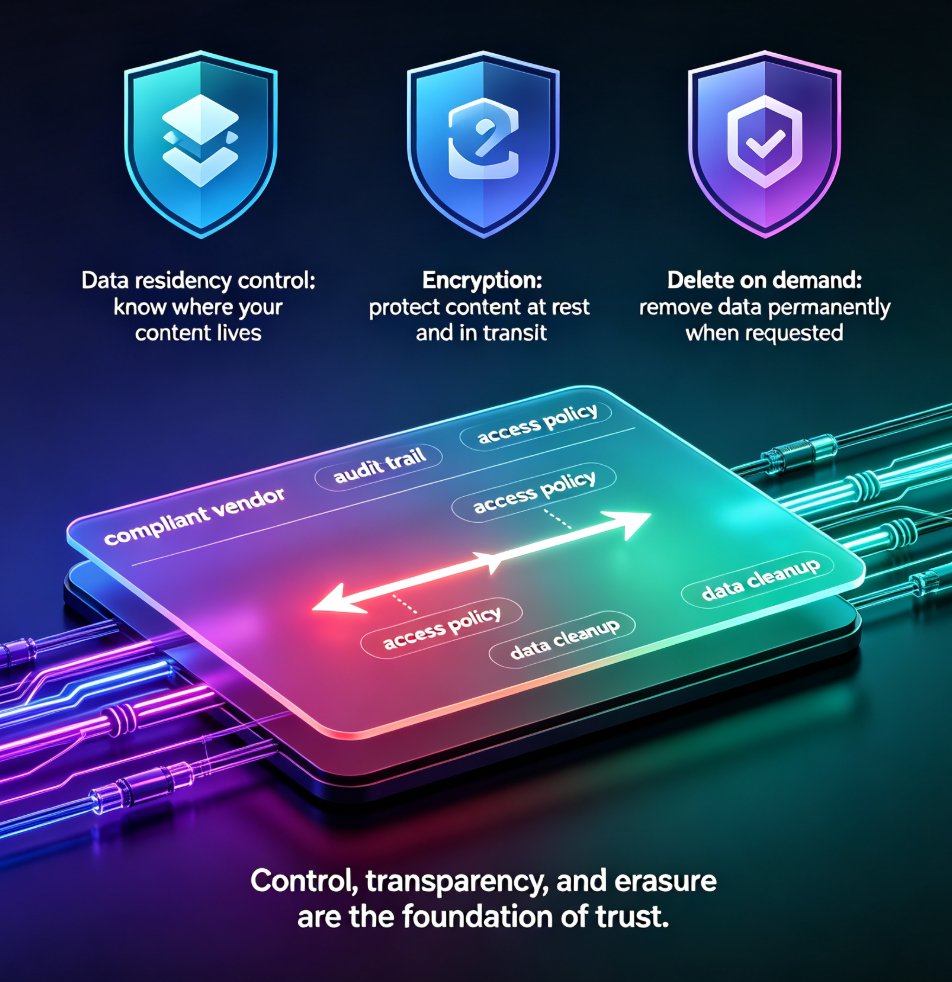
Data Security in AI Presentation Tools: The Private Deployment Trend
Let's be real: the Samsung story should have been a wake-up call for every team that touches AI tools. In 2023, engineers pasted internal source code into ChatGPT, and the company responded by banning external AI tools across the entire organization. That was two years ago. Since then, the problem hasn't gone away — it's gotten worse. Metomic's Q4 2025 research found that sensitive material now makes up 34.8% of employee ChatGPT inputs, up from just 11% in 2023. And IBM research has linked roughly one in five organizational breaches to "shadow AI" — the unauthorized use of AI tools that IT never approved.
If you're building presentations with AI tools, your slide deck might be the last place you'd expect a data leak. But think about what goes into a deck: client names, revenue figures, product roadmaps, employee data, training materials with proprietary processes. All of it gets uploaded to a tool that may or may not protect it.
The question isn't whether your team will use AI presentation tools — it's whether the tool you choose gives you real control over where your data lives. Private deployment is the answer that's quietly becoming the new baseline.
01 Why Data Security Became the #1 Concern in AI Presentation Tools
Here's the uncomfortable truth: most teams don't realize how much sensitive data flows through their AI tools until something goes wrong. The Cisco 2024 Data Privacy Benchmark Study found that 48% of respondents admitted entering non-public company information into generative AI tools. That's nearly half of all employees, and most of them didn't think twice about it.
The pain point is threefold:
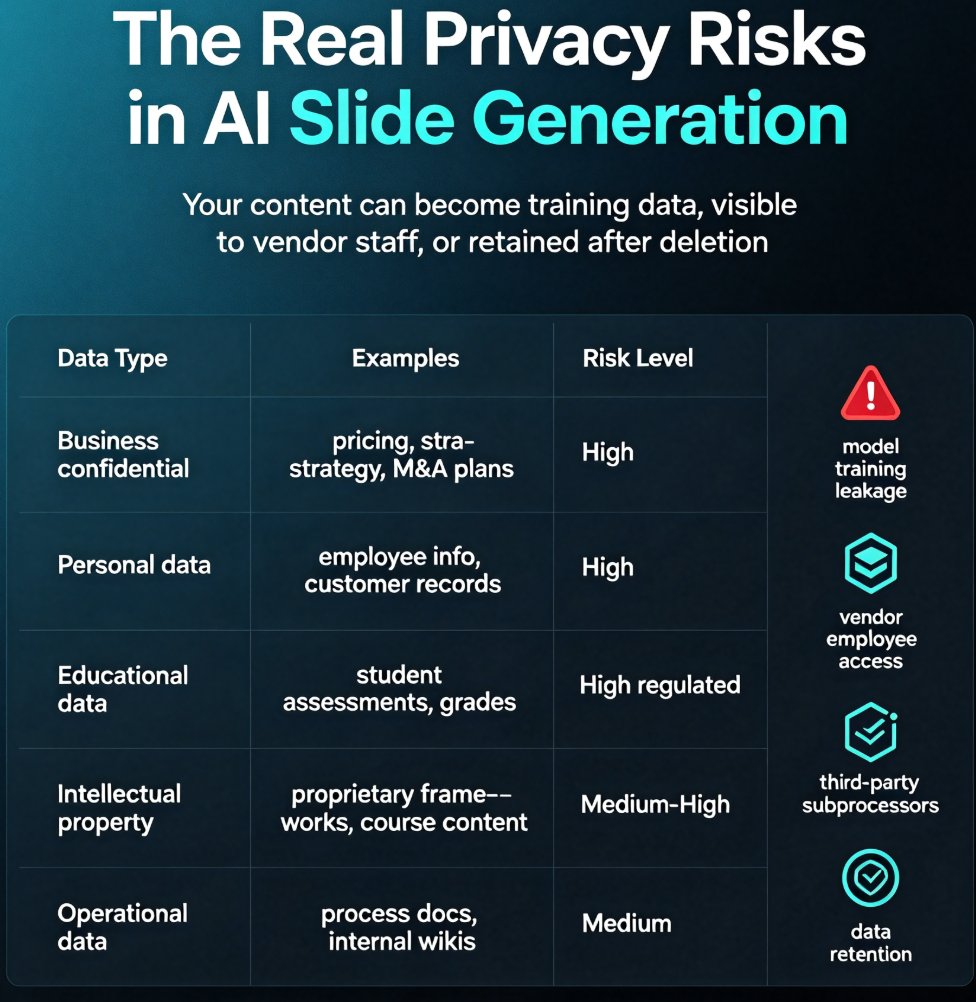
- You don't know where your data goes. When you paste a client brief into a public AI tool, that content may be used for model training, stored on shared servers, or accessed by vendor staff.
- You can't prove compliance. If a regulator or client asks where your data was processed, "we don't know" isn't an answer.
- You're exposed to shadow AI risk. Even if your company blocks certain tools, employees will find workarounds — and those workarounds are where leaks happen.
The solution isn't to ban AI tools. That's like banning email because of phishing. The solution is to choose tools that give you deployment control — so the AI comes to your data, not the other way around.
For education teams, the stakes are just as high. Student records, assessment data, and unpublished research are all regulated in most jurisdictions. A university that uses a public AI presentation tool to build courseware is effectively handing student data to a third party without a clear data processing agreement. That's a compliance risk that no amount of "we take privacy seriously" marketing can fix.
02 What the Data Says: Private Deployment Is No Longer a Niche Ask
If you still think private deployment is a niche requirement for a few paranoid IT departments, the numbers will change your mind. A 2025 report from Reveal, based on responses from senior legal technology decision-makers, found that:
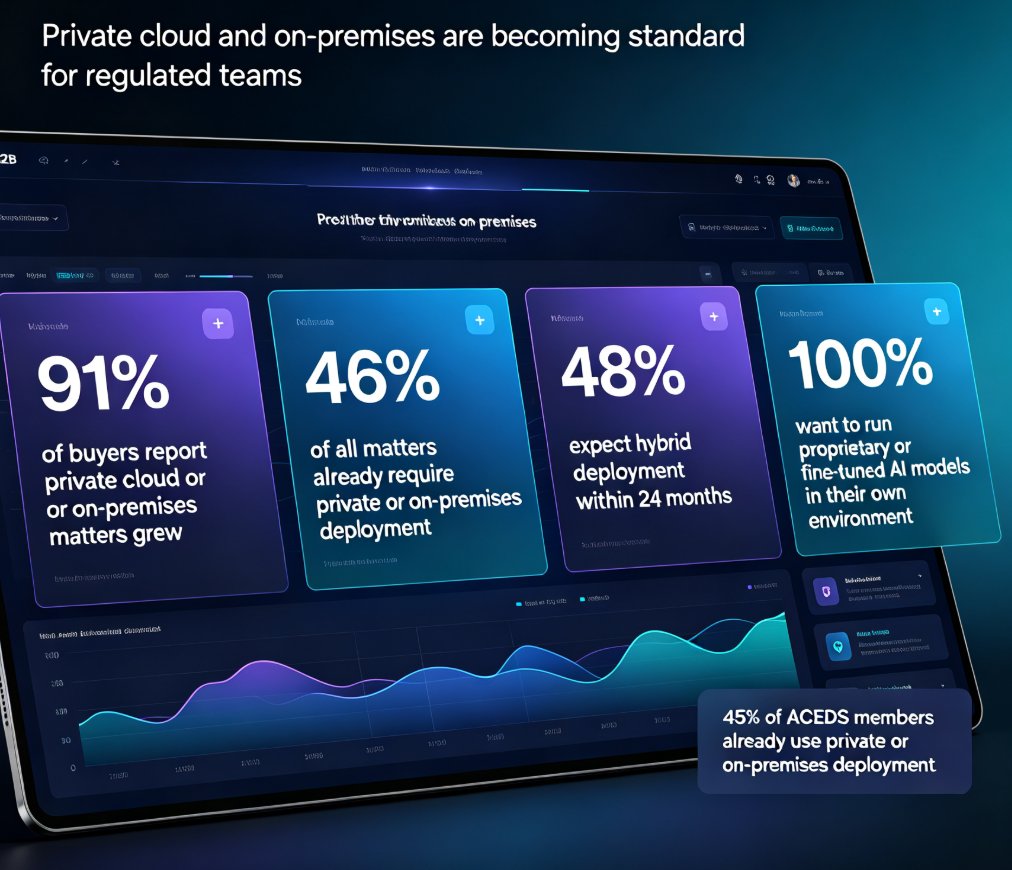
- 91% of buyers report that their share of matters requiring private cloud or on-premises deployment has grown over the past 24 months.
- 46% of all matters, on average, already require private or on-premises deployment due to data residency, cost, or security requirements.
- 48% expect to operate a hybrid deployment model within the next 24 months, routing work to both public and private environments based on specific requirements.
- 100% of respondents say the ability to run their own proprietary or fine-tuned AI models within their environment is important to their operations.
An independent companion survey of 60 practitioners, conducted with the Association of Certified E-Discovery Specialists (ACEDS), reached the same conclusion: 45% of ACEDS members already run private or on-premises deployment in some form, and nearly half expect to take a hybrid approach within 24 months.
The pattern is unmistakable: private deployment is moving from a compliance checkbox to a strategic requirement. Teams that lock themselves into a single vendor's public infrastructure are finding it harder to adapt as data volumes climb and regulations tighten.
03 Private vs. Public Deployment: What Actually Changes
Let's break down what private deployment actually means in practice, because the terminology gets thrown around a lot.
| Aspect | Public Cloud (SaaS) | Private Deployment (On-Prem / Private Cloud) | Hybrid |
|---|---|---|---|
| Where data lives | Vendor's shared servers | Your infrastructure or dedicated environment | Mixed, based on matter type |
| Data residency control | Limited; depends on vendor regions | Full control | Control where it matters |
| Model training risk | Your data may train shared models | Your data stays yours | Configurable |
| Compliance fit | Harder for regulated industries | Built for GDPR, HIPAA, FERPA, etc. | Best of both |
| Setup effort | Zero — just sign up | Requires IT resources | Moderate |
| Cost model | Subscription, predictable | Higher upfront, lower long-term | Tiered |
The key insight from the Reveal report: 68% of buyers believe their primary vendor's deployment recommendations are driven more by commercial interests than by customer needs. That's a trust problem. When a vendor pushes you toward public cloud, is it because that's genuinely best for your data — or because it's cheaper for them to operate?
For presentation tools specifically, the stakes are different from eDiscovery but the principle is the same. A training deck for a Fortune 500 client might contain unreleased product details. A university course deck might include student assessment data. A compliance deck might reference internal audit findings. None of that belongs on a shared server.
04 How to Evaluate an AI Presentation Tool for Private Deployment
Here's a practical framework for evaluating whether an AI presentation tool can meet your security bar. Ask these questions before you commit:
1. Where does your data actually live? Not where the marketing page says it lives — where the data flows. Does the tool process your content on shared infrastructure, or can it run in a dedicated environment?
2. Can you control model training? Some tools use your inputs to improve their models. If you can't opt out, that's a red flag. If you can't even find the setting, that's a bigger red flag.
3. What compliance certifications exist? Look for SOC 2, GDPR, HIPAA, or regional equivalents. But remember: certifications are a floor, not a ceiling. Ask how they handle data residency in practice.
4. Can you export everything? If you can't take your data out, you don't own it. Test the export flow before you commit.
5. What happens to your data when you delete it? Real deletion — not just "deactivated" — matters for compliance.
For a deeper dive on what to expect from AI presentation tools on the security front, check out our guide on 2026 data security trends in AI presentation tools. And if you're wondering about the broader transparency picture, our piece on AI transparency in presentation tools covers what users should expect from any vendor.
05 What Zendeck's Private Deployment Approach Looks Like
Here's where Zendeck comes in. We built Zendeck for teams that need AI-powered presentation creation without compromising on data control. Our private deployment options mean your sensitive content — client decks, training materials, courseware, internal presentations — stays within your organizational boundaries.
Concretely, that means:
- Your content isn't used to train shared models. What you create stays yours.
- Deployment matches your compliance needs. Whether you need on-premises, private cloud, or a hybrid approach, the infrastructure can be configured to your requirements.
- You keep full control over access and sharing. Your team collaborates within your environment, not on a public platform.
This matters most in two scenarios. First, corporate teams that handle confidential client data or proprietary processes — think consulting firms, financial services, HR departments. Second, educational institutions that manage student records and assessment data, where privacy regulations are strict and getting stricter. If you're already using Zendeck and want to tighten your security posture, our guide on AI transparency in presentations covers why trust matters in 2026. And for teams building compliance training, our compliance training deck guide walks through the practical side of creating secure, compliant courseware.
06 A Practical Checklist for Teams Moving to Private Deployment
If you're convinced that private deployment is the right move, here's a practical checklist to get started:
Step 1: Audit your current AI tool usage. What tools does your team actually use? Where does the data go? You can't fix what you can't see.
Step 2: Classify your presentation content. Which decks contain confidential data? Client names, financials, product roadmaps, student records? These are the ones that need private deployment.
Step 3: Define your compliance requirements. What regulations apply to your industry? GDPR, HIPAA, FERPA, SOC 2? Write down the specific requirements before you evaluate tools.
Step 4: Evaluate tools against your checklist. Use the five questions from Section 04. Don't skip the export test.
Step 5: Pilot with a small team. Roll out private deployment with one team or department first. Measure the friction, then scale.
Step 6: Document your data flow. When a client or regulator asks where their data lives, you should be able to answer in one sentence.
One more thing: don't let perfect be the enemy of good. You don't need to move everything to private deployment overnight. Start with the highest-risk content — client decks, compliance training, anything with regulated data — and expand from there. The hybrid model that 48% of buyers expect to adopt within 24 months is a perfectly reasonable starting point.
FAQ
Q: What is private deployment in AI presentation tools? A: Private deployment means the AI tool runs on your own infrastructure (on-premises) or in a dedicated private cloud environment, rather than on shared public servers. Your data stays within your organizational boundary, giving you control over data residency, access, and security.
Q: Why is private deployment becoming a trend in AI presentation tools? A: Because of rising data breach risks and compliance requirements. IBM research links roughly one in five organizational breaches to shadow AI, and Metomic found sensitive material made up 34.8% of employee ChatGPT inputs in Q4 2025. Teams need tools that protect their data, not just generate slides.
Q: Does Zendeck offer private deployment? A: Yes, Zendeck offers private deployment options that keep sensitive content within organizational boundaries. This makes it suitable for corporate and educational teams with strict compliance needs, including on-premises and private cloud configurations.
Q: What's the difference between public cloud and private deployment? A: Public cloud runs on shared infrastructure managed by the vendor, which can create data residency and model training risks. Private deployment runs on your own or dedicated infrastructure, giving you full control over where data lives and who can access it.
Q: How do I know if my team needs private deployment? A: If you handle confidential client data, proprietary research, student records, or regulated content, private deployment is worth serious consideration. With 91% of buyers reporting growth in private deployment needs, this is quickly becoming a baseline expectation rather than a luxury.