AI Deck Generator Data Privacy: What Schools & Enterprises Need in 2026
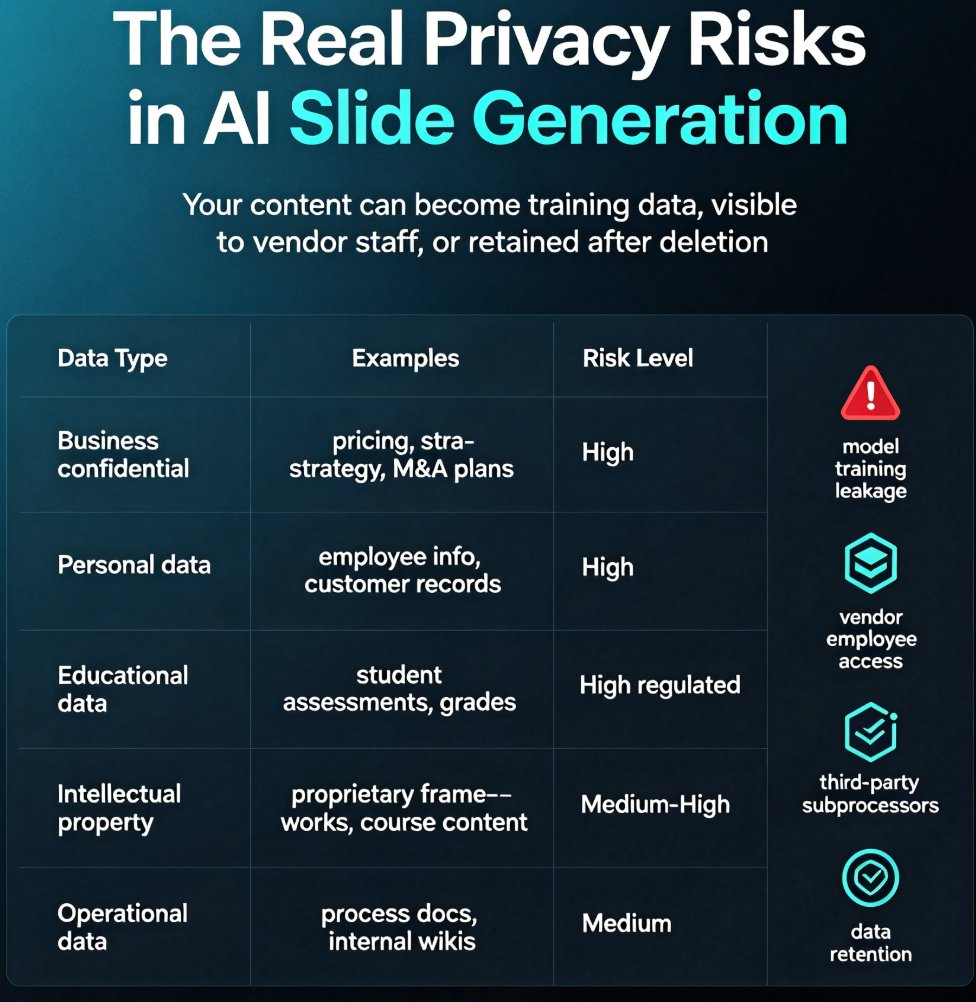
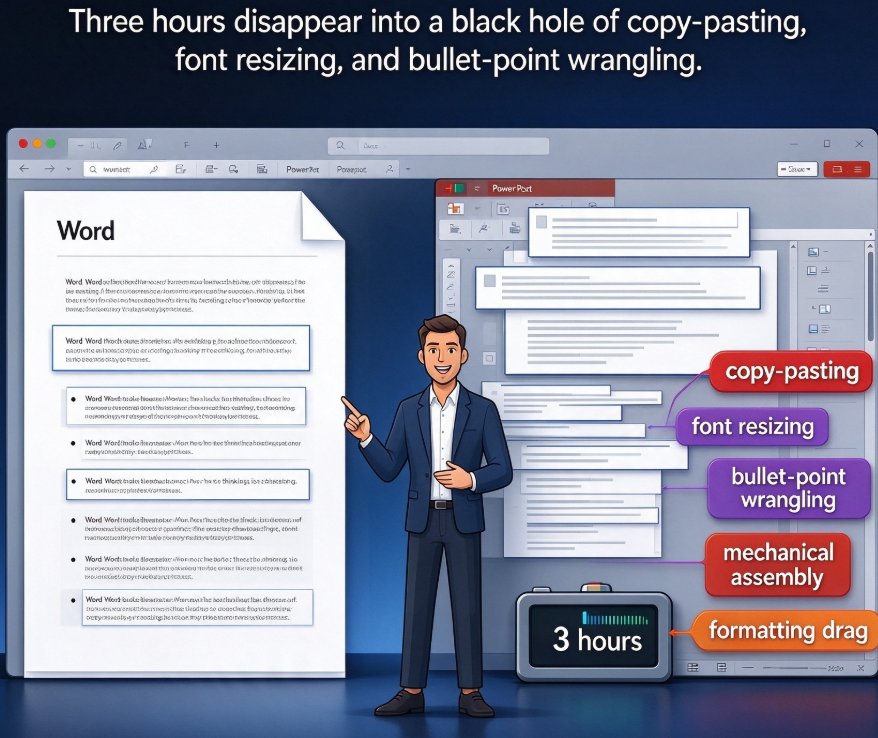
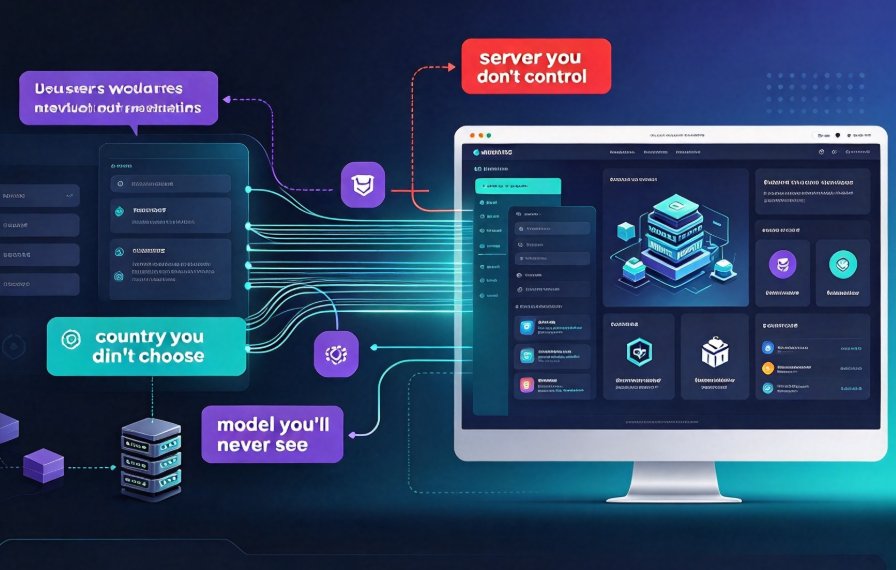
Let's be real: nobody opens an AI slide generator dreaming about data retention policies. You open it because you have a board meeting in two hours, or a lecture to prep before your students show up. But here's the uncomfortable truth we need to talk about—the moment you paste your latest sales figures, a confidential product roadmap, or a student's IEP information into a web-based AI tool, you may have just sent that data to a server you don't control, in a country you didn't choose, to train a model you'll never see.
I know, it kills the magic. But in 2026, this isn't a fringe concern for paranoid IT directors. It's the new table stakes. Let's break down exactly what's happening, who's at risk, and why 'private deployment' has suddenly become the hottest buzzword in the presentation software world.
01. The 2026 Wake-Up Call: Privacy Isn't a Feature, It's the Filter
We used to judge presentation tools by their template library. Now, we judge them by their subpoena response time. Okay, that's dramatic, but not that dramatic.
Here's the reality shift: Data privacy has evolved from a 'nice-to-have' checkbox into the primary selection criterion for AI presentation tools. If a tool can't prove it protects your data, the design quality doesn't matter, because your legal team won't let you use it anyway.
Let's look at the threat model. When you use an AI deck generator, three things happen: you upload your source material (usually a Word outline or Markdown), the server processes it via a large language model (LLM), and it returns a formatted deck. The problem is in step two. Who is theLLM? Is it hosted by the presentation vendor, or are they calling an API from OpenAI, Anthropic, or Google?
The chain of trust looks like this: You → Presentation Vendor → LLM Provider.
A slide generator can promise 'we don't train on your data,' but unless its LLM subprocessor also commits to no-training and appropriate retention, your data sits in the LLM provider's logs under that vendor's terms.
That's the loophole most procurement reviews miss. You sign a contract with a flashy slide tool, but your actual confidential data is being processed by a foundation model team you never interviewed.
02. Three Tiers of Security: Where Does Your Tool Fall?
If you're shopping for a tool in 2026, you'll find the market has stratified. The 'one-size-fits-all' consumer AI slide generator is dead for professional use. Here is the breakdown of the security tiers, so you can audit your current stack (or vet a new one).
Tier 1: Consumer Tools (The Danger Zone)
These are your free or low-cost web apps. They look sleek, they generate a lighthouse-themed deck in five seconds, and they are absolutely a security risk for any confidential data.
Verdict: Unsafe for anything that isn't public knowledge.
If a tool is free, you are the product. Your content may be used to improve their models, and the 'privacy policy' is usually written in a way that gives them broad rights to your uploaded files. If you work with client data, student records, or internal financials, paste them into a free tool and you've likely violated your own compliance obligations.
Tier 2: Business Tools (The Middle Ground)
These are paid platforms that market to teams. They offer: - A written no-training commitment (often in a public trust page) - SOC 2 Type II certification - SSO for enterprise logins - A signed DPA (Data Processing Agreement)
Verdict: Acceptable for most internal, non-regulated data.
If you're a marketing agency designing a pitch for a detergent brand, this tier is fine. The risk of a leak is low, and the contractual protections (no-training, deletion on request) usually satisfy a basic GDPR assessment.
Tier 3: Enterprise / Private Deployment (The Compliance Gold Standard)
This is where things get interesting for schools, law firms, banks, and healthcare providers. This tier adds: - SSO/SAML and SCIM provisioning - Role-based access control (RBAC) - Detailed audit logs - Configurable data residency (keep data in the EU, US, or specific region) - Signed DPAs with GDPR Standard Contractual Clauses - For healthcare: a signed BAA (Business Associate Agreement) - Zero-retention modes and customer-managed keys - Private deployment: running the entire generation stack on your own infrastructure
Verdict: Required for any data subject to regulatory frameworks.
Let's put the tiers side-by-side so you actually see the difference:
| Security Control | Tier 1 (Consumer) | Tier 2 (Business) | Tier 3 (Enterprise/Private) |
|---|---|---|---|
| Data Used for Training | Often Yes | No (Contractual) | Never (By Design) |
| SOC 2 Type II | Rarely | Yes | Yes |
| LLM Subprocessor Risk | Unmanaged | Managed via DPA | Eliminated (Local/Private) |
| SSO/SAML & SCIM | No | Limited | Mandatory |
| Audit Logs | No | Basic | Granular |
| Data Residency Control | No | No | Yes |
| HIPAA/FERPA/GDPR Compliance | Fails | Partial | Passes |
| Private/On-Prem Deployment | No | No | Yes |
That last row—private deployment—is the game changer. It moves the AI generation from 'the vendor's cloud' to 'your cloud.'
03. The AI Avatar Problem: Why Just Using a Big Name Isn't Enough
You might be thinking, 'Okay, we just buy Microsoft 365 Copilot or Google Gemini for Workspace. Those are huge, they must be safe.' You're not wrong to consider them—Microsoft 365 Copilot does offer enterprise-grade compliance (SOC 2, ISO 27001, FedRAMP, EU Data Boundary, and a BAA for healthcare). But here's the kicker: the promise of safety only holds if your entire data estate lives inside that ecosystem.
The minute you export content to a third-party AI deck tool—even a competent business-tier one—you've created a gap. The slide tool might be secure, but its backend LLM provider is a separate concern.
For example, an AI deck tool might say, "We use GPT-4o via API." Technically, OpenAI's enterprise API does promise not to train on your data. But the retention window is 30 days (unless you opt-out), and that data sits on OpenAI's servers. That's acceptable for marketing slides. Is it acceptable for a student psychological evaluation? Probably not.
Trust is not a binary switch. It's a chain, and it's only as strong as its weakest link.
04. The Policy vs. Architecture Fix
So, how do we solve this? We need two solutions: the paper fix (policy) and the iron fix (architecture).
The Paper Fix: Contracts and Certifications
You need a signed DPA. You need a written proof that no-training is enforced. You need a subprocessor list updated within 30 days. These are non-negotiable if you're a regulated entity.
This solves the legal liability issue. If data leaks and you didn't sign a DPA, you're in serious trouble. If you signed a DPA that says 'no-training' and they trained, it's now their problem.
The Iron Fix: Private Deployment
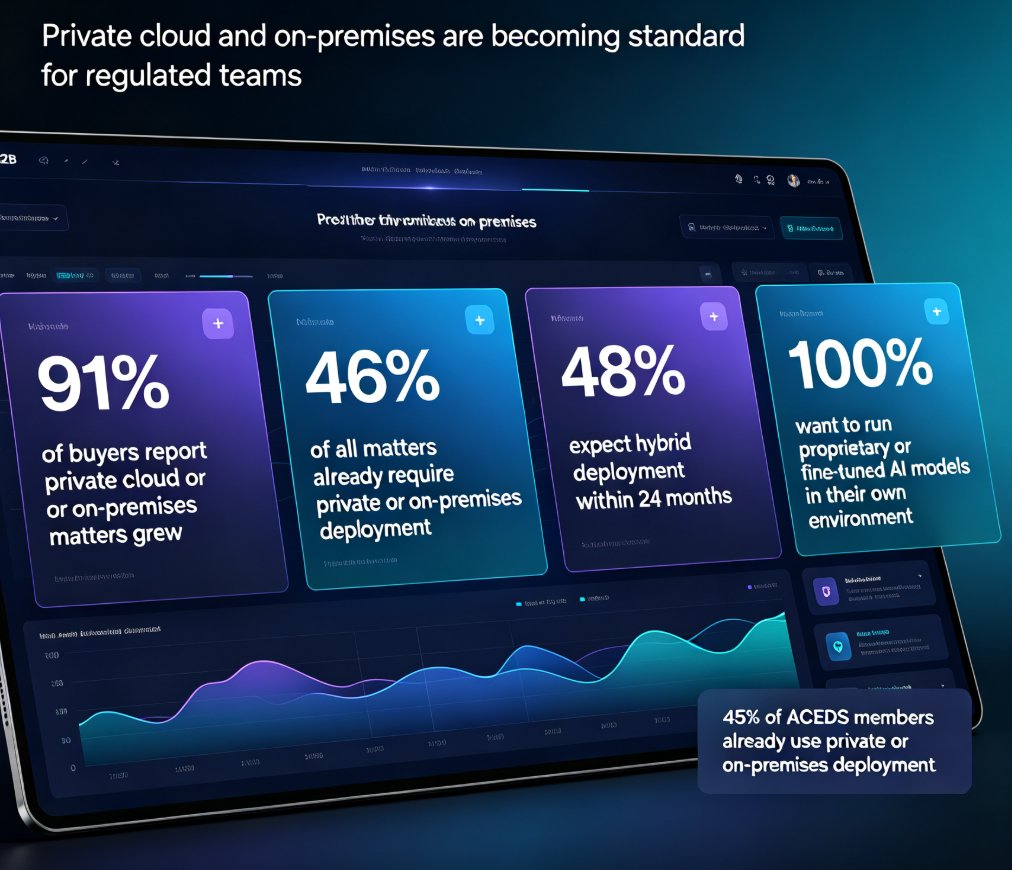
But legal documents don't stop hackers, and they don't stop accidental data ingestion into a public model. The only way to truly mitigate this risk—to achieve a zero-evidence approach—is to keep the data off the public grid entirely. This is where private deployment becomes necessary.
Here's what private deployment means in the context of an AI presentation tool: the vendor (like Zendeck) installs the entire suite—the generation engine, the LLM adapter, the template logic—inside your Virtual Private Cloud (VPC), or even on bare metal in your server room. Your Word outlines never cross the public internet boundary. The AI generation happens inside your firewall. It's the same zero-trust approach that banks use for their internal AI tools.
For schools dealing with FERPA (Family Educational Rights and Privacy Act) and GDPR Article 28 requirements, this is huge. It means you can use AI to automate courseware creation without a single data-transfer agreement with a foreign LLM provider. The data never leaves the district's network.
05. A Decision Roadmap for Educators and Enterprises
Alright, you're sold on the seriousness. Now, how do you make the choice? Stop evaluating tools like a designer and start evaluating like an architect.
Here's your 5-step audit for 2026:
1. Ask about the subprocessors immediately. Before even demoing the design features, ask: 'Do you call external LLMs? If so, which ones, and can I see the data retention policy?' If you get a vague answer, walk away. There are plenty of tools that will give you a straight answer.
2. Demand the certificates. Don't ask 'Are you SOC 2?' Ask 'Can I have the link to the latest independent SOC 2 Type II report?' A legitimate vendor will have it publicly available or share it under NDA immediately. In 2026, holding a copy of a dated SOC 2 report isn't a 'trust bonus'—it's a baseline requirement.
3. Check the 'no-training' wording. It needs to be explicit. 'We don't use your data to train our model' is good. 'We do not share your data with third parties' is suspicious—that wording often still allows internal use or processing by attached LLM providers.
4. Match the tier to the data. Ask yourself: 'What is the worst-case scenario if this content leaks?' If the answer is 'We'd be fined' or 'A student's privacy is breached,' you need Tier 3. If the answer is 'It would be embarrassing,' you can probably use a Tier 2 tool.
5. Consider the architecture, not just the contract. If you're in a highly regulated industry, a promise is not enough. The ability to deploy privately removes the LLM provider entirely from the equation. This is why we're seeing significant adoption of tools like Zendeck that offer this capability; it's the only way to get the efficiency of AI without handing over the keys to the kingdom.
A quick tip from someone who's sat through too many vendor meetings: don't let the salesperson 'connect you with their security team'. Get the answers in writing, today. If they stumble, that's a red flag big enough to sail a yacht on.
06. Why Zendeck's Architecture Is Built for Your Compliance Stack
Let's bring this back to the practical side. When you're building a course or a board deck, you need the personalization and speed of AI, but you need to do it without leaking your crown jewels.
This is precisely why Zendeck's architecture is differentiated. It's not just about generating a pretty slide deck from your outline—it's about doing so with the security posture of a bank.
Zendeck offers private deployment options as a core feature, not an add-on. This allows universities and large enterprises to run the Zendeck generation engine inside their own infrastructure. Your sources, your generated presentations, your brand kits—everything stays within the boundary of your organization. It's a direct counter to the 'LLM provider behind the scenes' risk I flagged earlier.
The narrative is straightforward for your security review: if the tool is running on your hardware, there is no third-party subprocessor to blame or trust. It's like buying a printer for your office instead of using a public print shop—you have the machine, you have the paper, the process is entirely yours.
If you want to dig deeper into how AI is reshaping deck creation without compromising governance, check out our analysis on why AI deck generation is replacing traditional PPT in 2026. We also cover the agentic shift in our piece on agentic AI in presentation tools in 2026. If your focus is specifically on student data and FERPA compliance, make sure you read our deep dive on data privacy in AI courseware.
07. The Bottom Line: Efficiency Can't Come at the Cost of Trust
The AI presentation tools we use today are stunningly effective. We can turn a rough outline into a branded, narrated micro-course in minutes. But as consultants, trainers, and educators, our most valuable asset isn't the typography—it's the trust our clients and students place in us by handing over sensitive information.
Selecting a tool without a verifiable privacy framework isn't a minor oversight; it's a compliance risk that could cost you more than a slide deck is worth.
As we move further into 2026, the question 'does this have a dark mode?' is being replaced by 'does this have secure mode?'. The vendors who survive will be the ones who treat security as the primary UX. For us users, staying informed is the only way to stay safe.
Now, go make some beautiful, secure, and policy-compliant slides.
FAQ
Are AI presentation tools safe for confidential data?
It depends on the tool's security posture. Consumer-grade tools may use your content for training, making them unsafe for confidential data. Business-tier tools with no-training commitments and SOC 2 Type II reports are acceptable for most internal data. For regulated data (healthcare PHI, financial MNPI, education records), you need enterprise-tier features like SSO, audit logs, data residency, and ideally private deployment.
Does Zendeck offer private deployment for institutions?
Yes, Zendeck offers on-premise and private cloud deployment options. This means your outlines, slides, and courseware are processed and stored within your own infrastructure or a dedicated VPC, ensuring no external third-party access. It is designed specifically for schools, government agencies, and enterprises that must comply with strict data governance policies.
What is the 2026 trend for AI presentation data privacy?
The trend has shifted from 'which tool makes the prettiest slides' to 'which tool can prove it won't leak our data.' As of 2026, AI deck generators are expected to provide transparent AI provider policies, zero-retention modes, and compliance with standards like SOC 2, GDPR, FERPA, and HIPAA. Private deployment is becoming the gold standard for regulated industries.
How do I check if an AI tool trains on my data?
Look for a clear 'no-training' clause in the Terms of Service and the Data Processing Agreement (DPA). Also, check the subprocessor list to see which LLM providers are used (OpenAI, Anthropic, etc.) and whether they also commit to no-training and no-retention. If the tool can't show you a signed DPA, assume your data is being used for training.
Why is Zendeck's private deployment a good fit for sensitive decks?
Because it closes the security chain. Even if a vendor promises no-training, the LLM provider behind the scenes might not. With Zendeck's private deployment, the 'generation' happens either on your hardware or in a dedicated, isolated environment, meaning your outlines never touch a public LLM API. It is the same zero-trust approach that banks use for their internal AI tools.