Data Privacy in AI Courseware: Protecting Student Information in 2026
You run the learning-design team at a mid-size university. Last semester, a vendor demoed an "AI courseware" tool that would magically turn your lecture notes into polished slides. Great, you thought. Then the vendor casually mentioned that the tool trains its models on user uploads — and your assistant had already pasted 40 students' essays into the trial version. That's the exact moment the room went quiet.
That scenario isn't hypothetical. It's playing out on campuses and in corporate L&D teams every single month. And it's precisely why data privacy is now the single biggest filter for choosing AI courseware in 2026. Not template variety. Not animation quality. Privacy.
Let's unpack what's actually changing, which regulations you can't afford to ignore, and how to build a privacy-first workflow without losing the magic of AI — because tools like Zendeck are proving that secure and fast aren't mutually exclusive.
01 / Why Data Privacy Became the Defining Trend in Courseware
For years, "data privacy in courseware" read like a compliance checkbox. You accepted the terms, moved on, and never thought about it again. Those days are gone.
The numbers tell the story. According to the IAPP-EY 2024 Privacy Governance Report, 59% of privacy leaders will make AI governance and data protection a top priority by 2026 — up from just 23% in 2022, a nearly 2.5x jump in four years. And it tracks directly with what educators are hearing in classrooms: students are asking pointed questions about how their work gets stored, shared, and potentially reused.
Let's be clear about why this matters so much in education specifically:
- Student data is sensitive by nature. Names, IDs, grades, essays, and even biometric data from proctoring all fall under FERPA in the U.S. and GDPR in Europe.
- AI models learn from everything they touch. If a courseware tool trains on student submissions, those essays don't just vanish when the semester ends.
- A breach is existential for trust. One leaked gradebook doesn't just cost money — it destroys the relationship between institution and student.
The old approach — "pray the vendor has decent settings" — is no longer a strategy. Privacy compliance is now a core buying criterion, sitting right next to export-to-PPT and collaboration features. The good news? Secure-by-design tools make this feel effortless rather than like a constant battle. Our team has been covering this shift across the board — our dedicated courseware design hub fills in the wider picture.
02 / The Regulatory Maze: FERPA, GDPR, CCPA, and the New Frameworks
Here's where it gets messy. Courseware crosses jurisdictions, and each one brings its own set of rules.
◉ What regulations actually apply to AI courseware in 2026?
The big one in the U.S. is FERPA (Family Educational Rights and Privacy Act), which governs how educational records are accessed, shared, and stored. On top of that, state-level biometric privacy laws and recording consent laws can trip you up — especially if your courseware records student audio or video for "engagement analytics" without explicit consent.
In Europe, GDPR treats student data as sensitive, requiring a lawful basis for processing plus the right to deletion. In California, CCPA gives students the right to know what's collected and to opt out of data sales.
◉ Which frameworks should your courseware actually follow?
Beyond the legal minimums, three technical frameworks are becoming the de facto standard:
| Framework | Focus | Why it matters for courseware |
|---|---|---|
| ISO/IEC 27001 | Information security management | Baseline for how vendors protect data at rest and in transit |
| ISO/IEC 27701 | Privacy information management | Extends security to personal data handling and privacy controls |
| NIST AI RMF | AI-specific risk governance | Addresses model-level risks: attacks, biased outputs, explainability |
The NIST framework is gaining serious traction among U.S. organizations because it goes beyond "is our data encrypted" and asks "what happens when the model itself is attacked or produces harmful output."
Here's the practical takeaway: vendors who treat privacy as a marketing line struggle with these frameworks. Vendors who build for them from day one make compliance feel boring — which is exactly what you want.
03 / What "Secure Courseware" Actually Means Under the Hood
Let's be real — most educators aren't cryptography experts. You don't need to be, as long as you know what to ask for.
◉ Can courseware use AI while still protecting student data?
Absolutely, but it takes specific engineering:
- Threat modeling for ML pipelines. This means identifying potential attackers, attack vectors, and system vulnerabilities before they're exploited. A vendor who's done this homework can articulate it in minutes.
- Adversarial AI hardening. Malicious actors can manipulate data inputs to compromise model results. Courseware that's been tested against this can stand up to real-world pressure.
- Privacy-preserving cryptography. Techniques like secure multi-party computation and homomorphic encryption let models compute on encrypted data without ever seeing raw inputs. This is how you get "AI that doesn't need to see your students' essays."
◉ Does private deployment solve everything?
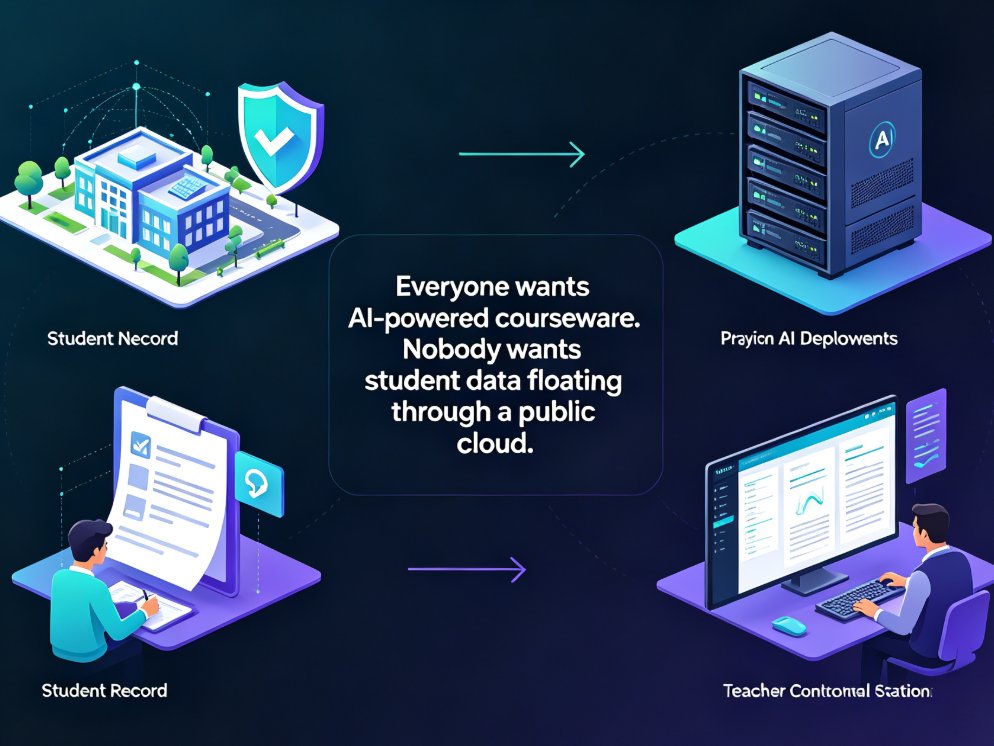
Not automatically, but it's a massive step forward. Private deployment — where the tool runs in your own cloud environment or on-premises — keeps student data inside your perimeter. Instead of uploading content to a shared public cloud, the AI comes to where your data lives. If you're weighing this security-versus-convenience trade-off, our deep dive on AI presentation data security and private deployment lays out the architectural options and what each costs in effort.
Security isn't a single feature. It's a stack: encryption at rest and in transit, granular access controls, data residency, deletion policies, and auditable logs. And in 2026, your courseware should own all of it by default — not as a paid add-on.
04 / Red Flags: Where Student Data Leaks in Everyday Workflows
You'd be surprised how often the leak is mundane. Not a shadowy hacker — a lazy default setting.
- Pasting student work into free AI chat tools. That tool just absorbed your students' graded essays into its training corpus.
- Third-party plugins that sync data home. A seemingly innocent plugin may route every file through servers in another country.
- Shared team accounts with no audit trail. No logs means you have no way to know who touched what — or when.
- Courseware without deletion controls. Both FERPA and GDPR demand that you can purge data on request. If you can't, that's a breach waiting to happen.
The fix isn't to ban AI — that would be throwing the baby out with the bathwater. The fix is to demand courseware that treats privacy as a default rather than a toggle. This is exactly where the whole 2026 data security trend in AI presentation tools is heading: the line between "a tool with security features" and "a secure-by-design tool" is the line you should care about.
05 / How Zendeck Builds Privacy Into Courseware — Without You Lifting a Finger
Okay, the part you've been waiting for. Let's talk about Zendeck.
Zendeck is an AI-driven content creation platform for educators, trainers, and teams. And while the design engine gets a lot of love, what our customers are most psyched about is simpler: Zendeck embeds enterprise-grade data privacy into the entire courseware workflow by default.
Here's what that looks like in practice:
- Your Word outlines and Markdown files stay inside your controlled environment — Zendeck doesn't scrape course content to train shared models.
- Role-based access controls and audit trails follow every collaboration session, so no one outside your team gets visibility into student data.
- You still get the full AI experience — outline-to-deck generation, smart layouts, one-click reskin, PPT-to-video micro-courses — without the "what did I just expose?" anxiety.

Is Zendeck the only tool with privacy features? Of course not. But the difference between Zendeck and "also has privacy features" tools is that privacy is baked into the product philosophy — not bolted on after a breach. Our guide to avoiding AI presentation mistakes covers more of the tactical side, including how seemingly innocent defaults can quietly leak information.
06 / A Practical Privacy Checklist for Educators and Trainers
If you're adopting AI courseware in 2026, run every tool through this list before you sign anything:
- Where does the data live? Does the vendor offer data residency or private deployment options?
- Who can see the data? Verify roles, access controls, and audit logs.
- How is data protected? Encryption at rest and in transit, plus provable deletion.
- Is your data used for model training? The vendor must say no, explicitly and in writing.
- What's the compliance story? FERPA, GDPR, CCPA alignment, plus ISO/NIST frameworks.
- What happens on account termination? Automatic, verifiable data destruction.
A quick friend-to-friend tip: insist on written commitments about AI training — not fine print buried in the terms of service. Ask the vendor to confirm in writing whether your content is used to improve shared models. If they hedge or deflect, walk away. There are too many good secure options to settle for evasive ones.
The tools you choose today will define your privacy posture for years. A five-minute vetting conversation now saves you from a month of remediation after a breach.
FAQ
Q1: What are the biggest data privacy risks in AI courseware?
The biggest risks are models training on student submissions, insufficient access controls, missing deletion features, and third-party integrations that exfiltrate data. Weak vendor defaults — like opting everyone into data sharing — are the most common culprit in real incidents.
Q2: Does Zendeck use my course content to train its models?
No. Zendeck keeps your content within your controlled environment and does not scrape course material into shared training models. Data residency controls and role-based access are standard parts of the platform.
Q3: What regulations apply to AI courseware in education?
In the U.S., FERPA governs educational records, with state-level biometric and recording-consent laws on top. Europe's GDPR and California's CCPA add privacy rights and deletion obligations. The technical frameworks to look for are ISO/IEC 27001, ISO/IEC 27701, and the NIST AI Risk Management Framework.
Q4: Does privacy protection slow down AI features?
Not when it's built in. Privacy-preserving techniques like secure multi-party computation and homomorphic encryption let AI work on protected data without meaningful performance loss. The lag you feel usually comes from tools that bolt privacy on after the fact.
Q5: What should I ask a vendor before adopting AI courseware?
Run through the six-point checklist: data residency, access controls, encryption, whether content is used for training, compliance alignment, and account-termination data destruction. Get written, explicit answers — verbal reassurances don't survive audits.