Private AI Deployment in Education: Data Security Meets Courseware
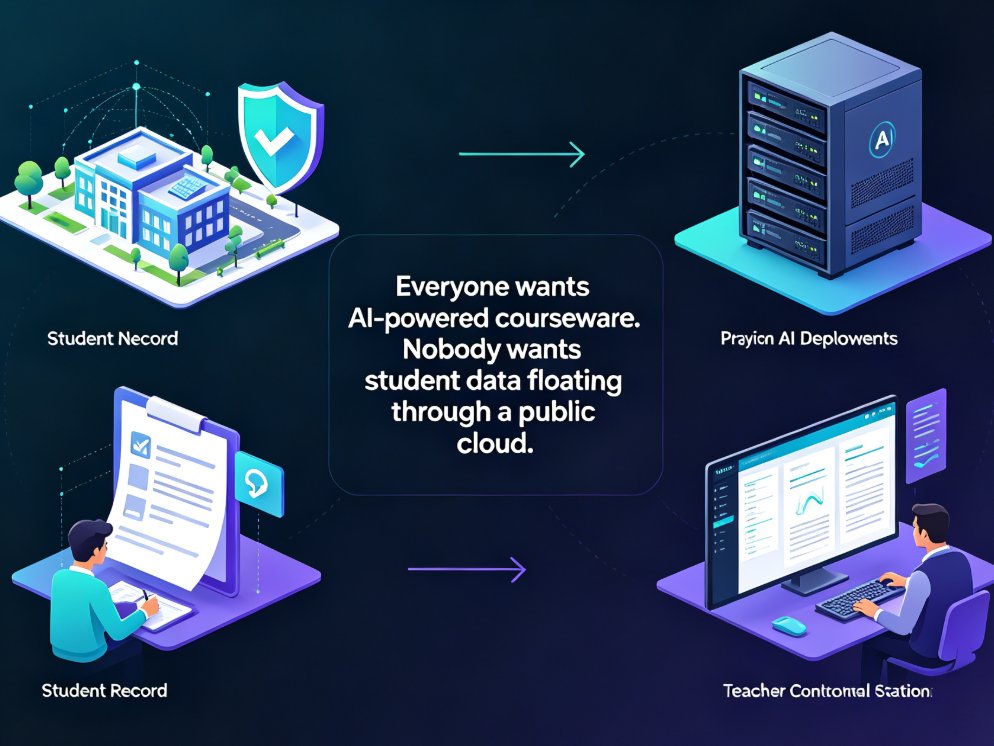
Let me be real for a second. If you run IT or academic technology at a school, you've probably felt the squeeze: everyone wants AI-powered courseware, but nobody wants student data floating through a public cloud. That tension isn't going away — it's reshaping how institutions buy presentation and courseware tools.
The short version: private AI deployment is becoming the default expectation in education, not a premium add-on. Schools and universities are prioritizing data sovereignty, and the tools that win their budgets are the ones that can run in a controlled environment while still delivering real AI capability.
I. Why schools are hitting the privacy wall with cloud AI tools
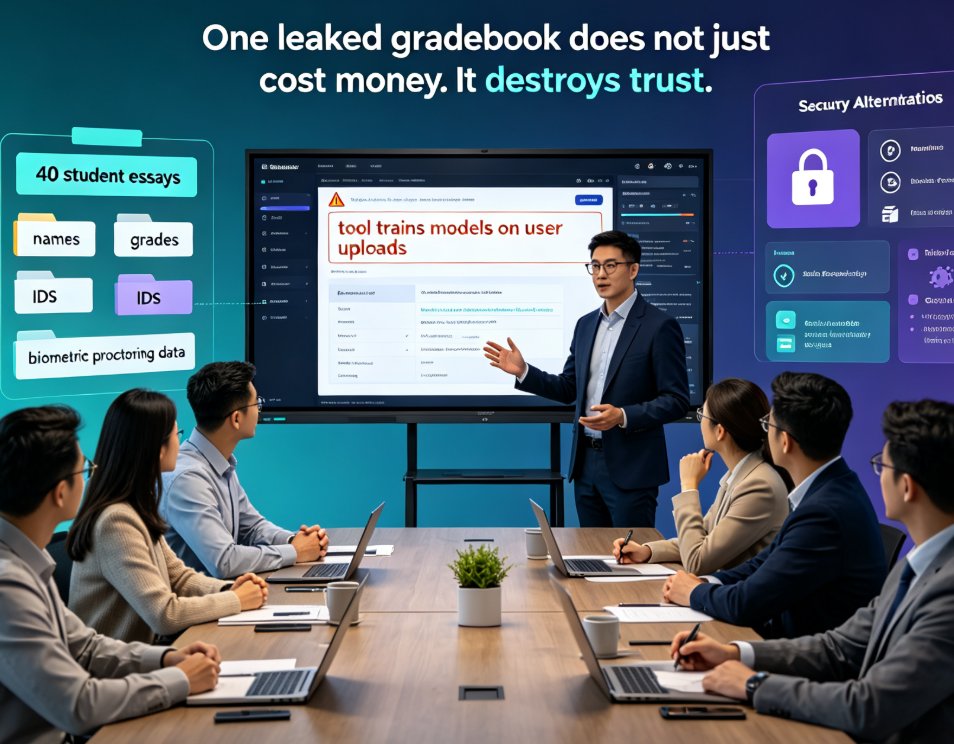
Here's the scenario. A faculty member pastes a syllabus into a public AI tool to generate a course deck. The tool processes that document on a shared server. Somewhere in that chain, student names, grades, and institutional data just left your network.
That's not paranoia — it's policy. Institutions are legally and ethically bound to protect student records, and cloud AI tools that process data on external servers create compliance exposure. FERPA in the US, GDPR in Europe, and a growing list of local data protection laws all point the same direction: you need to know exactly where your data goes.
The pain point is real. Teachers want AI efficiency. IT wants control. Procurement wants compliance. And the faculty member just wants the deck done before class.
Here's what typically happens in practice. The IT department gets a request to approve a new AI tool. They run a security review. They find that the tool processes data on third-party servers with unclear retention policies. The request gets denied — or worse, it gets approved with caveats that nobody reads. Meanwhile, faculty members are using unsanctioned tools anyway, creating shadow IT and even bigger compliance gaps.
The solution isn't to abandon AI — it's to choose tools that respect institutional boundaries. That's where private deployment comes in. And this isn't a niche concern anymore. The private deployment trend is showing up across industries, but education has the highest stakes because the data involved is protected by law.
When you look at the 2026 data security trends in AI presentation tools, the pattern is clear: vendors are racing to offer private deployment options because institutional buyers are demanding them. It's no longer a differentiator — it's table stakes.
II. What "private deployment" actually means for courseware
Let's clear up a common misconception. Private deployment doesn't mean you lose AI features. It means the AI runs in an environment your institution controls — either on-premise or in a dedicated private cloud instance.
Think of it this way. Public cloud AI is like renting a room in a shared building. Your stuff is there, but the building manager has keys, and other tenants are nearby. Private deployment is like owning your own building. Same amenities, but you control who comes in and out.
| Deployment Model | Data Location | Compliance Control | Setup Effort | AI Feature Access |
|---|---|---|---|---|
| Public cloud AI | Vendor's shared servers | Low — data leaves your network | Minimal | Full |
| Private cloud instance | Dedicated environment | High — data stays in your tenant | Moderate | Full |
| On-premise deployment | Your own servers | Highest — full data sovereignty | High | Full |
| Hybrid model | Mixed, policy-driven | High with proper governance | Moderate | Full |
The key insight: private deployment is a data governance decision, not a technology downgrade. You get the same AI-generated slides, the same smart layouts, the same courseware automation — but the data stays where your policy says it should.
For courseware specifically, this matters even more. Course decks often contain assessment data, student performance patterns, and proprietary curriculum. That's not the kind of content you want analyzed on a server you don't control.
Here's what data control looks like across deployment models:
The takeaway: the more sensitive your courseware content, the more you should lean toward private deployment. And the good news is, you don't have to sacrifice AI capability to get there.
III. The compliance landscape: FERPA, GDPR, and institutional policy
Let's talk about the actual regulations driving this shift.
FERPA (Family Educational Rights and Privacy Act) governs how schools handle student education records. If a courseware tool processes student data on external servers, that's a potential FERPA violation unless the institution has proper agreements in place.
GDPR takes an even stricter stance, requiring data minimization, purpose limitation, and clear accountability for any personal data processing. For European institutions, private deployment is often the cleanest path to compliance.
Beyond regulations, there's institutional policy. Many universities now require a data protection impact assessment (DPIA) before adopting any new AI tool. That assessment is dramatically easier when the tool supports private deployment.
The outcome? Institutions that adopt private AI deployment reduce compliance risk while still delivering modern courseware capabilities. It's not either/or — it's a governance framework that makes both possible.
If you're navigating enterprise compliance requirements for AI slide tools, the pattern is consistent: the more control you have over data, the easier compliance becomes.
Let me give you a concrete example. A mid-sized university recently evaluated AI courseware tools. They had three requirements: FERPA compliance, data residency within the country, and the ability to delete all data on demand. Of the seven tools they evaluated, only two could meet all three requirements. The rest either processed data offshore or couldn't guarantee deletion. That's the reality of the current market — and it's why private deployment is moving from "nice to have" to "must have."
IV. How Zendeck fits the institutional model
Here's where Zendeck comes in. Zendeck is built for exactly this scenario — AI-powered courseware creation that respects institutional boundaries.
When you use Zendeck, you're not just getting AI-generated slides and smart layouts. You're getting a platform designed with data security in mind. The asset library, template system, and courseware generation all work within a framework that institutions can govern.
For educators and instructional designers, this means you don't have to choose between efficiency and compliance. You can generate a full course deck from a Word outline, apply consistent branding, and even turn slides into narrated micro-courses — all within a tool that your IT department can approve.
The practical outcome: faculty get their time back, IT gets control, and students get better courseware. Everyone wins.
V. A practical checklist for evaluating private AI courseware tools
If you're evaluating tools for your institution, here's a checklist that actually works:
- Data residency — Can you specify where your data is stored? Is there a private cloud or on-premise option?
- Access controls — Can you manage who sees what? Role-based access is non-negotiable.
- Audit trail — Can you see who generated what, when, and with which inputs?
- Export and deletion — Can you export all your content and fully delete it when needed?
- Compliance documentation — Does the vendor provide SOC 2, DPIA support, or similar documentation?
- Feature parity — Does the private deployment option include all AI features, or is it a stripped-down version?
That last point is where many tools fail. Some vendors offer "enterprise" versions that are actually feature-limited. That's not a real solution — it's a compromise.
The right private AI courseware tool gives you full AI capability without compromising data governance. That's the standard to hold vendors to.
If you're just starting to think about this, the office efficiency category on Zendeck's blog has more practical guides on integrating AI tools into institutional workflows.
FAQ
Q: What is private AI deployment for courseware tools? A: Private AI deployment means the AI tool runs in an environment your institution controls — either on-premise or in a dedicated private cloud instance — rather than on shared public servers. This ensures student data and institutional content stay within your governance boundary.
Q: Why do schools need private AI deployment? A: Schools handle sensitive student records governed by regulations like FERPA and GDPR. Public cloud AI tools process data on external servers, creating compliance exposure. Private deployment keeps data within institutional control while still delivering AI capabilities.
Q: Does private deployment sacrifice AI features? A: No. The right tools offer full feature parity in private deployment mode. You get the same AI-generated slides, smart layouts, and courseware automation — just with data staying where your policy requires.
Q: How does Zendeck support institutional data security? A: Zendeck is designed with data governance in mind, offering flexible deployment options and secure asset management. Institutions can use Zendeck's AI courseware generation while maintaining control over their data.
Q: What should I look for when evaluating private AI courseware tools? A: Look for data residency options, role-based access controls, audit trails, full data export and deletion, compliance documentation, and — critically — feature parity between public and private deployment modes.