AI Slide Tools and Data Privacy: Enterprise Compliance Trends for 2026
Your next training deck might contain more sensitive data than your CRM. Employee records, product roadmaps, pricing strategies, student assessments — all sitting in a slide file that's about to be uploaded to an AI tool you haven't vetted.
Here's the uncomfortable truth: data privacy has quietly become the #1 purchasing criterion for AI presentation platforms in 2026 — ahead of design quality, ahead of template variety, ahead of speed. And for good reason.
I. Why Data Privacy Became a Deal-Breaker for AI Slide Tools
Three years ago, teams picked AI presentation tools based on one question: "Does it make good-looking slides?" Today, the first question is: "Where does my data go?"
The shift didn't happen overnight. It was driven by three converging forces:
1. Regulatory pressure. GDPR, CCPA, PIPL, and a growing list of regional data protection laws now carry penalties that make a bad design choice look trivial. A single compliance failure can cost more than the entire software budget for a decade.
2. The nature of slide content. We've normalized putting confidential information into presentations. Sales decks contain pricing and pipeline data. HR decks contain salary bands and performance reviews. Training decks contain proprietary process documentation. When you upload these to a public AI service, you're handing over your business's crown jewels.
3. AI's data-hungry architecture. AI models need data to function — and some platforms use your uploaded content to train or improve their models. That's a feature for the vendor, but a liability for you.
The outcome is clear: organizations are now treating AI presentation tools as security infrastructure, not just productivity software. Procurement teams run security reviews on slide tools the way they once did on CRM systems. The 2026 data security trends in AI presentation tools reflect this shift across every major industry.
II. The Real Privacy Risks in AI Slide Generation
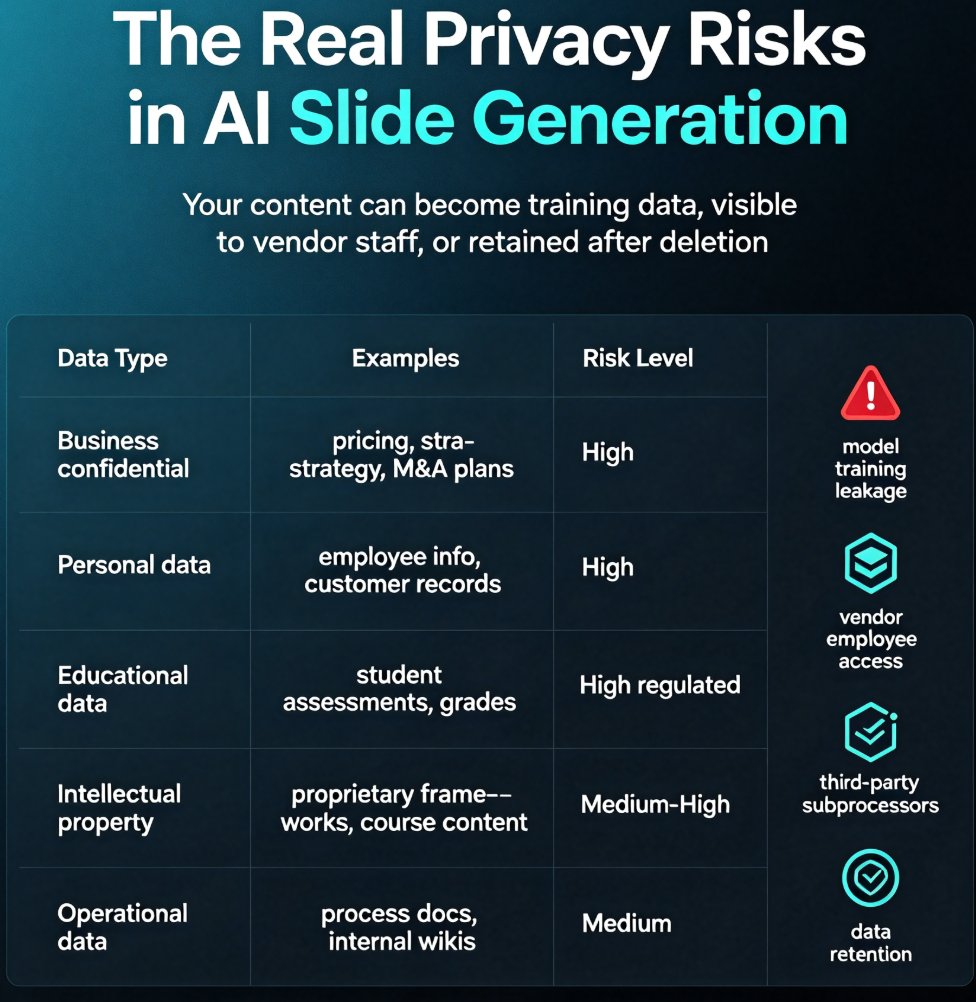
Let's be specific about what's actually at risk. When you use an AI slide tool, several types of data move through its systems:
| Data Type | Examples | Risk Level |
|---|---|---|
| Business confidential | Pricing, strategy, M&A plans | High |
| Personal data | Employee info, customer records | High |
| Educational data | Student assessments, grades | High (regulated) |
| Intellectual property | Proprietary frameworks, course content | Medium-High |
| Operational data | Process docs, internal wikis | Medium |
The risk isn't just unauthorized access. It's also:
- Model training leakage: Your content being absorbed into a public model and potentially resurfacing in another organization's output.
- Vendor employee access: Support staff or engineers at the tool provider being able to view your decks.
- Third-party subprocessors: The tool vendor outsourcing processing to other companies you've never heard of.
- Data retention: Your deleted decks lingering on vendor servers for months or years.
Most organizations discover these risks only after a security audit — and by then, the damage to trust is already done. The fix isn't to stop using AI tools. It's to demand a different architecture.
III. Private Deployment: The New Enterprise Standard
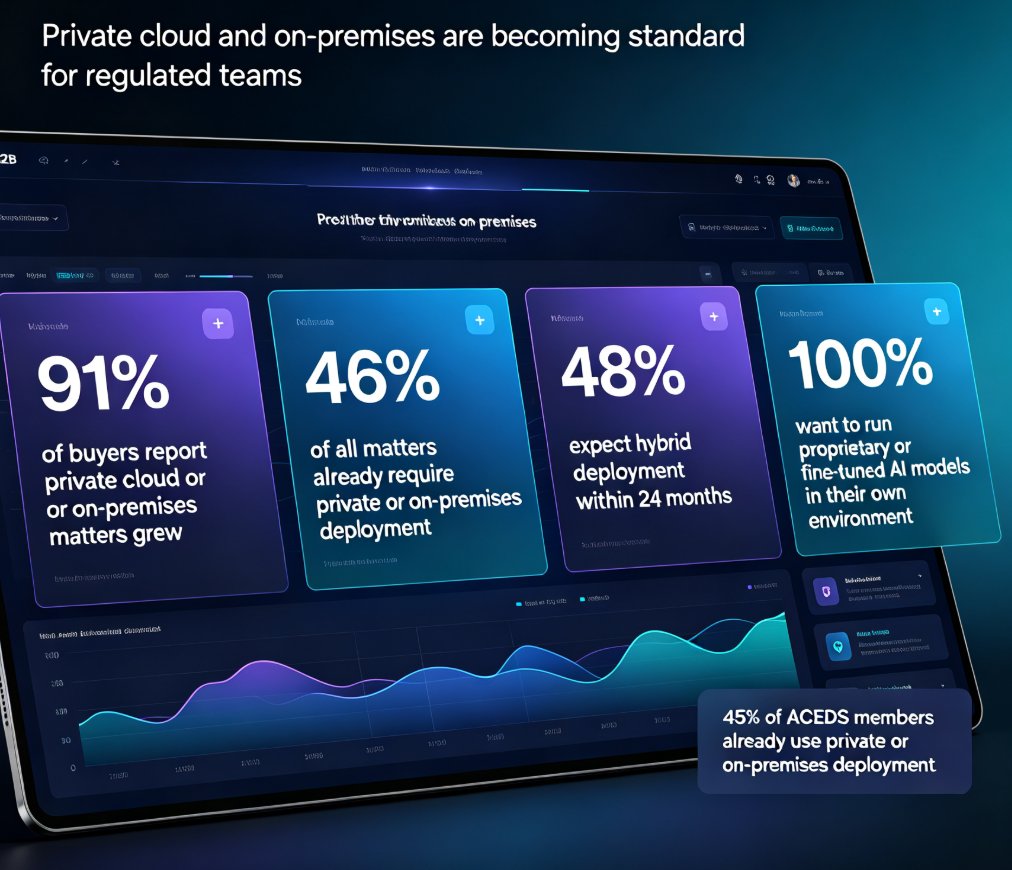
Here's the trend that's reshaping the market: private deployment is moving from a "nice-to-have enterprise feature" to the default requirement for regulated industries.
What does private deployment actually mean? Your AI presentation tool runs in an environment you control — either on your own infrastructure or in a dedicated, isolated cloud instance. Your data never mixes with other customers' data. The vendor's model processes your content in your environment, not in a shared public pool.
For schools, this is particularly critical. Educational data is heavily regulated, and student privacy laws in many regions impose strict requirements on where and how student data can be processed. A teacher uploading a lesson plan with student performance data to a public AI tool is a compliance violation waiting to happen.
For enterprises, private deployment solves the model-training problem outright. Your content stays in your environment, so there's zero chance of it leaking into a public model. If you're exploring this route, our deep dive on private deployment for AI presentation tools walks through the technical options in detail.
The pattern is consistent across industries: once an organization crosses a certain threshold of data sensitivity, public-cloud AI tools get rejected in procurement, and private deployment becomes the only acceptable option.
IV. Data Residency and Regional Compliance
Private deployment solves the "who can see my data" problem. But there's a second question: "where does my data physically live?"
Data residency — the requirement that data be stored and processed within a specific geographic region — has become a hard requirement in many jurisdictions. The EU's GDPR framework, China's data localization rules, and similar regulations in other regions all impose residency constraints.
This creates a practical challenge for global teams. A multinational company might have offices in three continents, each with different residency requirements. A university might have international students whose data falls under multiple regulatory regimes.
The compliance-first AI presentation platform of 2026 must offer flexible deployment options that respect regional data boundaries — not a one-size-fits-all cloud solution.
When evaluating tools, ask directly: - Where are your servers located? - Can I choose a specific region for data storage? - Do you offer dedicated instances for regulated data? - What happens to my data if I cancel?
If the vendor can't answer these clearly, that's your answer.
V. What a Compliance-First AI Presentation Platform Should Offer
Let's turn this into a practical checklist. When your organization evaluates AI slide tools, here's what to look for:
| Capability | Why It Matters | Red Flag If Missing |
|---|---|---|
| Private deployment option | Data stays in your environment | Cloud-only, no isolation |
| Data residency choice | Compliance with regional laws | Single global data center |
| No model training on your data | Prevents content leakage | Vague "we may use data to improve services" language |
| Encryption in transit and at rest | Basic security hygiene | No mention of encryption |
| Role-based access control | Limits who can view/edit decks | Everyone with a link can access |
| Audit logging | Track who accessed what, when | No audit trail |
| Data deletion guarantees | Compliance with erasure rights | "Data deleted within 90 days" (too vague) |
| Subprocessor transparency | Know every third party involved | No subprocessor list |
The tools that win enterprise contracts in 2026 are the ones that treat these as baseline features, not premium add-ons.
One more thing worth checking: whether the platform's AI features work offline or in an isolated environment. Some tools require constant cloud connectivity for AI generation, which defeats the purpose of private deployment. The best tools offer AI generation that runs within your chosen environment.
VI. Zendeck's Approach to Enterprise Data Security
This is where Zendeck's architecture matters. Zendeck was built with a compliance-first mindset, which means data security isn't bolted on as an afterthought — it's embedded in how the platform works.
For organizations that need maximum control, Zendeck supports private deployment options that keep your courseware and business content inside your own infrastructure. Your decks, your source outlines, your generated slides — all processed and stored in an environment you control.
This matters for a few specific scenarios:
- Corporate training teams building onboarding decks that contain confidential process documentation.
- HR departments creating internal communications with salary or restructuring information.
- Universities and schools handling student data under strict educational privacy regulations.
- Consultancies preparing client deliverables with proprietary frameworks.
In each case, the value of AI slide generation — speed, consistency, professional design — is preserved without compromising data sovereignty.
The practical outcome: teams get the productivity gains of AI presentation tools without needing to explain to their CISO why confidential content was uploaded to a public cloud service.
If you're evaluating AI presentation tools for your organization, add data privacy to your evaluation criteria from day one. It's no longer a technical detail — it's a strategic decision. And if you're already using AI tools, it's worth reviewing the common AI presentation mistakes that teams make around security and compliance.
FAQ
Q: What is private deployment in AI presentation tools? A: Private deployment means the AI tool runs in an environment your organization controls — either on your own infrastructure or in a dedicated, isolated cloud instance. Your data never mixes with other customers' data, and the vendor's AI processes your content in your environment rather than in a shared public pool.
Q: Do AI slide tools use my content to train their models? A: It depends on the vendor. Some public AI services use uploaded content to improve their models, which creates a data leakage risk. Compliance-first platforms either don't train on your data at all or offer private deployment options where your content stays in your environment.
Q: What is data residency and why does it matter for AI presentations? A: Data residency refers to the requirement that data be stored and processed within a specific geographic region. Regulations like GDPR and various data localization laws impose residency constraints. For global teams, this means choosing a tool that lets you select where your data physically lives.
Q: How should schools evaluate AI presentation tools for student data privacy? A: Schools should prioritize tools that offer private deployment, no model training on student data, clear data deletion policies, and compliance with educational privacy regulations. A public cloud AI tool that processes student data without explicit consent is a compliance risk.
Q: What's the difference between SaaS, private deployment, and on-premise for AI slide tools? A: SaaS (public cloud) means your data is processed alongside other customers' data in the vendor's shared environment. Private deployment gives you a dedicated, isolated environment — either in the vendor's cloud or your own. On-premise means the software runs entirely on your own hardware. For sensitive content, private deployment or on-premise are the safer options.