AI Presentation Trends 2026: How AI Agents Replace Manual Deck Design
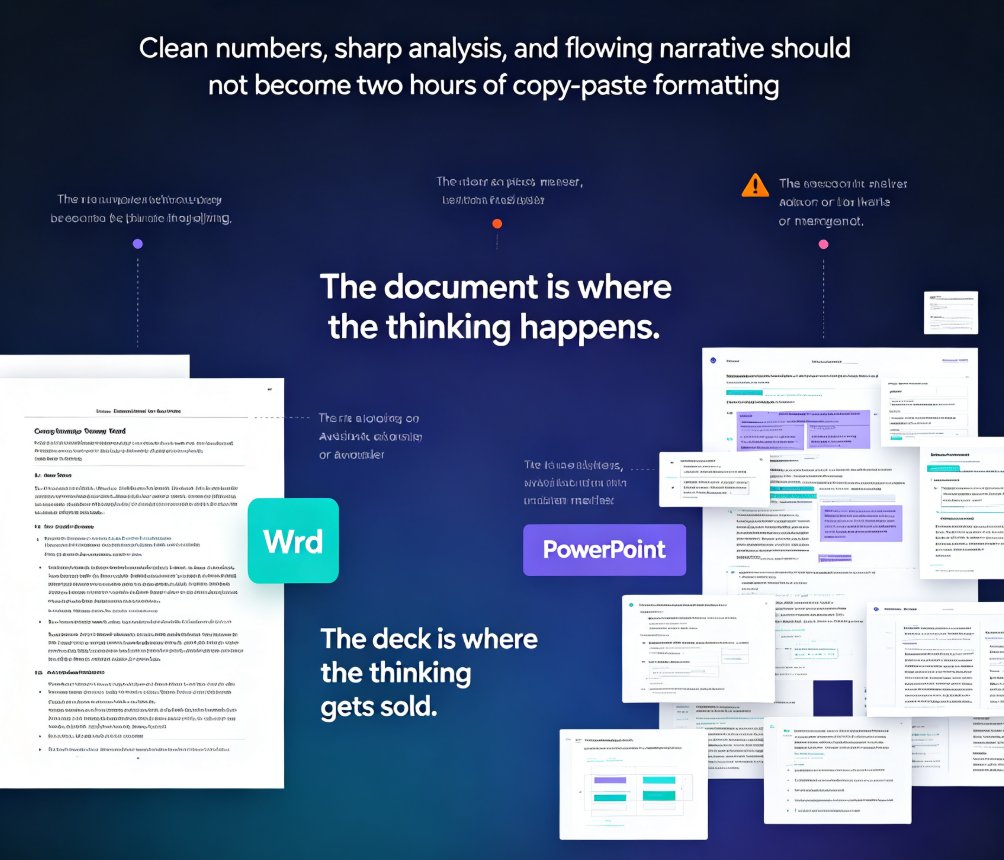
Let's be honest about something most of us won't say out loud: the hardest part of making a presentation was never the content. It's the hours you lose to formatting, aligning boxes, picking colors, and fighting a template that refuses to behave. In 2026, that entire battle is quietly disappearing.
The shift is called agentic AI, and it's changing what presentation software does — from a tool you operate to a system that executes the whole job for you. This article breaks down what that means, why it matters, and how professionals who still build decks manually can adapt.
I. The manual design bottleneck that's finally breaking
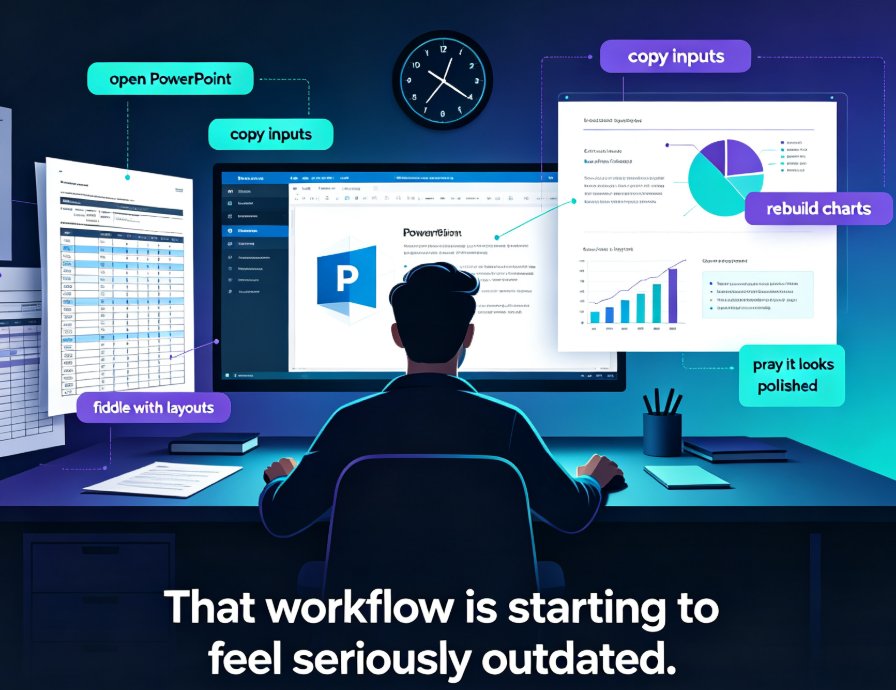
For the past decade, the workflow has been the same. You open PowerPoint or Google Slides, paste your outline, and then spend two hours making it look presentable. Then you spend another hour fixing the slides that still look off. Then you send it to a colleague, and they move one text box, and suddenly everything is misaligned again.
The pain is real. Most professionals spend more time on formatting and design than on actual content creation. The irony is that the design work is often invisible — nobody applauds your perfectly aligned bullet points, but everyone notices when they're crooked.
The shift we're seeing in 2026 is that the design layer is being automated entirely, not just templated. This isn't an incremental improvement. It's a change in what the tool does for you.
The old model asked you to choose a template and then fight your content into it. The new model starts with your content and builds the design around it. That's a fundamentally different relationship with your software.
II. What agentic AI actually means for presentations
Let's define the term before we throw it around. Agentic AI doesn't mean "a smarter autocomplete." It means an AI that can take a goal — say, "turn this course outline into a 20-slide deck" — and execute the entire workflow autonomously: structuring content, selecting layouts, generating visuals, and producing a finished, polished deck without you touching a design tool.
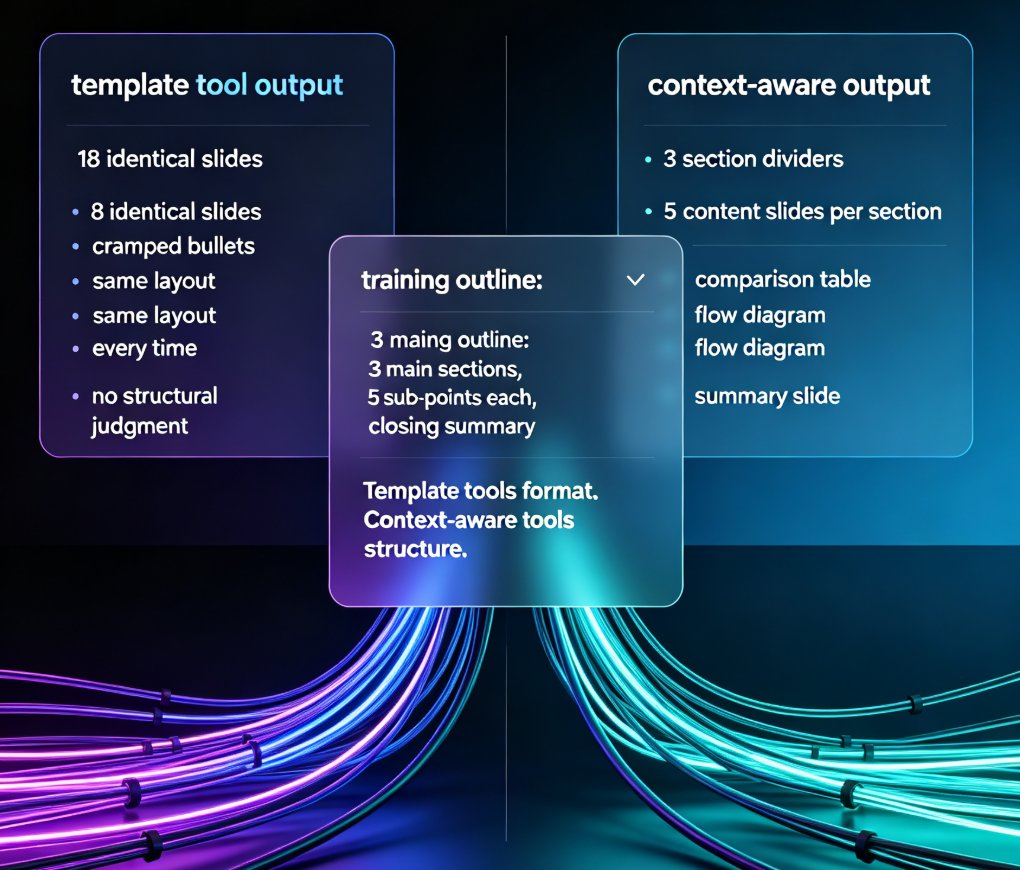
This is a fundamental shift from the previous generation of tools. Earlier AI presentation tools were essentially template pickers — they'd ask you to choose a style, then fill in your content. The agentic generation goes further: it understands context, audience, and tone, and makes design decisions for you.
The difference is the difference between a tool you operate and a colleague you delegate to. One requires your hands on every step. The other takes the brief and comes back with the deliverable.
◉ Is agentic AI just a rebrand of smart templates?
No. A smart template still starts with a fixed container and adapts your content to fit it. Agentic AI starts with your content and builds the container around it — the layout, the visual hierarchy, the asset choices all respond to what you're actually saying. That's a structural difference, not a marketing one.
For a deeper look at how this trend is playing out across the industry, check out our analysis of agentic AI in presentation tools and how autonomous decks are reshaping workflows in 2026.
III. From template-picking to fully automated generation
The 2026 trend is clear: AI decks are moving from template selection to fully automated generation. The old model asked "which template do you want?" The new model asks "what do you want to say?" and handles the rest.
This matters because templates were always a compromise. A template is a generic container that your content gets poured into. Automated generation, by contrast, builds the design around your content — the layout adapts to your text length, your data, your narrative flow.
For educators and trainers, this is transformative. A course outline that used to take a full day to turn into polished courseware can now become a structured deck in minutes. The design decisions — font hierarchy, color contrast, spacing — are made by the system, consistently, every time.
We've covered this evolution in detail in our piece on AI decks in 2026: from template picking to fully automated generation. The short version: the template is no longer the starting point. The content is.
IV. What this means for your workflow in 2026
Let's be practical. What does this actually change for you?
First, the content-to-deck pipeline collapses. You write the outline, the AI builds the deck. No more copy-paste, no more manual formatting, no more "let me just fix this one slide" spiraling into an hour of tweaking.
Second, consistency becomes automatic. When an AI system handles layout, every slide follows the same design logic. Your brand colors, your fonts, your spacing — all enforced by the system, not by your willpower.
Third, the output is no longer static. The same deck can be turned into a narrated video, a micro-course, or a shareable link without rebuilding anything.
The professionals who adopt agentic workflows in 2026 aren't just saving time — they're changing what their job looks like. Instead of being a slide designer, you become a content strategist. The mechanical work disappears, and the judgment work — what to say, how to structure the argument, what matters to the audience — becomes the whole job.
◉ How much time can you actually save with agentic AI?
It varies by deck complexity, but the pattern is consistent: the tasks that consume the most manual hours — formatting, asset hunting, alignment — shrink dramatically. The chart below illustrates the relative time spent on common deck creation tasks in a manual workflow versus an agentic one. (Values are illustrative, but the pattern holds across teams we've observed.)
V. Manual vs agentic: a side-by-side look
If you're still on the fence about whether this shift matters for you, the comparison below should settle it. It maps the same 20-slide deck through a manual workflow and an agentic one.
| Task | Manual workflow | Agentic workflow (2026) |
|---|---|---|
| Content structuring | You organize and outline manually | AI structures from your outline or prompt |
| Template selection | You browse and guess | AI selects based on context and audience |
| Layout and formatting | Hours of manual alignment | Automated smart layouts |
| Visual assets | You search for icons, charts | AI generates or suggests from asset library |
| Brand consistency | Manual enforcement | System-enforced via brand kit |
| Video conversion | Separate tool, manual sync | Built-in PPT-to-video |
| Total time for a 20-slide deck | Several hours | Minutes |
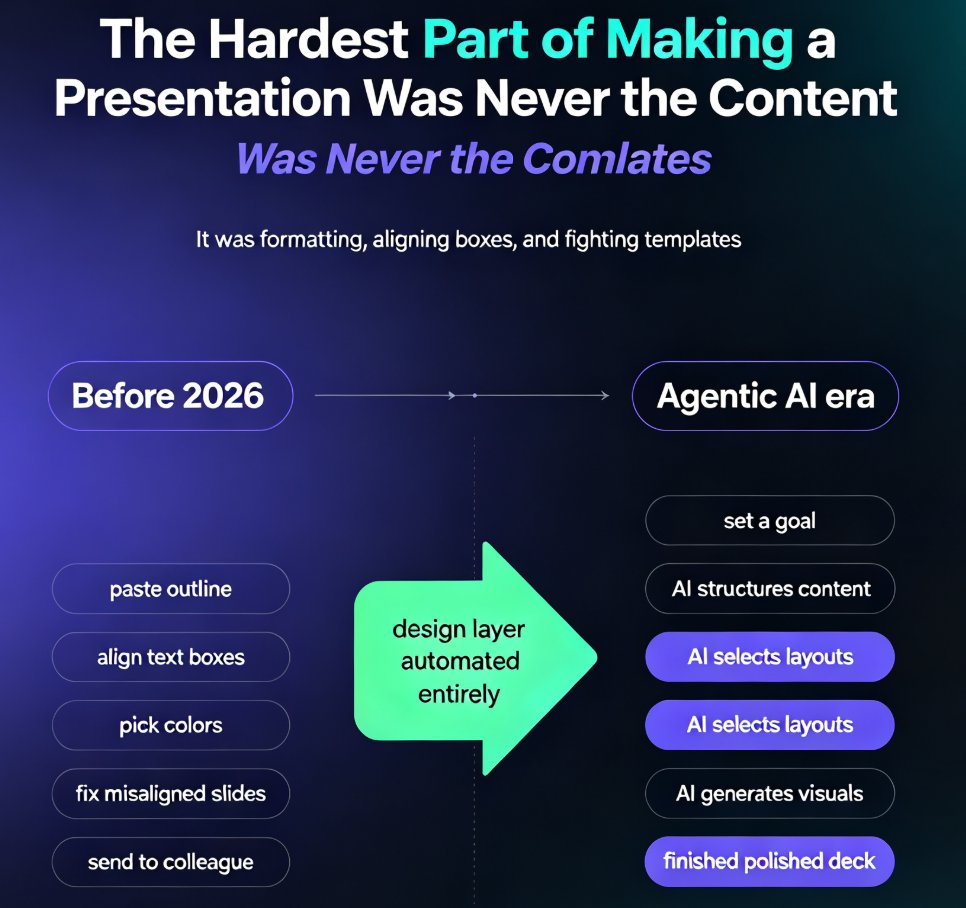
The pattern is consistent: the manual workflow spreads your time across many mechanical tasks, while the agentic workflow concentrates it where it matters — deciding what to say and how to frame it.
VI. Zendeck and the agentic shift
This is where Zendeck fits. Zendeck's core workflow — upload a Word outline or paste Markdown, and get a structured, visually consistent deck — is exactly the agentic pattern described above. You bring the content and the intent; the system handles the design decisions.
The platform also covers the downstream steps: one-click reskinning to unify fonts and colors, a template library for premium looks, and PPT-to-video conversion for turning static slides into narrated micro-courses. For educators, trainers, and HR teams, this means the entire content production pipeline — from outline to published course — lives in one place.
If you want to see the workflow in action, our guide on generating professional slides from a prompt walks through the process step by step. And if you're wondering whether this replaces traditional PPT entirely, our analysis of AI deck generation replacing traditional PPT in 2026 covers that question directly.
The takeaway: agentic AI isn't about removing human judgment. It's about removing the mechanical work that sits between your ideas and your audience. The judgment — what to say, who you're saying it to, why it matters — stays with you. The execution becomes the software's job.
FAQ
What is agentic AI in presentation tools?
Agentic AI in presentation tools refers to systems that can execute an entire deck-creation workflow autonomously — from structuring content and selecting layouts to generating visuals and producing a finished deck — based on a high-level goal like an outline or prompt, without requiring manual design intervention at each step.
How is 2026 different from earlier AI presentation tools?
Earlier AI presentation tools were essentially template pickers: they asked you to choose a style and then filled in your content. The 2026 generation of agentic tools understands context, audience, and tone, and makes design decisions for you — building the design around your content rather than forcing content into a generic template.
Will agentic AI replace the need for design skills?
Not entirely. Agentic AI removes the mechanical work — formatting, alignment, asset selection — but the judgment work remains yours: deciding what to say, how to structure the argument, and what matters to your audience. The professional's role shifts from slide designer to content strategist.
Can agentic AI maintain brand consistency across decks?
Yes. Because the AI system handles layout and design logic, it can enforce brand colors, fonts, and spacing consistently across every slide and every deck. This is typically done through a brand kit or style profile that the system applies automatically, eliminating the manual enforcement that often breaks down under deadline pressure.
How does Zendeck fit into the agentic AI trend?
Zendeck embodies the agentic pattern: you upload a Word outline or paste Markdown, and the system generates a structured, visually consistent deck. It also covers downstream steps like one-click reskinning, template selection, and PPT-to-video conversion, making it a complete pipeline for educators, trainers, and teams.