AI Presentation Agents: How Autonomous Decks Reshape Workflows in 2026
You've probably spent a Sunday night rebuilding a deck from scratch. Let's be real—that's not a skill issue, it's a workflow problem. In 2026, AI presentation agents are turning that problem into a relic. These aren't just smarter templates; they're autonomous systems that can research, structure, design, and even deliver a complete presentation from a single prompt. And the shift is happening faster than most teams realize.
By 2027, agentic workflows will handle 60% of routine business presentations end-to-end, reducing creation time from hours to seconds. That's not a futuristic fantasy—it's the trajectory we're already on. The question isn't whether you'll adopt AI agents, but how you'll adapt your workflow before they become the default.
01 The Shift from Tools to Agents
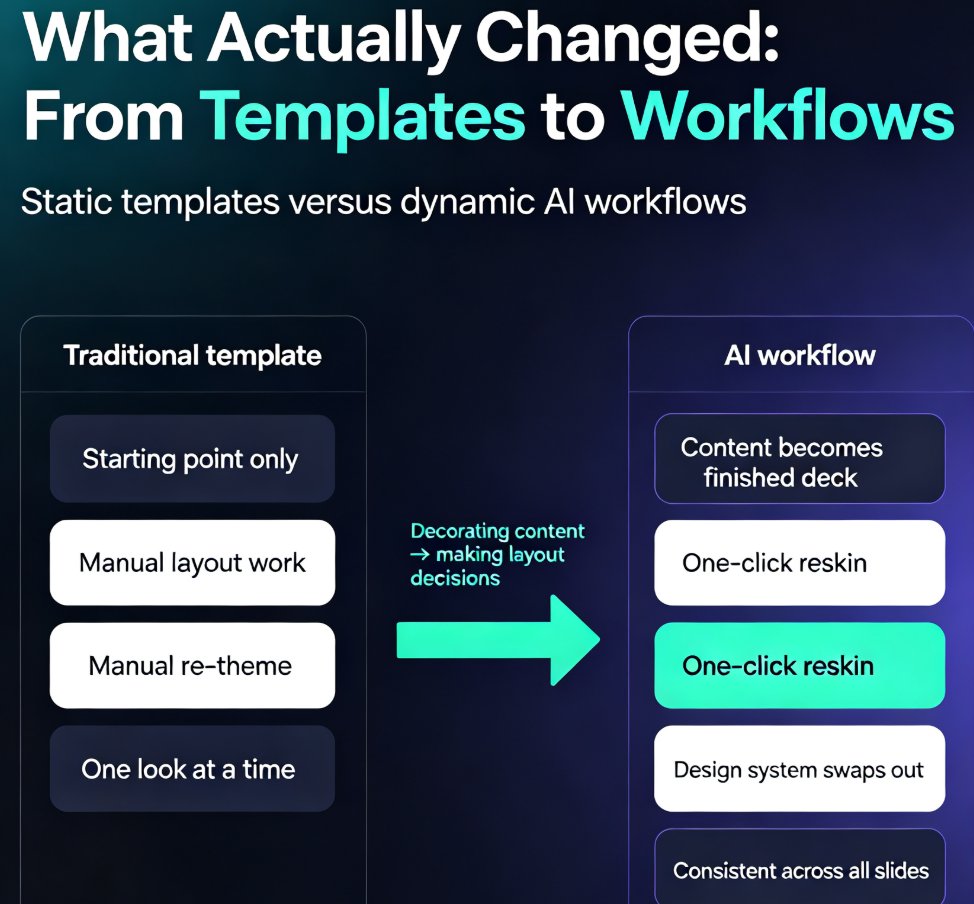
For years, "AI presentation tools" meant software that suggested layouts or rewrote bullet points. You still did the heavy lifting—dragging boxes, aligning text, choosing colors. It was like having a junior designer who needed constant supervision.
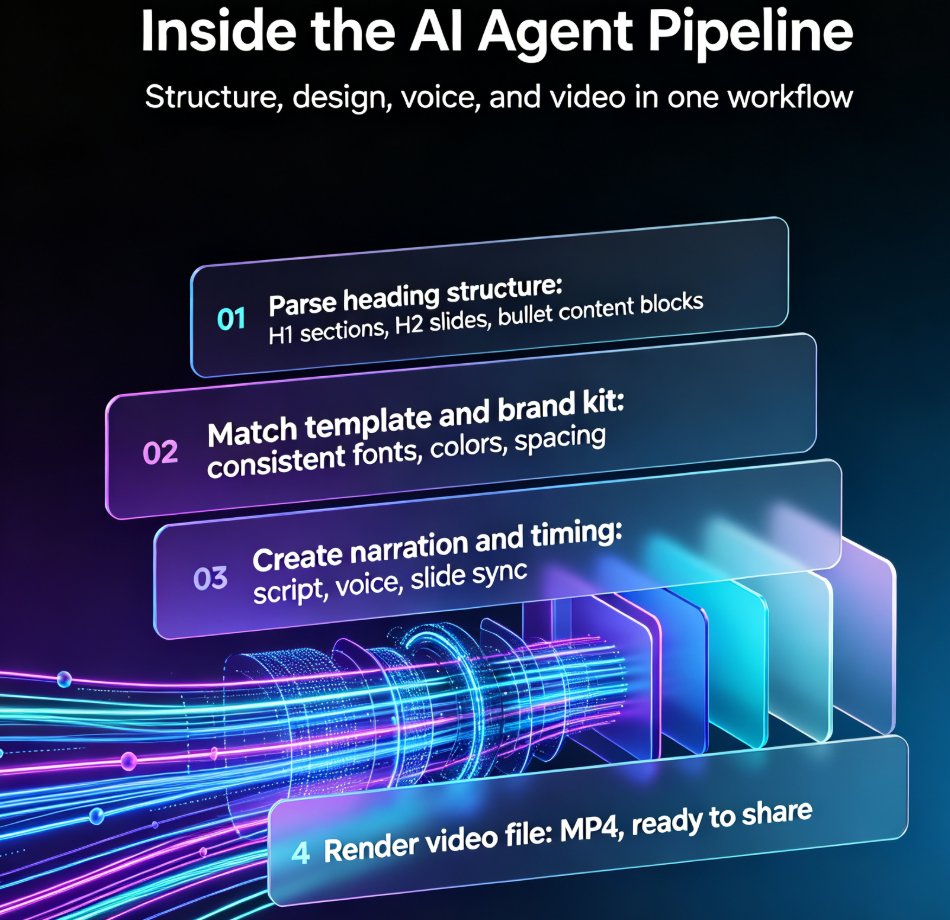
AI presentation agents flip that model. They don't assist; they execute. You give them a goal, and they independently research the topic, structure the narrative, select design templates, and produce a polished deck. Early reports suggest these agents can slash deck-building time by 70–95% compared to manual effort when fully applied.
The difference is autonomy. A tool waits for your input; an agent takes initiative. That's why the 2026 landscape looks so different from even two years ago.
02 What an AI Presentation Agent Actually Does
Let's break down the capabilities that separate agents from traditional tools:
- Research: Agents can pull from internal documents, web sources, or your own notes to gather relevant data and insights.
- Structure: They organize content into a logical flow—introduction, problem, solution, call to action—without you mapping it out first.
- Design: They apply consistent visual themes, choose appropriate charts, and ensure every slide looks intentional.
- Delivery: Some agents can even generate speaker notes or turn the deck into a narrated video.
This isn't hypothetical. Platforms like 2Slides already generate professional PowerPoint decks in under 30 seconds across 22+ languages with 1,500+ templates. And with MCP (Model Context Protocol) integration and API access, agents are becoming programmable infrastructure that fits into your existing tech stack.
03 The 2026 Reality: Autonomy Levels and What They Mean for You
Not all agents are created equal. Autonomy exists on a spectrum, and understanding where your tool falls helps you set expectations.
In 2024, AI suggested layouts and rewrote text—low autonomy, high human involvement. By 2025, tools like Gamma and Tome generated full decks from prompts, but you still had to review and edit every slide. In 2026, agents handle end-to-end creation with MCP integration and API access, meaning you approve the final output rather than building it. By 2027, multi-agent collaboration will have research, design, and review agents working in parallel, with humans setting goals and constraints only.
The real shift isn't from human to machine—it's from manual assembly to strategic oversight. Your value moves from clicking and dragging to defining the problem, setting constraints, and making judgment calls.
04 How to Work with AI Agents Without Losing Your Voice
Here's the fear: if an AI builds your deck, will it sound like everyone else's? Will it reflect your brand's personality? These are legitimate concerns, but they're manageable with the right workflow.
First, set clear goals before you prompt. Don't just say "make a deck about Q3 results." Specify the audience, the key message, the tone, and the desired outcome. The more context you give, the more tailored the output.
Second, maintain brand consistency. This is where tools like Zendeck shine. You can create a custom brand kit—fonts, colors, logos—and apply it to any AI-generated deck with one click. That way, even if the agent generates the structure, your visual identity stays intact. If you're dealing with legacy decks, Zendeck's one-click reskin can rebrand them in minutes.
Third, review with a critical eye. Agents are great at assembly, but they don't know your company's inside jokes, your client's pet peeves, or the nuance of a sensitive topic. Always read through the final deck and inject your voice where it matters.
05 The Multi-Agent Future: Research, Design, Review
The next 18 months will bring the biggest change yet: networks of specialized agents working together. Instead of one agent doing everything, you'll have a research agent that digs up data, a design agent that builds slides, and a review agent that checks for consistency and errors. They'll operate in parallel, like a well-oiled team.
Here's how that compares to what we have today:
| Capability | Traditional AI Tools (2024) | Single AI Agent (2026) | Multi-Agent Pipeline (2027) |
|---|---|---|---|
| Research | Manual | Basic auto-fill | Autonomous deep research |
| Structure | User-defined | AI-generated | AI-generated + self-review |
| Design | Template-based | Consistent themes | Adaptive, context-aware |
| Human Role | Build every slide | Review and edit | Set goals, approve final |
| Example | Copilot in PowerPoint | 2Slides Agent, Zendeck | Agentic pipelines |
This evolution means you'll spend even less time on mechanics. But it also means you need to be clear about your objectives, because the agents will execute whatever you ask for—literally.
06 Practical Steps to Start Using AI Agents Today
You don't have to wait for 2027 to benefit. Here's how to start integrating AI agents into your workflow right now:
- Start with a hybrid tool. Zendeck lets you import a Word outline or Markdown and generate a structured deck in minutes. You keep control over the final polish. It's a low-risk way to test the waters.
- Use templates as a safety net. Zendeck's 500+ template library means you're never staring at a blank page. Pick a starting point, then let AI fill in the content.
- Automate the boring parts. If you regularly turn reports into presentations, try importing a PDF or research report and letting AI generate an executive summary deck. That's a perfect use case for agents.
- Collaborate in real time. Agents work best when humans can jump in and out. Zendeck's real-time collaboration features let your team review and edit together, so the agent's output becomes a starting point, not a final product.
- Measure the time savings. Track how long a deck takes you now versus with an agent. The 70–95% reduction is real, but you'll only appreciate it if you measure it.
FAQ
What is an AI presentation agent?
An AI presentation agent is an autonomous system that can research, structure, design, and even deliver a complete presentation from a single prompt or outline. Unlike traditional AI tools that assist slide-by-slide, agents handle the entire workflow end-to-end, with minimal human intervention.
How much time can AI agents save on deck creation?
Early reports suggest AI agents can slash deck-building time by roughly 70–95% compared to manual effort when fully applied. For routine business presentations, this can reduce creation from hours to seconds, freeing teams to focus on strategy and messaging.
Will AI agents replace human presenters?
No. AI agents handle the mechanical work of assembling slides, but the strategic thinking, storytelling, and personal delivery still require human judgment. The best workflow is a partnership: you set the goals and constraints, the agent handles the heavy lifting, and you review and refine the final output.
How can I start using AI presentation agents with Zendeck?
Zendeck is a great starting point because it offers AI-powered generation with human control. You can import a Word outline or Markdown, generate a structured deck, then use one-click reskinning and brand kits to keep it on-brand. It's a practical middle ground between fully manual and fully autonomous creation.
Ready to see how AI agents can fit into your workflow? Start with a tool that gives you both speed and control. Zendeck's AI presentation platform is designed for teams that want to automate without losing their identity. Try it on your next deck and feel the difference.