
Agentic AI in Presentation Tools: Zendeck's 2026 Automation Trend
Let's be honest for a second. You've probably sat through a Friday afternoon that went like this: copy the content into slides, fight the template, resize the images, re-align the bullets, and then redo half of it because the client changed direction at 3 PM. Sound familiar?
That's the reality of presentation work for most teams — and it's exactly the problem agentic AI is quietly solving in 2026.
I. The Deck-Building Bottleneck Nobody Talks About
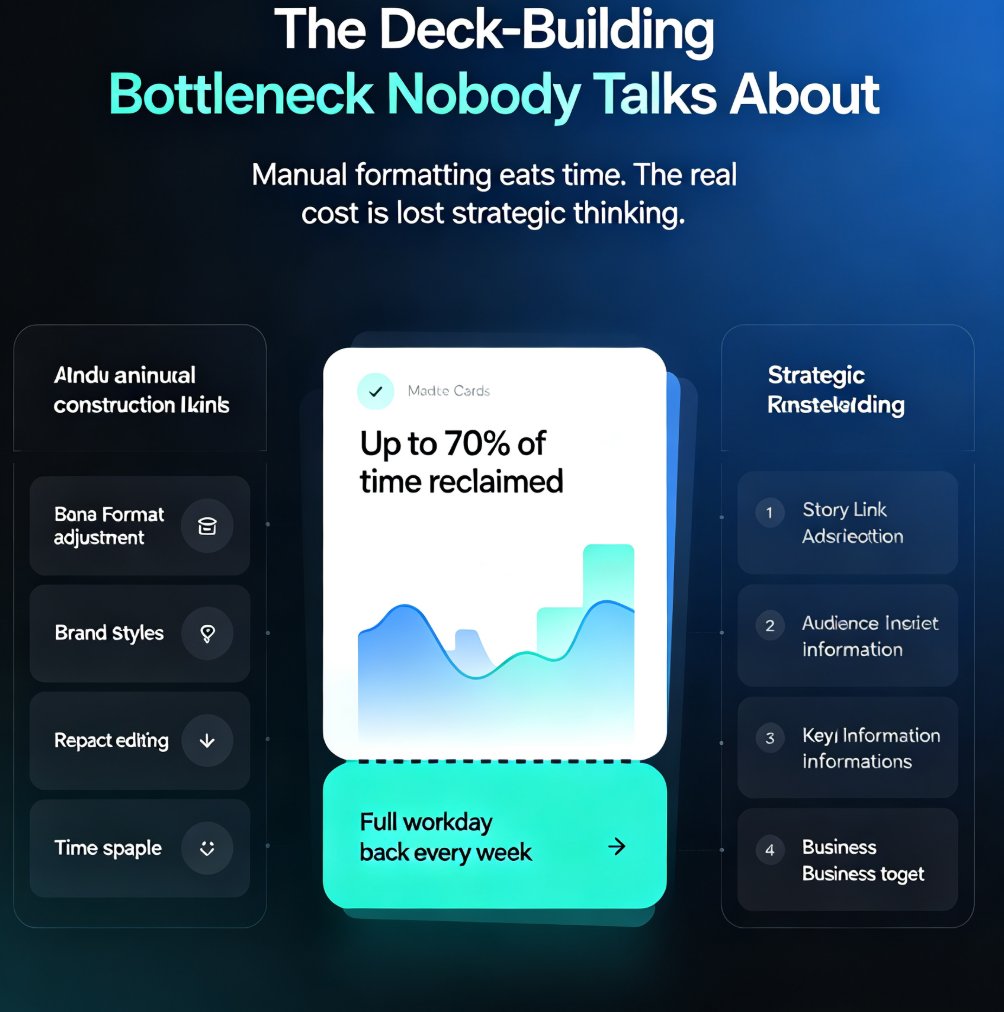
Here's a number that should make you pause: businesses that automate presentation creation regularly reclaim up to 70% of the time lost to manual slide design and formatting (source: Matik's 2026 automation guide). Let that sink in. Seventy percent. That's not a marginal efficiency gain — that's a full workday back every week for anyone who builds decks regularly.
The pain point is universal. You open PowerPoint, stare at a blank slide, and the clock starts ticking. Formatting eats hours. Brand consistency eats more. And by the time you've polished the visuals, you've spent so long on the "how" that you've lost sight of the "why."
The real cost of manual deck building isn't the time — it's the strategic thinking you never get to do.
That's the shift worth paying attention to. The best teams aren't looking for faster formatting tools anymore. They're looking for systems that handle the execution so they can focus on the story. And that's precisely where the conversation has moved in 2026 — from "how do I make slides faster" to "how do I get the thinking right and let the machine do the rest."
II. What Actually Changed: Agentic AI vs. Traditional AI Tools
◉ What makes an AI "agentic" in the first place?
Most people assume AI presentation tools are all the same — you type a prompt, you get slides. But there's a fundamental difference between a tool that helps you design and a system that does the work.
Traditional AI tools are reactive. You give them a prompt, they give you output, and then you're back in the driver's seat — fixing, editing, re-prompting. It's faster than manual, sure, but it's still a tool you operate. The thinking, the sequencing, the design judgment — that's still on you.
Agentic AI is different. It reasons, plans, and executes across the entire workflow without you micromanaging each step. As the 2Slides research on AI agents puts it, this marks a fundamental shift from tool-assisted design to fully autonomous slide generation — the AI researches the topic, structures the narrative, selects the design, and produces a polished deck from a single prompt.
Here's the practical difference:
| Capability | Traditional AI Tools | Agentic AI Systems |
|---|---|---|
| Content generation | Requires detailed prompts | Researches and structures autonomously |
| Design decisions | You pick templates manually | Selects layout based on content and audience |
| Workflow coverage | Single step (e.g., text to slides) | End-to-end (outline to final deck) |
| Human involvement | Constant oversight needed | Set direction, then review |
| Typical time per deck | 1-2 hours | Under 30 minutes |
The distinction matters because it changes what you're actually doing with your time. With traditional tools, you're still project managing the AI. With agentic systems, you're the strategist — and the AI is the production team.
III. The 2026 Shift: From Design to Strategy
Here's the trend line that should shape your planning: by 2027, agentic workflows will handle 60% of routine business presentations end-to-end, cutting creation time from hours to seconds (source: 2Slides). That's not a vendor prediction — it's the direction the entire category is moving, and the numbers back it up.
The implication is bigger than "faster slides." When the execution layer is automated, the competitive advantage shifts entirely to strategy. The teams that win in 2026 won't be the ones with the best design skills — they'll be the ones with the clearest thinking, because the AI will handle the rest. This is the same shift we explored in our analysis of why AI slide generation is moving from design to strategy.
◉ Does this mean designers are obsolete?
No — and this is where a lot of coverage gets it wrong. What changes is the division of labor. Designers stop spending hours on repetitive formatting and start owning the creative direction, the visual identity, and the moments where human judgment actually matters. The AI handles the grunt work; humans handle the taste. If anything, the bar for strategic thinking goes up, because that's now the only thing that differentiates your deck from the next person's.
IV. Zendeck's Take: Automating the Full Workflow
This is where the trend gets practical. Zendeck has built its platform around the agentic philosophy — not just generating slides, but automating the full journey from outline to polished presentation.
Here's what that looks like in practice:
Step 1: Start with your thinking, not your design. Drop in a Word outline, paste Markdown, or just dump your rough notes. Zendeck's AI takes the structure and runs with it — no blank-slide paralysis, no staring at a white canvas wondering where to begin.
Step 2: Let the AI handle the visual logic. The system selects layouts, applies consistent typography, and matches your brand kit automatically. If you've ever watched a colleague manually align 40 slides, you know exactly how much time this saves. The one-click reskin feature alone can unify fonts, colors, and layout across an entire deck in seconds.
Step 3: Review like a strategist, not a production assistant. Because the execution is handled, your review becomes about substance — is the story right? Is the argument tight? — instead of pixel-pushing. You can even turn the finished deck into a narrated video course without leaving the platform.
The result is what the agentic trend promises but rarely delivers: you spend your time on the thinking that matters, and the AI spends its time on the execution that used to eat your week.
If you want to see how this plays out in a specific workflow, our guide on turning a brain dump into a structured presentation walks through the exact process. And if you're curious about where the category is heading, the deep dive on AI presentation agents covers the broader 2026 landscape — including how autonomous systems are reshaping everything from pitch decks to training materials.
V. What This Means for Your Team in 2026
Let's bring this down to your Monday morning. What does agentic AI actually change for you?
You stop being the bottleneck. When a stakeholder asks for a deck at 4 PM, you don't have to choose between a rushed job and a late night. The AI produces a structured, on-brand draft in minutes — you refine, you don't rebuild. That's the difference between dreading the request and handling it in one sitting.
Your consistency stops depending on discipline. Brand drift happens when people are in a hurry. When the AI enforces the brand kit on every slide, consistency becomes the default, not the exception. Your decks start to look like they came from one team, not five people with five different interpretations of the logo guidelines.
Your strategy gets the time it deserves. The 70% time reclaim isn't a productivity flex — it's hours redirected to the thinking that actually moves your work forward. That's the part of the agentic trend that doesn't show up in the benchmark charts but matters most in practice.
One honest caveat: agentic AI doesn't mean zero oversight. You still need to review, refine, and apply judgment. The difference is that your review starts from an 80% solution instead of a blank page. And if you're worried about security or compliance in an AI-driven workflow, it's worth checking how modern platforms handle data protection before you commit.
VI. FAQ
◉ What is agentic AI in presentation tools?
Agentic AI refers to systems that reason, plan, and execute across the entire presentation workflow independently — researching content, structuring narratives, and selecting designs — rather than requiring step-by-step human prompts. It marks a shift from tool-assisted design to autonomous slide generation.
◉ How is agentic AI different from regular AI presentation tools?
Traditional AI tools are reactive — they generate output only when you prompt them, and you handle most of the execution. Agentic systems take a single direction and handle the full workflow end-to-end, from outline to polished deck, with humans reviewing rather than operating.
◉ Will agentic AI replace presentation designers?
No. It changes the division of labor. Designers move from repetitive formatting to creative direction, visual identity, and judgment calls. The AI handles execution; humans handle taste and strategy.
◉ How much time can agentic AI actually save?
According to industry research, businesses that automate presentation creation reclaim up to 70% of time lost to manual slide design and formatting. By 2027, agentic workflows are projected to handle 60% of routine business presentations end-to-end.
◉ How does Zendeck apply agentic AI to presentation creation?
Zendeck automates the full workflow from outline to final deck — you provide the content and direction, and the AI handles structure, layout, and brand consistency. This lets you review as a strategist rather than a production assistant.


