How a Startup Used Zendeck to Craft a Winning Pitch Deck
Maya had a working product, a waiting list of 200 companies, and exactly zero design skills. Her seed round depended on a pitch deck she had to build in one week. Sound familiar?
If you're a founder, you know the drill: the product is real, the metrics are solid, but the deck — the deck is where good ideas go to look amateur. You open PowerPoint, stare at a blank slide, and suddenly you're a graphic designer, a copywriter, and a data storyteller all at once. None of which you signed up for.
Let's be real: investors don't read your deck. They skim it. In the first 30 seconds, they decide whether your startup is worth a second look. That's brutal for non-designers.
01. The Pitch Deck Problem: Why Founders Without Design Skills Struggle
Here's the uncomfortable truth about pitch decks: investors judge your business by your slides before they ever meet you. A deck that looks thrown together signals a team that can't execute. A deck that looks polished signals competence, even before you say a word.
The problem? Most founders aren't designers. And the traditional options are all painful:
- Hiring a designer: A professional pitch deck can cost anywhere from $2,000 to $5,000, and takes two to three weeks of back-and-forth. When your runway is burning, that's an eternity.
- DIY with PowerPoint or Google Slides: You'll spend hours fighting alignment, choosing fonts, and resizing images. The result? A deck that looks like a middle-school science project.
- Freelance marketplaces: You get a template, but it's generic, and you still have to feed it your content, your data, and your story.
The outcome of this struggle is predictable: founders spend weeks on a deck that still doesn't feel right. They know the content is good, but the presentation undermines it.
That's exactly where Maya found herself. She had a clear problem statement, a validated market, and early revenue. What she didn't have was a deck that made investors believe it.
02. The 30-Minute Turnaround: How AI Generation Works
Maya's breakthrough came when she stopped trying to design and started letting AI do the heavy lifting. She used Zendeck's AI generation to turn her raw content into a structured, visually consistent deck.
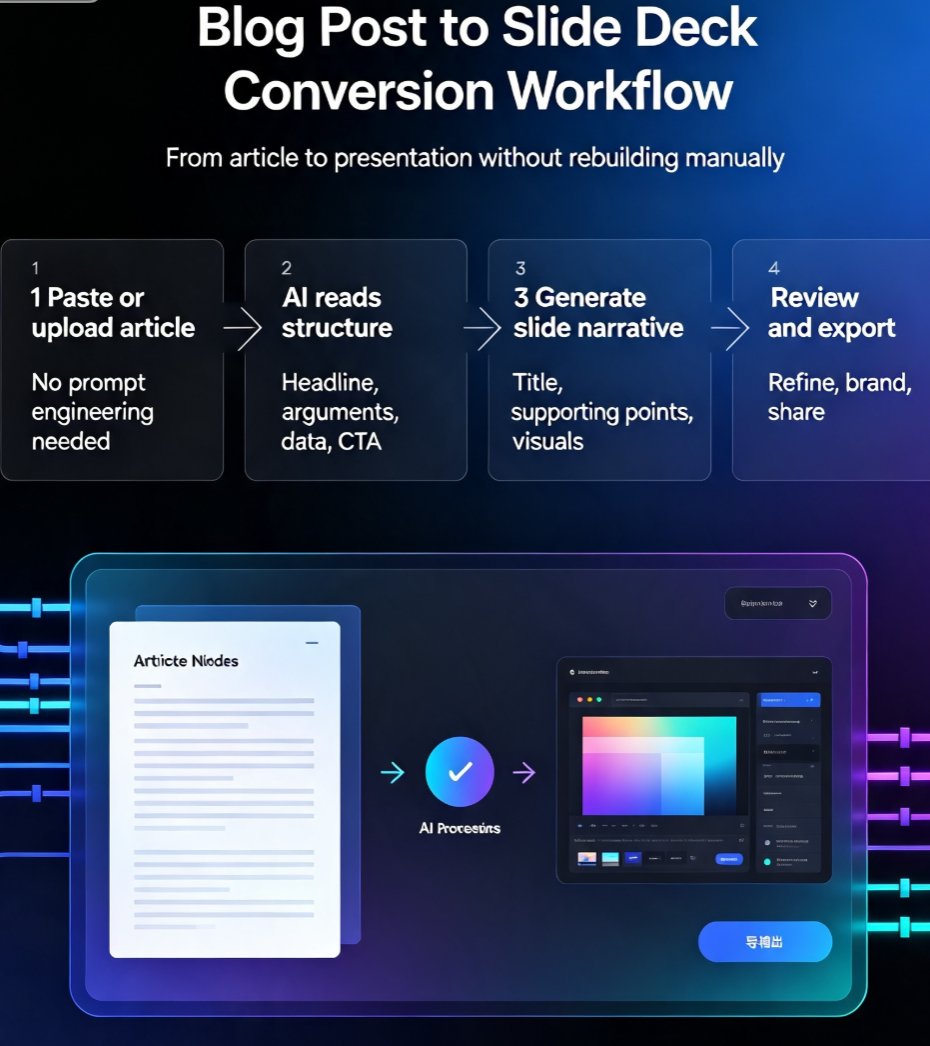
The workflow is almost embarrassingly simple:
- Dump your content: Maya pasted her outline — problem, solution, market size, traction, team, financials — as plain text. No formatting, no design decisions.
- Let the AI structure it: Zendeck parsed her outline and generated a complete slide deck with a logical flow, appropriate slide types, and consistent typography.
- Pick a template: She chose a clean, investor-friendly template from the library. No more font pairing, no more color theory. Done.
The entire process took 30 minutes. Not three weeks. Not three days. Thirty minutes.
That's the difference between a tool and a crutch. Zendeck doesn't just give you slides — it gives you a deck that looks like it was designed by someone who actually knows what they're doing. The AI handles the layout, the hierarchy, and the visual rhythm, so you can focus on the story.
If you want to understand the mechanics behind this, check out our guide on how to create a winning pitch deck with AI — it breaks down the problem-to-solution flow in detail.
03. The Template Library: Starting On-Brand, Not From Scratch
Here's where most AI tools fall short: they generate generic slides that all look the same. Investors have seen a thousand of those decks. They can smell a template from across the room.
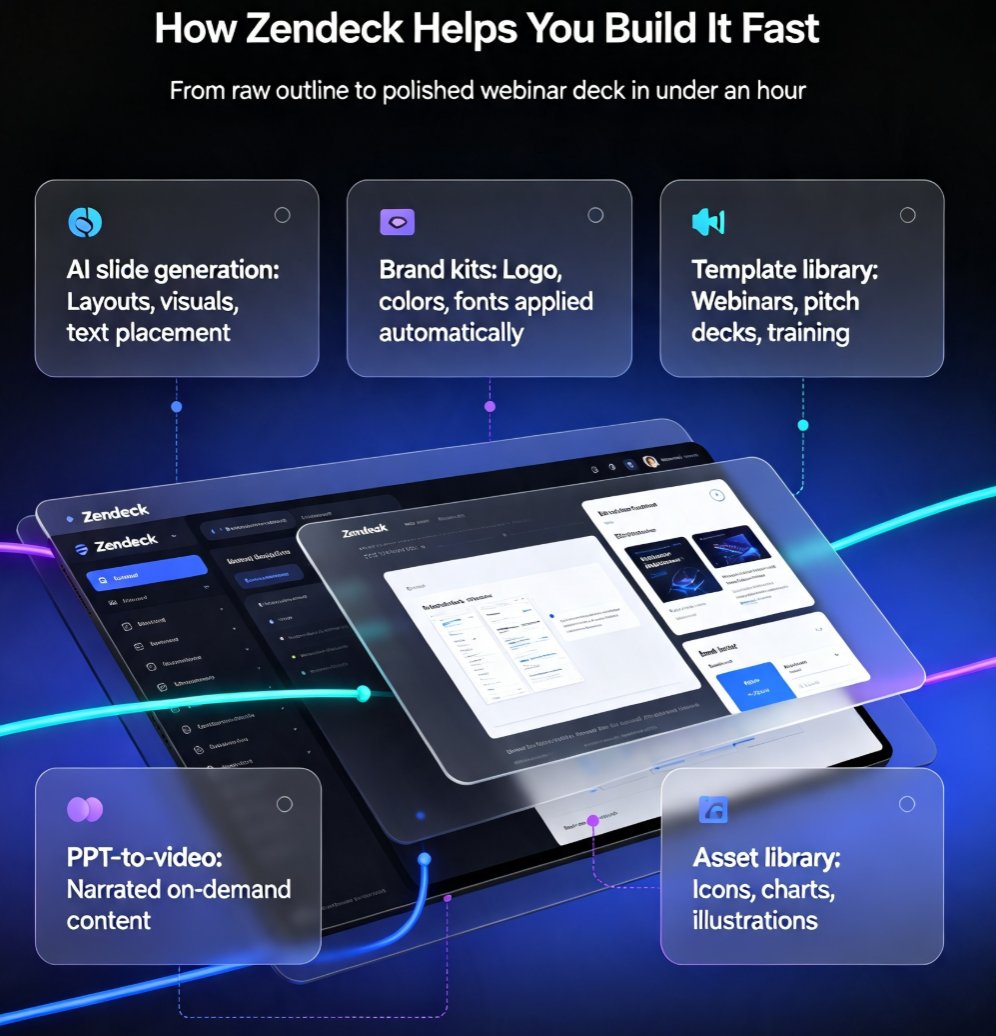
Zendeck's template library is different. It's not just a pile of pre-made designs — it's a system for keeping your deck on-brand from the first slide to the last.
Maya used the brand kit to lock in her logo, colors, and fonts. Every slide the AI generated automatically adhered to her brand guidelines. No manual tweaking, no "wait, why is this slide blue when everything else is green?"
Consistency is the silent signal of professionalism. When every slide in your deck looks like it belongs to the same family, investors subconsciously register that your team pays attention to details. And if you pay attention to slide details, you probably pay attention to product details.
If you're building decks regularly, this is the feature that saves you hours every week. Here's how to set up a brand kit in Zendeck for consistent presentations, and why it matters for on-brand presentations with Zendeck's template library.
04. What Investors Actually Look For (and How the Deck Delivered)
Let's talk about content, because a pretty deck with weak content is just a polished failure.
According to Silicon Valley Bank's guide to investor pitch decks, the core elements investors expect are: a clear explanation of the problem, the size of your market, your growth model, and evidence that your team can execute. That's it. Four things.
Maya's deck hit all four:
- Problem: A clear, one-slide explanation of the pain point her product solved. No jargon, no fluff.
- Market size: A data-backed slide showing the TAM, SAM, and SOM. The AI helped her visualize the numbers in a clean chart.
- Growth model: A simple slide showing how she acquires customers and how revenue scales.
- Team: A slide that made her two-person team look like a formidable force — because the design made them look credible.
The deck didn't just look good; it told a coherent story. Each slide flowed into the next, building a narrative that made investors want to know more.
This is where a lot of founders trip up. They stuff every slide with text, hoping to preempt every question. But investors don't want to read your deck — they want to understand your business in 10 minutes and then ask questions. A good deck is a conversation starter, not a data dump.
05. From Deck to Meeting: The $1.5M Seed Round Story
Here's the payoff. Maya sent her Zendeck-crafted deck to a seed-stage fund on a Tuesday. By Thursday, she had a meeting. Two weeks later, she had a term sheet.
The final result: a $1.5M seed round, closed with a deck that took 30 minutes to build.
Now, let's be clear: the deck didn't close the round by itself. The product was real, the traction was real, and the team was capable. But the deck opened the door. It got her the meeting. It made investors take her seriously from the first email.
That's the real value of a good pitch deck: it's not the deal — it's the access. A polished deck gets you in the room. Once you're in the room, you still have to deliver. But you never get the room if your deck looks amateur.
The chart below shows the time difference between the traditional approach and what AI made possible:
06. Beyond the Pitch: Reusing Your Deck for Other Audiences
Here's a bonus that most founders don't think about: your pitch deck isn't just for investors. The same deck can be repurposed for customers, partners, and new hires.
Maya reused her deck three ways:
- Customer meetings: She trimmed the investor-specific slides and used the core story to explain her product to enterprise prospects.
- Partner pitches: She added a slide about integration opportunities and used it to pitch potential partners.
- Team onboarding: She turned the deck into a narrative overview for new hires, so everyone understood the company story.
The platform makes this easy because you can export your deck to PPTX, PDF, and Google Slides in a couple of clicks. No rework, no redesign. The same deck that raised $1.5M becomes your sales tool, your recruiting tool, and your internal alignment tool.
07. FAQ
Q: How long does it really take to create a pitch deck with an AI tool? A: For a founder with content ready, a polished deck takes about 30 minutes. You paste your outline, let the AI structure it, pick a template, and review. Most of the time is spent on content, not design.
Q: Do I need design skills to use an AI presentation tool for my pitch deck? A: No. The tool handles layout, typography, and visual consistency automatically. If you can write an outline, you can create a professional-looking deck that investors take seriously.
Q: Can the AI help with the content of my pitch deck, not just the design? A: Yes. The AI can help structure your content into a logical flow — problem, solution, market, traction, team, financials — and suggest slide types that match your content, so your story lands clearly.
Q: Is an AI-generated pitch deck good enough for serious investors? A: Yes. The deck looks professionally designed because it follows consistent design principles and brand guidelines. Investors care about clarity and credibility, and a well-structured AI deck delivers both.
Q: Can I edit the deck after the AI generates it? A: Absolutely. You can edit any slide, change templates, adjust colors, and add your own content. The AI is a starting point, not a cage — you stay in control of the final result.