Contextual Intelligence in AI Decks: Beyond Keyword-Based Generation
You've been there: you paste a detailed outline into an AI presentation tool, hit generate, and get back a deck that looks... fine. The fonts match, the colors are coordinated, but the content feels like it was written by someone who skimmed your notes and guessed at the rest. The industry jargon is wrong. The tone is off. The slides don't tell a coherent story.
That's the problem with keyword-based generation. It's the difference between a translator who knows every word in the dictionary and one who understands the culture, the nuance, and the intent behind what you're saying. The first one gives you a literal translation; the second gives you something you'd actually present to a client.
Contextual intelligence is the next frontier in AI deck generation — and it's what separates tools that produce generic slides from those that produce presentations you'd proudly put your name on.
Let's break down what this actually means, why it matters for your workflow, and how Zendeck's semantic understanding is changing the game.
01 | The Problem: Why Your AI Slides Still Feel Off
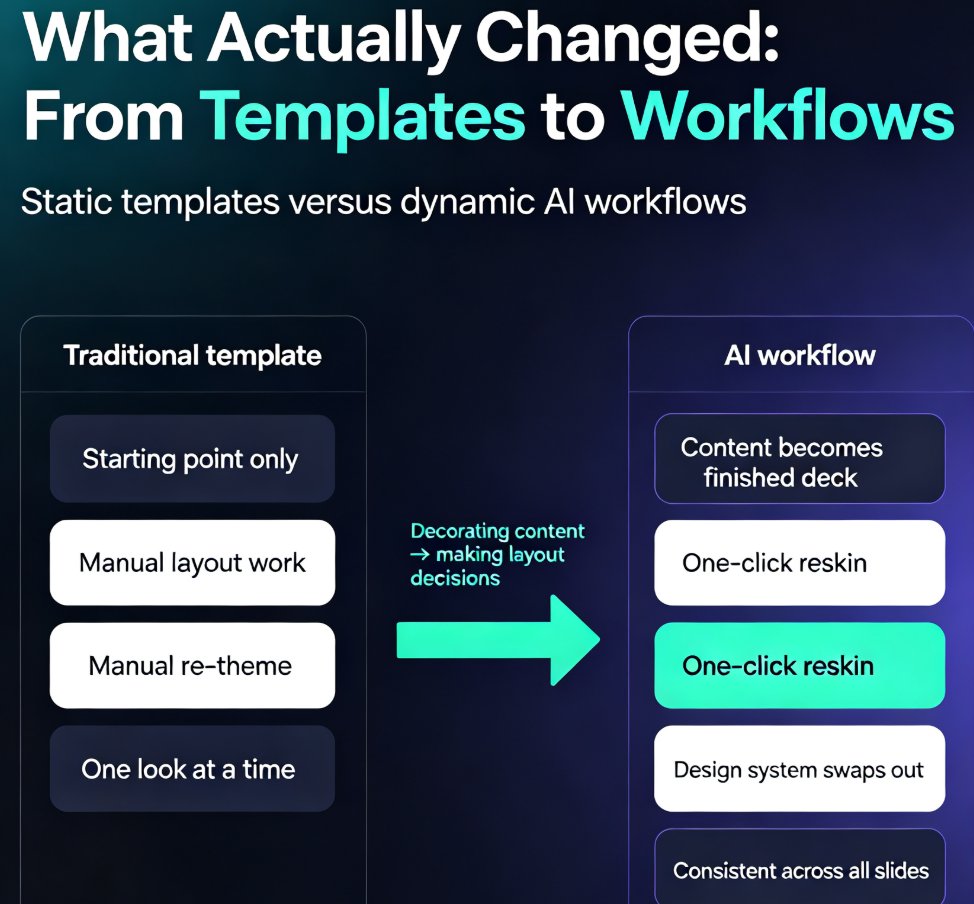
Let's be real. Most AI presentation tools on the market today are glorified template matchers. They scan your input for keywords, then pull content from a database of pre-written phrases and drop it into a layout. The result? Slides that are technically correct but contextually hollow.
Consider this scenario: you're a training manager at a pharmaceutical company. You need a deck on regulatory compliance for a new drug launch. You feed your outline into a generic AI tool, and it generates slides filled with generic phrases like "ensure compliance" and "follow guidelines." Technically accurate. Completely useless for your audience of seasoned regulatory affairs specialists.
The core issue is that most AI tools generate content based on patterns in large datasets, failing to incorporate the nuanced needs of a particular industry or company. This is a known limitation, acknowledged by industry leaders like Prezent, which notes that "other AI presentation businesses fail to provide industry-specific accuracy, often generating content that is overly generic."
For a tech company, this might mean missing the technical detail required in product roadmaps. For a finance team, it could mean oversimplifying complex valuation models. For educators, it's creating courseware that doesn't align with learning objectives.
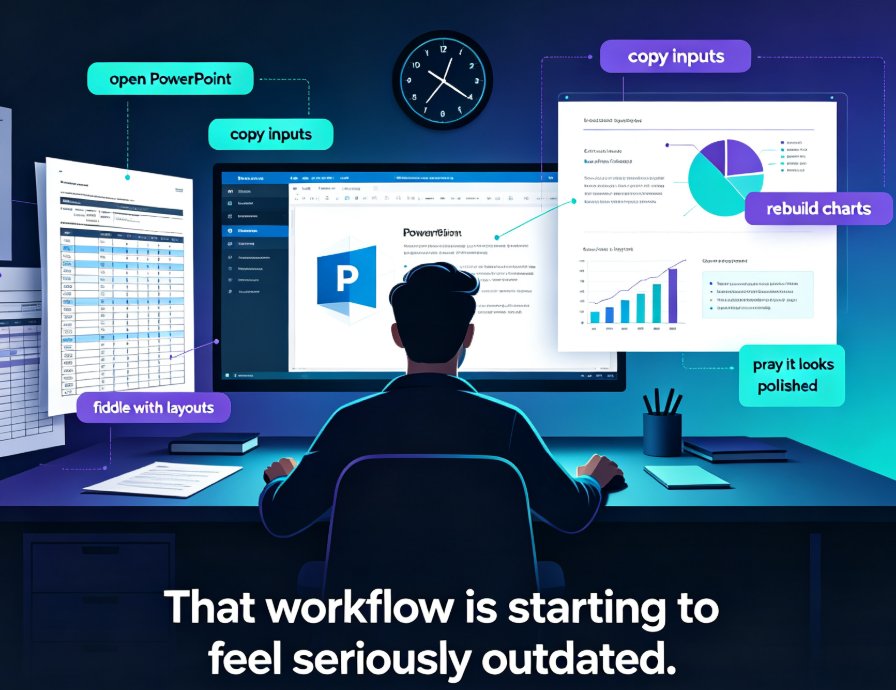
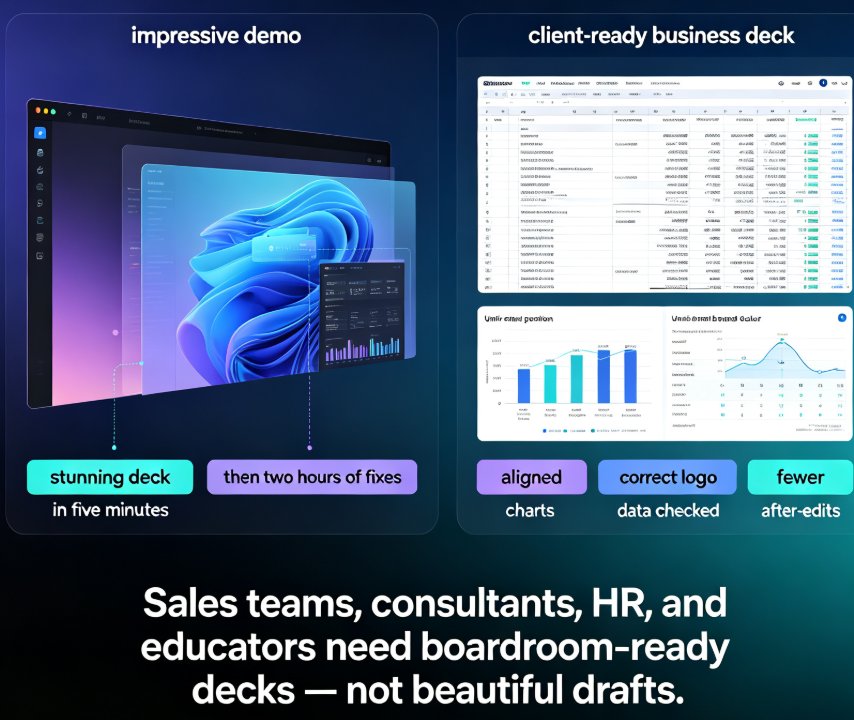
The pain is real, and it's costly. You spend hours editing AI-generated content, fixing inaccuracies, adjusting tone, and restructuring slides. By the time you're done, you've saved maybe 20 minutes compared to starting from scratch. That's not the productivity revolution AI promised.
02 | What Is Contextual Intelligence, Really?
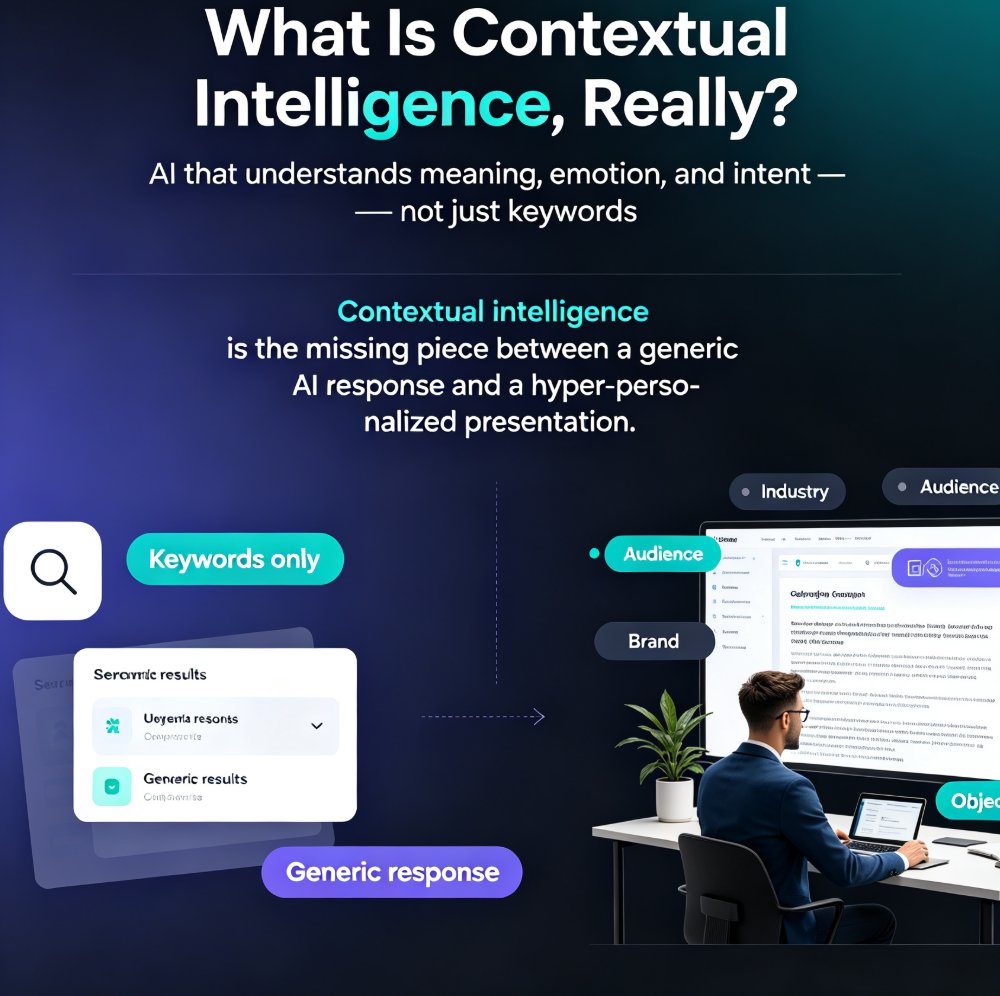
Contextual intelligence (CI) is the ability of an AI system to understand meaning, emotion, and intent — not just keywords. It's the difference between a search engine that returns pages containing your query terms and a knowledgeable colleague who understands what you're actually trying to achieve.
In the presentation space, CI means the AI considers:
- Your industry: the specialized terminology, standards, and conventions that matter
- Your audience: their level of expertise, their expectations, their pain points
- Your brand: your voice, your visual identity, your messaging guidelines
- Your objective: whether you're persuading investors, training employees, or educating students
Contextual intelligence is the missing piece between a generic, vague AI response and a hyper-personalized presentation — so tailored to your prompt that you're 80% complete in minutes rather than starting from zero.
This isn't just a nice-to-have feature. It's the difference between AI that saves you time and AI that makes you look good. When the AI understands your context, it can generate content that's precise, compelling, and aligned with your communication goals.
Prezent's research on contextual intelligence highlights this shift: "By feeding the AI platform with relevant context, such as industry-specific terminology, brand guidelines, individual preferences and much more, generated presentations are precise and compelling — enabling more effective business communication."
03 | The Shift: From Keyword Matching to Semantic Understanding
So how does this play out in practice? Let's compare the old approach with the new.
Keyword-based generation works like this: you type "quarterly sales report," and the AI finds slides about sales, quarters, and reports. It assembles them into a deck with a generic structure: title slide, agenda, market overview, sales figures, conclusion. The content is predictable, and it could apply to any company in any industry.
Semantic understanding works differently. The AI analyzes your outline, understands the relationships between concepts, and generates content that flows logically. It recognizes that "Q3 revenue decline" is not the same as "Q3 revenue growth" — not just in the numbers, but in the narrative. It knows that a decline requires a different slide structure, different messaging, and different visualizations than growth.
Here's a simple comparison:
| Aspect | Keyword-Based Generation | Contextual Intelligence (Semantic) |
|---|---|---|
| Input understanding | Matches keywords to templates | Analyzes meaning, intent, and relationships |
| Industry accuracy | Generic phrases, no specialized terminology | Industry-specific language and standards |
| Audience adaptation | One-size-fits-all tone | Adjusts to expertise level and expectations |
| Brand consistency | Requires manual adjustment | Incorporates brand guidelines automatically |
| Content coherence | Slides feel disconnected | Narrative flows logically across slides |
| Editing time | Significant manual rework | Minimal adjustments needed |
The shift from keyword matching to semantic understanding is what makes AI-generated decks actually usable. It's the difference between a tool that produces a draft and a tool that produces a presentation.
This shift is already happening across the industry. As noted in Prezent's analysis, "Context bridges the gap between AI's capabilities and human-centered communication and design, creating a powerful intersection between technology and humanity." The best tools are moving toward this model, and Zendeck is built on it from the ground up.
04 | How Zendeck Applies Contextual Intelligence
Now, let's talk about what this looks like in practice with Zendeck. When you upload a Word outline or paste Markdown into Zendeck, the AI doesn't just scan for keywords. It processes the semantic structure of your content — the relationships between ideas, the hierarchy of points, the implied narrative.
Here's how that plays out across Zendeck's core capabilities:
Semantic content understanding: Zendeck analyzes your outline to understand the logical flow of your argument. It identifies which points are supporting evidence, which are key takeaways, and which are transitional. This allows it to structure your deck in a way that makes sense, not just in a way that fills slide templates.
Context-aware design: Based on your content, industry, and audience, Zendeck's smart layout system automatically selects appropriate visual treatments. A technical training deck gets diagrams and flowcharts. A sales pitch gets compelling visuals and clear calls to action. The design serves the content, not the other way around.
Brand integration: Zendeck's brand kit system ensures that every generated slide adheres to your visual identity. This isn't just about colors and fonts — it's about maintaining consistent messaging and tone across hundreds of slides. If you need to build this from scratch, our guide on creating a custom brand kit walks you through the process.
Industry adaptation: Whether you're in biopharma, technology, finance, or education, Zendeck adapts its language and content to match your field. This is the contextual intelligence that Prezent identifies as crucial: "a tech company might require advanced product roadmaps or architecture diagrams that need to adhere to specific standards of technical detail."
05 | The Impact: What Contextual Intelligence Means for Your Workflow
So what does this actually save you? Let's quantify it.
Time savings: With keyword-based tools, you might spend 2-3 hours editing a generated deck to make it usable. With contextual intelligence, that editing time drops to 30-45 minutes. The AI gets the content right the first time, so you're polishing rather than rewriting.
Quality improvement: Contextually intelligent decks are more coherent, more relevant, and more persuasive. They don't just look good — they communicate effectively. This matters whether you're pitching investors, training employees, or teaching students.
Consistency at scale: When the AI understands your brand and industry, every deck you generate is consistent with the last one. This is crucial for teams that produce multiple presentations per week. Our article on maintaining brand consistency across hundreds of slides explores this in depth.
Reduced errors: Contextual intelligence catches the subtle errors that keyword-based tools miss. It knows that "compliance" means different things in healthcare than in finance. It understands that a "pitch deck" for a startup has different requirements than a "pitch deck" for a corporate initiative.
The outcome is simple: you get better presentations in less time, with less effort. That's the promise of contextual intelligence, and it's what Zendeck delivers.
06 | Common Mistakes to Avoid When Using AI Presentation Tools
Even with contextual intelligence, there are pitfalls. Here's what I've seen trip people up:
Mistake 1: Providing vague input. The AI can only be as contextual as your input allows. If you give it a one-line prompt, you'll get a one-dimensional deck. Spend five minutes structuring your outline, and the AI will reward you with a coherent presentation.
Mistake 2: Ignoring the audience parameter. Contextual intelligence works best when you tell the AI who you're presenting to. A deck for C-suite executives needs different language and visuals than one for frontline staff. Make sure you're specifying your audience.
Mistake 3: Skipping the brand kit. If you don't set up your brand kit, the AI will use default styling. That's fine for a draft, but it won't reflect your organization's identity. Take the time to configure this once, and every future deck will benefit. If you're unsure where to start, check out our guide on setting up brand kits in Zendeck.
Mistake 4: Not reviewing the output. Contextual intelligence is powerful, but it's not a replacement for human judgment. Always review the generated deck for accuracy, tone, and alignment with your goals. The AI gets you 80% there; you provide the final 20%.
Mistake 5: Using the wrong tool for the job. Not all AI presentation tools are created equal. Some are still stuck in keyword-matching mode. If you're consistently spending hours fixing AI-generated content, the problem might be the tool, not your input. Our analysis of common AI presentation mistakes can help you diagnose the issue.
07 | The Future: Where Contextual Intelligence Is Heading
Contextual intelligence isn't a static feature — it's evolving rapidly. Here's what I see on the horizon:
Deeper personalization: Future tools will learn from your past presentations, your editing preferences, and your audience feedback. The AI will get better at predicting what you need before you even ask.
Real-time adaptation: Imagine a presentation that adjusts its content and visuals based on live audience reactions. This is already emerging, as explored in our article on adaptive presentations and audience reactions.
Integration with broader workflows: Contextual intelligence will extend beyond slide generation to video, interactive content, and real-time collaboration. The AI won't just create your deck — it'll help you deliver it, record it, and repurpose it.
The trend is clear: AI is shifting from design to strategy. As I've noted in our analysis of AI slide generation trends, the tools that succeed will be those that understand not just what you're saying, but why you're saying it and who you're saying it to.
08 | Getting Started with Contextual Intelligence
Ready to experience the difference? Here's how to get started with Zendeck:
- Upload your outline: Paste Markdown or upload a Word document with your content structure. The more detailed your outline, the better the AI understands your intent.
- Set your context: Specify your industry, audience, and objective. This helps Zendeck apply the right terminology, tone, and design approach.
- Configure your brand kit: If you haven't already, set up your brand kit with your colors, fonts, and logo. This ensures every generated slide aligns with your identity.
- Generate and refine: Let Zendeck work its magic, then review and refine. The AI handles the heavy lifting; you provide the human touch.
- Share and collaborate: Once your deck is ready, share it with your team for real-time collaboration. Zendeck supports external client collaboration with granular permissions.
The bottom line: contextual intelligence is not a luxury feature — it's the new baseline for AI presentation tools. If you're still wrestling with generic AI-generated content, it's time to upgrade your expectations.
Zendeck is built for this shift. Our semantic understanding, combined with smart design and brand governance, produces decks that are relevant, coherent, and presentation-ready. Whether you're an educator creating courseware, a trainer developing compliance materials, or a professional pitching to clients, contextual intelligence changes what you can achieve with AI.
Try it with your next outline. You'll notice the difference immediately — not in the fonts or colors, but in the content. That's the power of understanding context, not just keywords.
FAQ
Q: What is contextual intelligence in AI presentation tools?
A: Contextual intelligence is an AI's ability to understand meaning, emotion, and intent beyond surface-level keywords. In presentation tools, it means the AI considers your industry, audience, brand guidelines, and specific goals to generate slides that are relevant and coherent, not just grammatically correct.
Q: How is Zendeck different from other AI presentation tools?
A: Zendeck uses semantic content understanding to interpret your outline or prompt in context. Instead of matching keywords to generic templates, it analyzes the relationships between ideas, adapts to your industry and audience, and produces a structured deck with consistent design and messaging.
Q: Why do AI-generated slides still look generic?
A: Most AI tools generate content based on patterns in large datasets, ignoring the nuanced needs of a specific industry or company. They produce generic text and layouts that don't capture specialized knowledge or brand voice. Contextual intelligence bridges this gap by feeding the AI relevant context.
Q: Can I maintain brand consistency with contextual AI?
A: Yes. Contextual AI tools like Zendeck can incorporate brand guidelines, preferred terminology, and design standards. This ensures every slide aligns with your visual identity and messaging, even when generating hundreds of decks across teams.
Q: Is contextual intelligence only for large enterprises?
A: No. While enterprises benefit from industry-specific accuracy, educators, trainers, and small teams also gain from AI that understands their audience and objectives. Zendeck makes this capability accessible to anyone creating presentations, regardless of design skills.