Zendeck vs Gamma: Which AI Presentation Tool Wins for Business Decks?
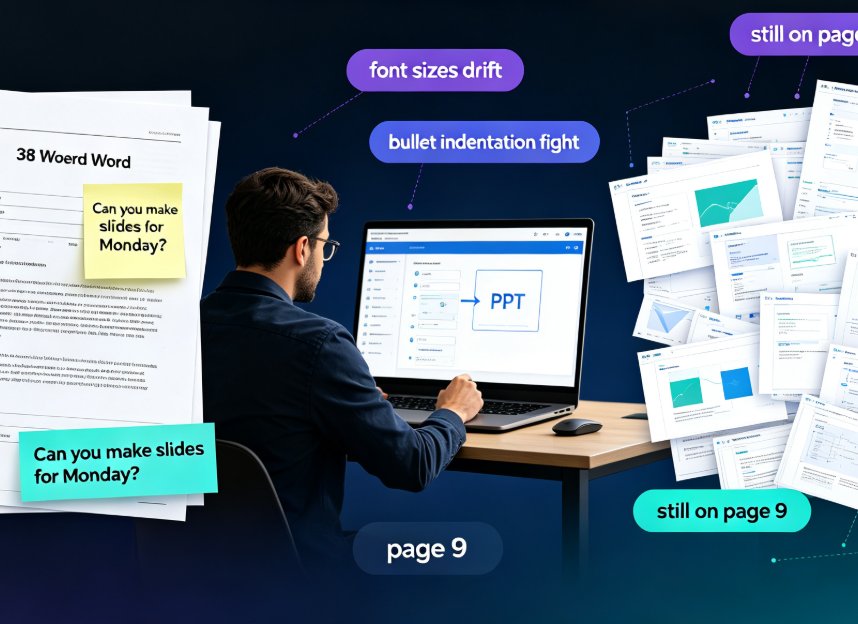
Let's be honest: finding the right AI presentation tool feels like a never-ending game of whack-a-mole. You try Gamma, get a stunning deck in five minutes, then spend two hours fixing misaligned charts, re-inserting your logo, and re-checking every data point against your source file. Sound familiar?
That friction is exactly why this comparison exists. This isn't a generic roundup of AI deck tools—it's a head-to-head built for business professionals who need boardroom-ready decks without the after-editing grind. We're talking sales teams prepping partner decks, consultants packaging multi-slide deliverables, HR teams building training courseware, and educators turning Word syllabi into polished course materials.
Spoiler alert: for business decks, the winner isn't the tool with the flashiest demos—it's the one that gets you to a client-ready deck in the fewest edits. And on that metric, Zendeck wins.
I. Why Gamma Owns the Hype (And Where It Falters for Business)
Gamma's reputation is well-earned. It nails web-native aesthetics, generates AI images on demand, and restyles entire decks in one click through its Agent feature. SlideSpeak's 2026 testing shows Gamma winning multiple categories—content quality, design, collaboration, and innovation—against Presentations.AI (source).
But winning "best overall against Presentations.AI" isn't the same as winning "best tool for your quarterly business review." Here's where Gamma's glow fades in professional practice:
- Alignment drift on dense content: Gamma's generated layouts shine on airy, image-led slides but stumble when you drop in a 14-row financial table or a complex org chart.
- Brand governance gaps: One-click restyling is impressive, but enforcing your corporate palette and typography across a 40-slide investor deck still requires manual passes.
- Data density challenges: Gamma is built for visual storytelling, not for slides that must carry three data points, a source note, and a call to action simultaneously.
The lesson is clear: a tool that crafts beautiful consumer content doesn't automatically produce believable business decks. The margin between a pitch that closes and one that gets challenged in the room often lives in alignment precision and consistent data visualization—not gradient effects.
II. Zendeck vs Gamma: Feature Matrix
| Feature | Zendeck | Gamma |
|---|---|---|
| Generation input | Word outline, Markdown, TXT, or prompt | Prompt-driven; Agent research |
| Smart layout | Auto-unifies fonts, colors, and alignment after generation | One-click restyle via Agent |
| Asset library | Premium icons, charts, illustrations built in | Limited; relies on AI image generation |
| Brand kit enforcement | Dedicated brand kit for consistent decks | Template-level only |
| PPT-to-video | Native narration, subtitles, and micro-course creation | Not a core strength |
| Data-heavy slides | Optimized for structured, dense business content | Optimized for visual storytelling |
| Collaboration | Online editing and link sharing | Real-time multiplayer, comments, workspaces |
| Best fit | Business deliverables, consulting, training, education | Marketing, creative storytelling, quick web docs |
The matrix tells the real story: Gamma optimizes for "looks impressive fast"; Zendeck optimizes for "ready to present to stakeholders fast." Neither approach is wrong—but when your deck carries real financial projections, that difference decides whether you spend two hours or twenty minutes on cleanup.
III. The Smart-Layout Difference: Where Business Decks Are Won
Here's the part most reviews skip. Gamma generates gorgeous output immediately, but business users routinely find themselves editing decks long after generation. Canva-vs-Gamma analyses even acknowledge that teams "spend hours editing a deck before it's ready to share" (source).
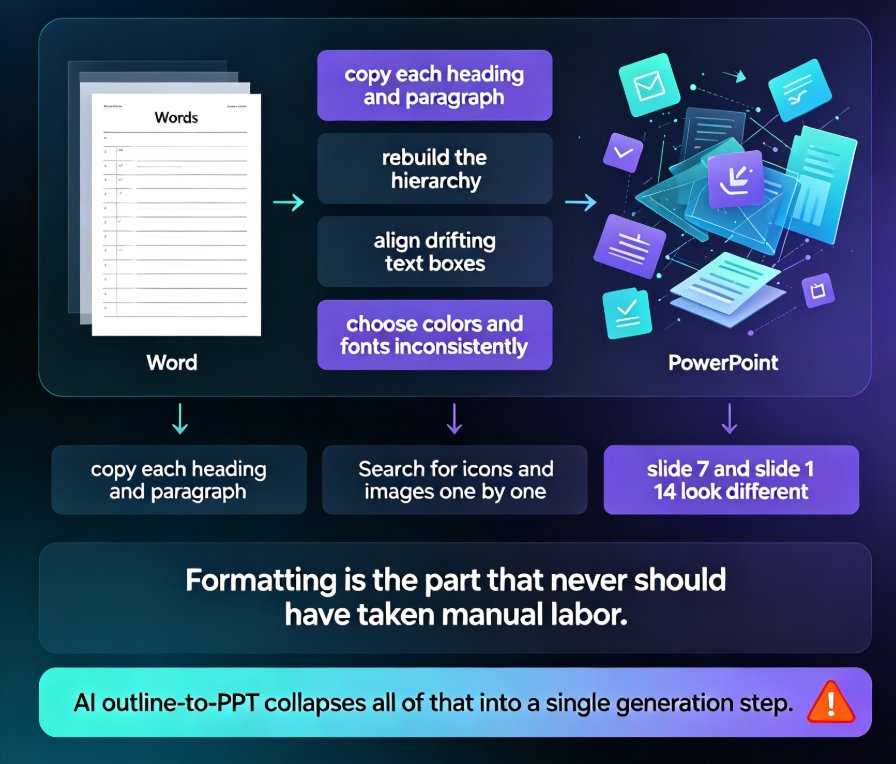
Zendeck tackles this at the architectural level. After AI generates your structure from an imported Word outline or Markdown file, smart layout automatically unifies fonts, colors, and alignment across every slide. Compound that with a built-in asset library of premium icons, charts, and illustrations, and the result is a deck that's business-governed from the moment it's generated—no design cleanup marathon required.
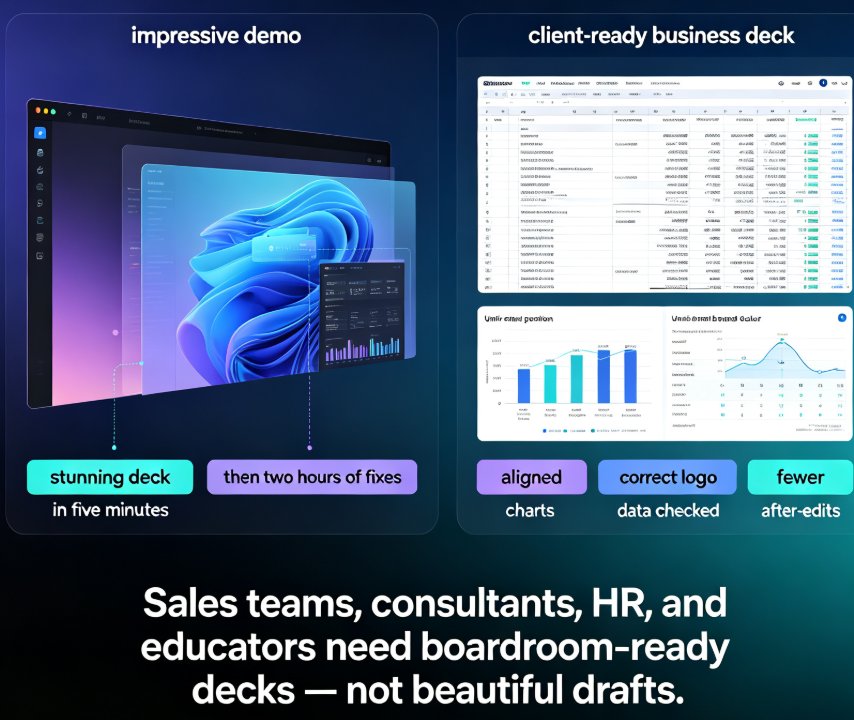
In practice, this means Zendeck users stop policing visual consistency and start refining the message. For a consultant assembling a 30-slide client deliverable, that's the difference between a productive morning and an all-nighter before the review meeting.
IV. Time-to-Deck: The Numbers That Actually Matter
SlideSpeak's research shows AI presentation tools accelerate creation by up to 5x versus manual methods. But raw generation speed is table stakes now. The metric that matters is time-to-final-ready-deck—the moment your presentation is polished, branded, and safe to present. Here's a realistic model for a 20-slide business deck:
| Workflow stage | Manual PowerPoint | Gamma | Zendeck |
|---|---|---|---|
| Initial generation | 4 hours (manual build) | 30 minutes (prompt) | 30 minutes (outline import) |
| Layout & alignment fixes | 2 hours | 1.5 hours | 20 minutes (smart layout) |
| Brand consistency pass | 1.5 hours | 1 hour | 10 minutes |
| Data-viz cleanup | 1.5 hours | 1 hour | 30 minutes (asset charts) |
| Total time-to-final | 9 hours | 4 hours | 1.5 hours |
These numbers don't flatter AI tools—they reflect a simple reality: generation speed is now a commodity; post-generation cleanup is where business decks are truly won. And that's precisely where Zendeck's smart layout and asset integration pay for themselves within the first two decks you ship.
V. The Workflow: From Word Outline to Boardroom-Ready
Let's ground this in a scenario most business teams will recognize. You're a sales enablement manager who needs a partner deck by Friday, and your only source asset is a 14-page Word brief. Here's how the two tools handle it:
With Gamma, you'd either paste the brief into a prompt and hope the AI extracts the right structure, or rebuild key slides from scratch. Then you'd need to check every generated claim, restyle the visual tone, and hunt for charts that fit your data.
With Zendeck, you upload the Word outline directly. The platform generates structured, formatted slides. Smart layout unifies the design language. The asset library supplies the exact chart and icon treatments for your data. If the field team needs a recap version, you convert the deck into a narrated micro-course with auto-generated subtitles.
The outcome: one source document produces a branded, boardroom-ready deck plus a training video—with zero design skills and zero payload of manual cleanup. That's the workflow advantage that turns Zendeck into a business staple rather than a novelty. It's part of a broader shift where AI deck tools are moving beyond templates into context-aware design, and where AI deck generation is steadily replacing traditional PPT production.
VI. When Should You Still Pick Gamma?
An honest comparison names Gamma's genuine strengths. There are clear scenarios where it's the better choice:
- Narrative-driven sales decks: When your pitch is mostly concept, mood, and story with minimal hard data.
- Web-native sharing: Gamma decks genuinely shine as immersive web pages for internal audiences.
- Quick exploratory docs: When you need a first-pass visual document, not a governed deliverable.
But for any deck carrying real numbers, strict brand rules, or a formal approval chain, Zendeck is the pragmatic pick. If you're running a sales org, consulting practice, HR function, or education program, you'll feel the difference within one real project. Teams that need consistent visual identity across decks should also check out 5 ways to create a custom brand kit in Zendeck, and for data-heavy content, how to add interactive charts with Zendeck's asset library is a workflow worth adopting.
VII. The Verdict: Zendeck Wins for Business Decks
Let's wrap this up without the usual roundup fluff. Zendeck beats Gamma for business decks because it pairs AI generation with smart layout and a real asset library, eliminating the post-generation cleanup that plagues flashier alternatives. Gamma remains a fantastic creative tool; Zendeck is the business weapon.
Here's my advice: don't test either with a toy deck. Run your actual upcoming business review through both platforms and measure the time-to-final-ready-deck yourself. That's the test that separates marketing demos from workflow reality—and it's the test Zendeck wins every time.
FAQ
Is Zendeck or Gamma better for business presentations?
Zendeck wins for business presentations because it combines AI generation with smart layout automation, a premium asset library, and brand kit enforcement. Gamma is better for creative storytelling, but business users report spending more time fixing post-generation layout and data-visualization issues.
Can Zendeck import my existing Word or Markdown content?
Yes. Zendeck converts Word outlines and Markdown/TXT files into structured, visually consistent slides automatically—no prompt rewriting of existing content needed.
Does Zendeck enforce brand consistency across slides?
Yes. Zendeck's smart layout and custom brand kit features unify fonts, colors, and layout across the entire deck, ensuring corporate governance without manual effort. Gamma offers template-level styling but lacks the same governance depth.
Can I turn a Zendeck presentation into a training video?
Yes. Zendeck's PPT-to-video feature converts static slides into narrated micro-courses with voiceover and auto-generated subtitles, which is ideal for field training and customer education.
What type of user is Gamma better suited for?
Gamma is ideal for marketing professionals, creative teams, and anyone producing storytelling-first decks meant for web-native sharing. Zendeck is better suited for business deliverables like sales decks, consulting reports, HR training, and educational courseware.