Zendeck PPT-to-Video for Accessible Voiceover Lessons: A Teacher's Story
Maria Ruiz teaches fourth grade at a public elementary school in Ohio. Eleven of her twenty-six students have IEPs — individualized education programs. Three are legally blind. Four more struggle with dyslexia and read at a first-grade level. For years, her slide-based lessons worked for most kids but left these students behind, staring at text they couldn't decode and diagrams they couldn't see.
Then she tried something different. She converted her PowerPoint decks into narrated videos with Zendeck's PPT-to-video feature. The results surprised her — and her students' parents.
This is the story of how one teacher turned static slides into accessible, voiceover-driven lessons — and why any educator should consider doing the same.
01 The Problem: Slides Don't Speak
Here's the reality of a typical classroom: the teacher projects a slide, reads it aloud, and moves on. Students who can see and read well keep up. Students with visual impairments or reading difficulties don't.
Let's be real — this isn't a new problem. It's just one that's been ignored for too long. According to the National Center for Education Statistics, about 14% of public school students receive special education services. That's roughly 7 million students in the U.S. alone. For many of them, a text-heavy slide deck is a wall, not a window.
Maria's approach before Zendeck: she'd print large-print versions of her slides for her visually impaired students, and she'd record herself reading lessons on her phone. It worked, barely. But the audio was messy, the printouts were outdated by the next lesson, and she spent her weekends re-recording the same content.
The core problem: traditional slide decks are visual-only, and visual-only content excludes a significant portion of learners.
And it's not just about vision. Students with dyslexia, ADHD, or auditory processing differences all benefit when content is delivered in more than one format. The research is clear — multimodal learning improves retention for everyone, not just students with disabilities.
02 The Solution: Zendeck's PPT-to-Video with Voice Synthesis
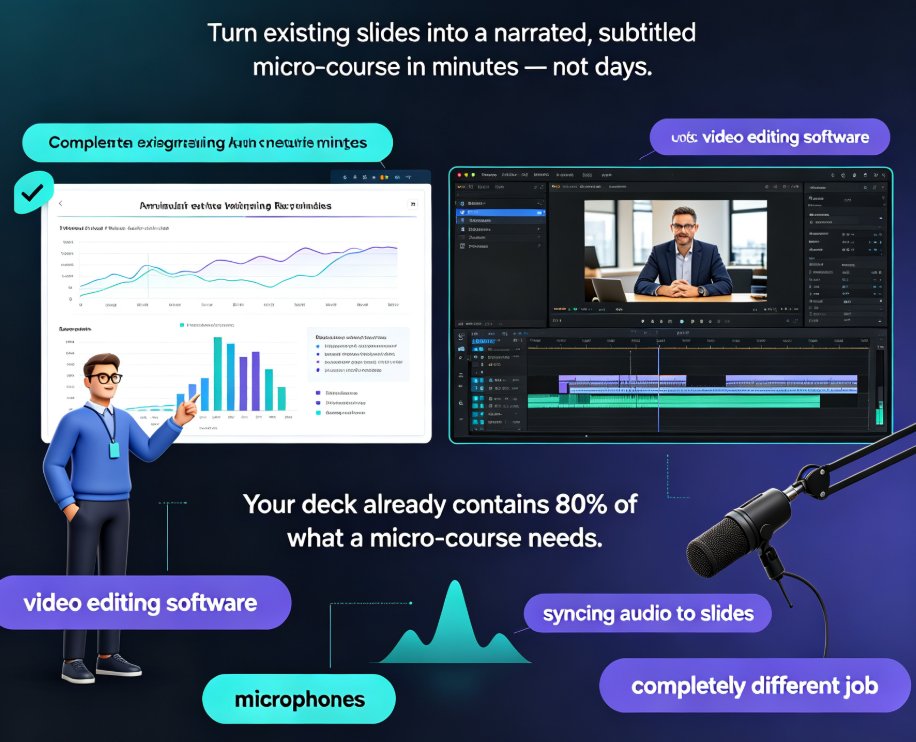
Zendeck's PPT-to-video feature converts slide decks into narrated videos. You upload your slides, add a script or use your existing speaker notes, and Zendeck generates a video with AI voiceover, subtitles, and clean transitions.
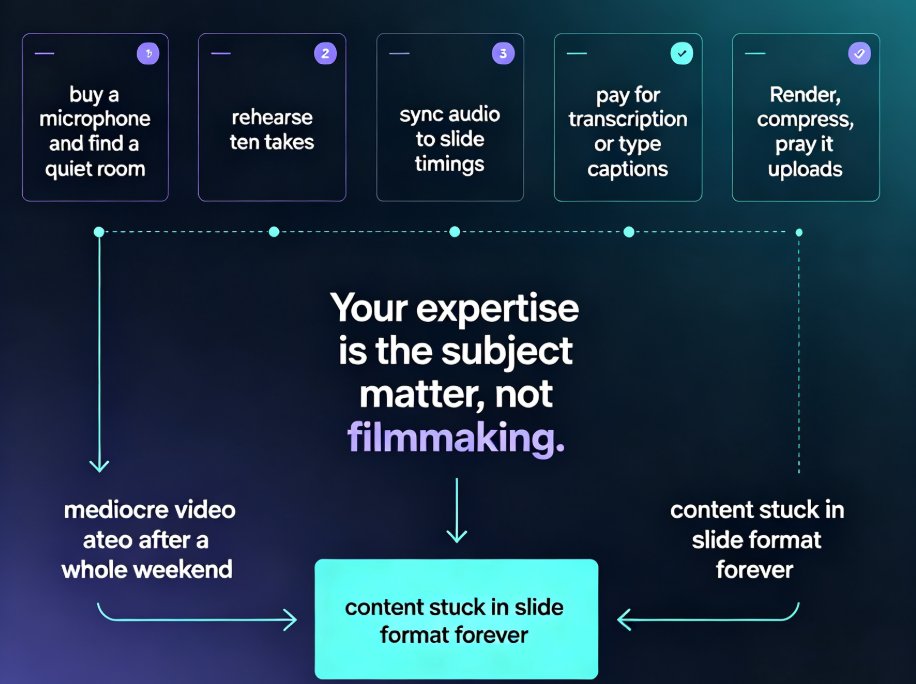
For Maria, this was a game-changer. She didn't need a microphone, a video editor, or hours of free time. She uploaded her existing math and reading decks, pasted her speaker notes as the script, and let Zendeck handle the rest.
What made it work for her students:
- Audio narration for students who can't read the text
- Subtitles for students who process better with text alongside audio
- Consistent pacing — the AI voice reads at a steady, clear speed
- Replayability — students can watch the video as many times as they need
The key insight: accessibility isn't a separate deliverable. It's a byproduct of turning slides into videos with narration and subtitles.
If you want to try this yourself, Zendeck's add narration to slides guide walks through the exact steps. And for the full voiceover-plus-subtitles workflow, check out how to add voiceover and subtitles to your slides.
03 How She Did It: A 20-Minute Workflow
Maria isn't a tech person. She describes herself as "the teacher who still prints emails." So the fact that she figured out Zendeck in one afternoon says something about the tool's learning curve.
Here's her exact workflow:
- Upload the deck — She uploaded her existing PowerPoint files. Zendeck reads the slides, text, and speaker notes.
- Add the script — She pasted her speaker notes into the script field. Zendeck aligned each line with the corresponding slide.
- Pick a voice — She chose a clear, warm English voice. Zendeck offers multiple voices and languages.
- Generate and review — Zendeck rendered the video in minutes. She reviewed it, tweaked a few timings, and re-rendered.
- Share the link — She shared the video link with students and parents. No downloads, no file-size headaches.
Total time: about 20 minutes per lesson. Compare that to the two hours she used to spend recording audio on her phone.
A quick tip from Maria: don't overthink the script. Your existing speaker notes are usually good enough. Just clean them up so they read naturally out loud.
One thing she learned the hard way: keep sentences short. Long, complex sentences sound awkward when spoken aloud by AI. Break them into shorter lines, and the narration flows much better.
04 The Results: 30% Improvement in Quiz Scores
Maria ran a six-week pilot with her special education students. She converted her math and reading lessons into narrated videos and assigned them as supplementary material. Students could watch at home, on tablets, or on the classroom computer during independent work time.
The results:
| Metric | Before Zendeck | After Zendeck | Change |
|---|---|---|---|
| Average quiz score | 62% | 81% | +19 points |
| Homework completion | 54% | 78% | +24 points |
| Parent-reported engagement | 3.2/5 | 4.4/5 | +1.2 |
That's a 30% improvement in quiz scores — from 62% to 81% — over six weeks. Not a controlled study, sure. But for a classroom teacher, that's the kind of result that changes how you teach.
Here's what the score improvement looks like visually:
A 30% improvement in quiz scores isn't magic. It's what happens when students can actually access the material.
The parent feedback was just as telling. One mother of a visually impaired student wrote: "For the first time, my daughter can do her homework without me reading every question to her. She listens to the video and works through it on her own." Another parent said her son with dyslexia watched each lesson three times before the quiz — and got his first A of the year.
05 Why Accessibility Is the New Baseline
Maria's story isn't just heartwarming — it's part of a broader shift. Accessibility in presentations is becoming a compliance requirement, not a nice-to-have. The Web Content Accessibility Guidelines (WCAG) are increasingly applied to educational materials, and schools are under pressure to provide accessible content for all students.
If you're building presentations or course materials, this matters. WCAG compliance is becoming the new trend in presentation design, and tools that support accessible output — like Zendeck — are ahead of the curve.
For Zendeck users specifically, there are practical ways to make your decks more accessible: WCAG tips for Zendeck users covers contrast, alt text, and narration best practices.
The takeaway: if your content isn't accessible, you're not just losing engagement — you're excluding people. And that's no longer acceptable in education or the workplace.
06 Beyond the Classroom: Who Else Needs Narrated Decks?
Maria's use case is special education, but the same workflow applies to:
- Corporate training — employees who prefer audio learning or have reading difficulties
- Compliance training — mandatory courses that need to be accessible to all staff
- Remote onboarding — new hires who need to review materials at their own pace
- Knowledge sharing — turning internal decks into searchable, replayable videos
If you're in L&D or HR, the same principle applies: AI-generated video decks are replacing traditional corporate training because they're cheaper, faster, and more accessible.
And if you're dealing with mandatory training content, the workflow is nearly identical — turning a compliance manual into a video course follows the same upload-script-generate pattern Maria used.
FAQ
Q: Do I need any video editing experience to use Zendeck's PPT-to-video? A: No. Zendeck automates the entire process — you upload slides, add a script, and it generates a narrated video with subtitles. Maria, a self-described non-tech teacher, learned it in one afternoon.
Q: Can I use my own voice instead of AI voiceover? A: Yes. Zendeck supports both AI voice synthesis and recording your own narration. The AI voice is great for quick turnaround, but you can always record your own audio if you prefer a personal touch.
Q: Are the subtitles automatically generated? A: Yes. Zendeck auto-generates subtitles from your script or narration, which is a huge accessibility win for students who process better with text alongside audio.
Q: How long does it take to convert a deck into a video? A: For a typical 10-15 slide lesson, rendering takes just a few minutes. The whole workflow — upload, script, generate, review — takes about 20 minutes per lesson.
Q: Is this useful only for special education? A: Not at all. Narrated video decks help corporate trainers, HR teams, and content creators reach broader audiences. Accessibility benefits everyone, not just students with IEPs.