Micro-Course Production Costs: Zendeck vs. Agency Outsourcing
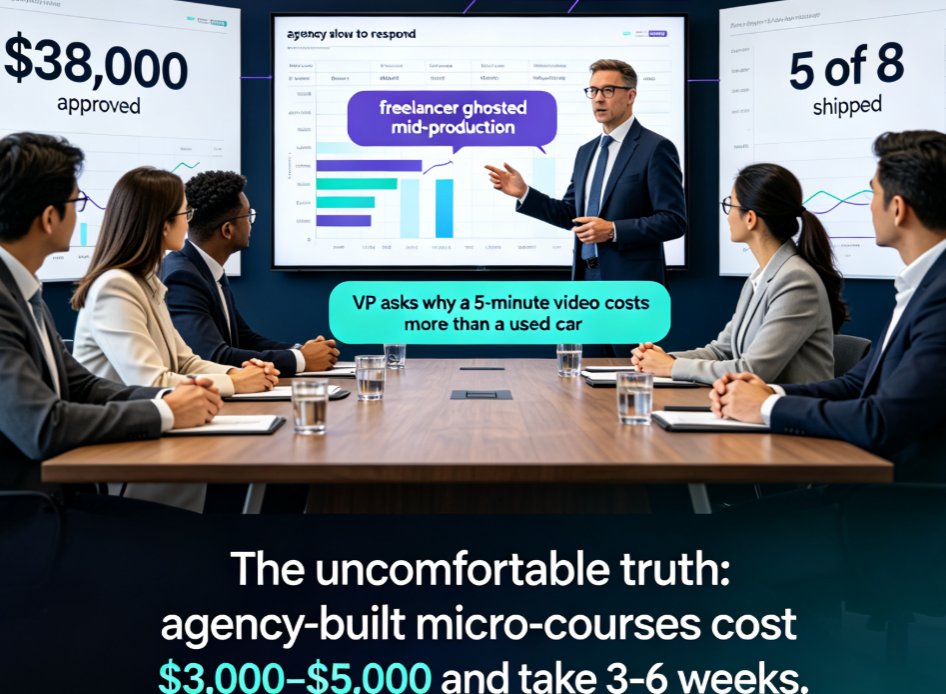
It's Monday morning and you're in a budget review you'd rather skip. The numbers don't lie: you approved $38,000 for eight micro-courses last quarter, and only five have shipped. The agency is great — when they respond. The freelancer you hired for two courses ghosted you mid-production. And the VP just asked, in front of everyone, why a 5-minute training video costs more than a used car.
Here's the uncomfortable truth: the average agency-built micro-course costs between $3,000 and $5,000 and takes three to six weeks to deliver. Producing that same course in-house with Zendeck's AI workflow costs about $35 in tool time and lands in your LMS the same day. You can read that as a bold claim, or you can read it as the budget justification you've been looking for. Let's walk through the math, the quality question, and the one scenario where you genuinely still need outside help.
01 | The agency invoice problem: where the money actually goes
Let's start with the market baseline. Full-service production agencies charge between $800 and $3,800 per person per month for outsourced work, depending on seniority and region (source: Zedtreeo, 2026 cost guide). A typical 5-7 minute micro-course burns one to two weeks of a producer's time, plus a designer, plus a project manager — which is how you land at a $3,000-$5,000 per-course invoice.
And that's just the headline number. The real cost structure is worse than the sticker price, because you're also paying for:
- Discovery meetings. Two kickoff calls, an email thread with eleven people CC'd, and a "creative brief" that restates your own requirements back at you.
- Revision rounds. Agencies typically bundle two revision cycles, then charge $300-$800 for every round after that. Your stakeholders will use them all.
- Project management overhead. Someone needs to coordinate the coordinator. That person's hours are on your invoice.
None of that is fraud — it's just how the agency model works. The deeper problem, though, is structural: a talent shortage that pushes prices up and timelines out. According to Master of Code's 2026 outsourcing research, 72% of organizations report being unable to find the internal talent they need for production work, so they turn to external vendors who know they hold the leverage in every negotiation.
The pain is real, and it compounds. When a single course costs $4,000, you can't afford to iterate. When it takes a month to ship, you can't respond to changing compliance requirements fast enough. And when stakeholders request changes two weeks after launch, you're looking at another invoice — not a quick edit.
02 | What you're really buying (and what AI gives you for free)
Break down any agency-produced micro-course and you'll find the invoice is mostly labor: storyboarding, visual design, voiceover talent, editing, subtitle generation, and file delivery. Each of those steps has a human attached to it, and each human costs money.
Now map those same steps to what Zendeck does automatically:
| Production Step | Agency Cost | Zendeck Workflow |
|---|---|---|
| Storyboarding | $400-$800 | AI structures your Word or Markdown outline into a slide sequence |
| Visual design | $800-$1,500 | Smart layout engine + template library applies consistent design |
| Brand compliance | $200-$500 | Brand kit applies fonts, colors, and logo rules automatically |
| Voiceover | $300-$900 | AI narration or your own recording synced to slides |
| Subtitles | $150-$400 | Auto-generated from your script |
| Revisions | $300-$800/round | Edit text or slides directly, regenerate in minutes |
The difference isn't that AI replaces all expertise — it's that the expertise is now embedded in the tool instead of billed by the hour. Your instructional designer focuses on the learning objectives and script quality, and the production layer takes care of itself. That's a fundamental shift from buying labor to buying a capability.
If you want to see how far the automation goes, the full path from text outline to published video-with-narration is worth understanding — Zendeck's AI agents handle the chain from prompt to finished deck, and we've mapped the entire AI agent course creation workflow here.
03 | Zendeck vs. agency: the hard numbers
The comparison below uses 2026 market rates for agency and freelance production, versus the tool cost of a Zendeck subscription spread across a typical annual catalog of 20 micro-courses. Individual quotes vary, but the magnitude of the difference doesn't.
| Cost Driver | Agency (Full-Service) | Freelance Outsourcing | Zendeck In-House |
|---|---|---|---|
| Per-course cost (5-7 min) | $3,000-$5,000 | $800-$1,500 | $25-$50 (tool share) |
| Onboarding / setup | $2,000-$5,000 retainer | $500-$1,000 | $0 (self-service) |
| Production time | 3-6 weeks | 2-4 weeks | 2-6 hours |
| Revision cost | $300-$800 per round | $150-$400 per round | Included, instant |
| Brand consistency | Extra project mgmt fee | Manual, error-prone | Automated via brand kit |
| 20-course catalog | $60,000-$100,000 | $16,000-$30,000 | $500-$1,000 |
If your catalog has 20 micro-courses, the gap between agency outsourcing and a Zendeck workflow is somewhere between $76,000 and $100,000. That's an entire mid-level L&D salary, or three new training programs, funded by a single tooling decision. The math doesn't reward incremental thinking here — it rewards a workflow switch.
Now, before you call your agency contact in a panic — this is not a blanket condemnation of outsourcing. The right model, as the 2026 hybrid research shows, pairs AI tools with a smaller number of human specialists to get 2-3x productivity at 70-80% of the cost of traditional onshore hiring. You're not eliminating human expertise. You're concentrating it where it matters.
04 | Quality parity: the objection that dies fast
The first pushback you'll hear from stakeholders is "but agencies make things look better." Let's be honest about where that's true and where it's a myth.
Agencies genuinely win on premium motion graphics, live-action video, and bespoke illustration. If your micro-course needs a fully animated 3D explainer with a celebrity voiceover — fine, you need an agency. But for the other 85-90% of corporate training — product updates, compliance refreshers, onboarding modules, soft-skills content — the visual bar is consistency, clarity, and brand alignment. That's exactly what Zendeck's template engine and smart layout system were built to deliver.
Here's what quality actually looks like in the Zendeck workflow:
- Brand kits enforce your fonts, colors, and logo placement on every slide, so a 40-course catalog looks like it came from one design system. We wrote a full playbook on building custom brand kits for consistent decks.
- Auto-generated subtitles and narration handle the accessibility basics that agencies often bill as extras. The PPT-to-video pipeline in Zendeck turns a static deck into a narrated micro-course in one pass.
- Interactive elements — quizzes, charts, clickable sections — lift engagement beyond what a typical passive agency video achieves. You can add interactive quizzes directly to keep learners active.
The quality gap between a good AI-generated course and a mid-tier agency course is now nearly invisible to learners — while the cost gap remains at 100:1. The learners who watch your courses care about clear information, clean visuals, and not being bored. They don't care who rendered the transitions.
05 | Speed, iteration, and the hidden multiplier
Cost per course is the headline, but the hidden multiplier is speed. Agency timelines are measured in sprints; Zendeck timelines are measured in coffee breaks.
Consider a typical compliance update: the legal team sends revised policy language on a Wednesday. With an agency, you're looking at a quote, a scheduling slot next month, and a delivered course in six weeks. With Zendeck, you update the outline, regenerate the deck, re-sync the narration, and push it to the LMS before lunch. The ability to iterate at this speed changes what L&D teams can promise the business — from quarterly catalog pushes to same-day training responses.
Speed also changes how your team works. Instead of a production queue with weeks of lead time, you get a built-in asset library with icons, charts, and illustrations that your instructional designers can mix and match without waiting for a designer's availability. When a stakeholder wants a version of the course with a different emphasis, you don't open a change request — you duplicate the deck and adjust.
And if you're worried about data handling, note that AI courseware security and privacy have become a core requirement in L&D procurement. Check what your vendor does with your content before you push sensitive training materials through it.
06 | The hybrid playbook: when you still hire a human
Let's be realistic. There are projects where agencies remain the right call:
- Flagship, outward-facing content. A launch video for a major product, a keynote-ready investor deck, or a brand campaign — the kind of thing the CEO will scrutinize frame by frame.
- Live-action production. Filming people, locations, and physical props is a genuinely different craft.
- Specialized subject-matter production. Highly regulated industries or deeply technical content where a producer's domain expertise adds real value.
For everything else — the long tail of routine training, updates, and internal enablement — an in-house AI workflow is the financially responsible choice. The search-result data agrees: the highest-ROI approach in 2026 pairs offshore or specialist human talent with AI tools, achieving 2-3x productivity at 70-80% less cost than traditional onshore production. You're not replacing expertise; you're removing it from tasks where it adds no value.
Practical tip if you're making the case to your CFO: run the pilot before the pitch. Take one existing course that cost $4,000 with an agency, rebuild it in Zendeck in an afternoon, and put both versions side by side. Let the finance team do the math on a 20-course annual catalog. The numbers will do the persuasion for you.
FAQ
How much does it cost to produce a micro-course with Zendeck compared to an agency?
A full-service agency typically charges $3,000-$5,000 per 5-7 minute micro-course, plus revision fees. With Zendeck, the tool cost per course drops to roughly $25-$50 when you spread a subscription across a catalog. Production time falls from 3-6 weeks to the same day.
Can AI-generated micro-courses really match agency production quality?
For standard corporate training — slides, narration, subtitles, simple motion — yes. Zendeck's template engine, brand kit system, and smart layout tools produce visually consistent decks that match agency work for most use cases. Agencies still win on complex custom animation, live-action filming, and high-end motion design.
What does the Zendeck micro-course workflow include?
You start from a Word outline or Markdown, generate a structured deck, apply your brand kit, then use the PPT-to-video pipeline to add narration and auto-generated subtitles. Interactive quizzes and charts can be dropped in from the asset library to boost engagement.
When should I still hire an agency instead of using AI?
Keep agencies for flagship content: executive-facing launches, brand-critical campaigns, live-action video, or courses requiring highly specialized subject-matter production. For the other 80-90% of your catalog, an in-house AI workflow is faster and dramatically cheaper.
Is this approach scalable for a 50-course annual catalog?
Yes — that's the main financial argument. At $3,500 average per agency course, 50 courses cost $175,000. The same catalog with Zendeck runs under $2,000 in tool costs, leaving budget for a junior L&D coordinator to manage quality control.