Generic Templates Hurt Your Pitch: Zendeck's Industry Library Wins
Generic Templates Hurt Your Pitch: Zendeck's Industry Library Wins
You're a corporate trainer. You've got a session on compliance coming up, and you open your presentation software. You scroll through the template gallery—the same generic slides you've seen a thousand times. You pick one with a blue gradient and some stock photos. Your audience has seen it too. They've seen it in every other training they've attended. They're already bored.
Generic templates are the enemy of engagement. They don't speak to your audience's context, their challenges, or their industry. They're a one-size-fits-all solution that fits no one.
But what if your templates were designed for your specific scenario? What if they reflected the realities of a hospital, a sales floor, or a classroom? That's where scenario-based learning and industry-specific templates come in.
01. Why Generic Templates Fail
Let's be real: generic templates are the default for a reason. They're safe, they're easy, and they're everywhere. But that's exactly the problem. When your audience sees a template they've seen in a dozen other presentations, they subconsciously tune out. It signals that you didn't invest in understanding their world.
The core issue is relevance. A generic template doesn't know if you're training nurses on patient safety, onboarding new hires at a tech startup, or teaching high school students about financial literacy. It just gives you a placeholder for content.
The result? Disengagement, lower retention, and a presentation that feels like a chore—for you and your audience.
02. What Is Scenario-Based Learning?
Scenario-based learning (SBL) is an instructional strategy that places learners in realistic, context-driven situations. Instead of passively absorbing facts, they make decisions, see consequences, and learn from outcomes. According to eLearning Industry, SBL "presents learners with realistic, context-driven scenarios that mimic actual workplace challenges."
Scenario-based learning outperforms fact-based learning in modern jobs. As Rued Riis points out, "Memorizing a list of facts becomes less and less valuable as a skill, now that computers have taken over much of the memory capability we used to possess." We're training people for complex decision-making, not memorization.
SBL isn't just for high-stakes simulations. It can be as simple as a branching scenario in a slide deck, where learners choose a path and see the consequences. The key is that the content is embedded in a context that feels real.
03. Zendeck's Industry-Specific Template Library
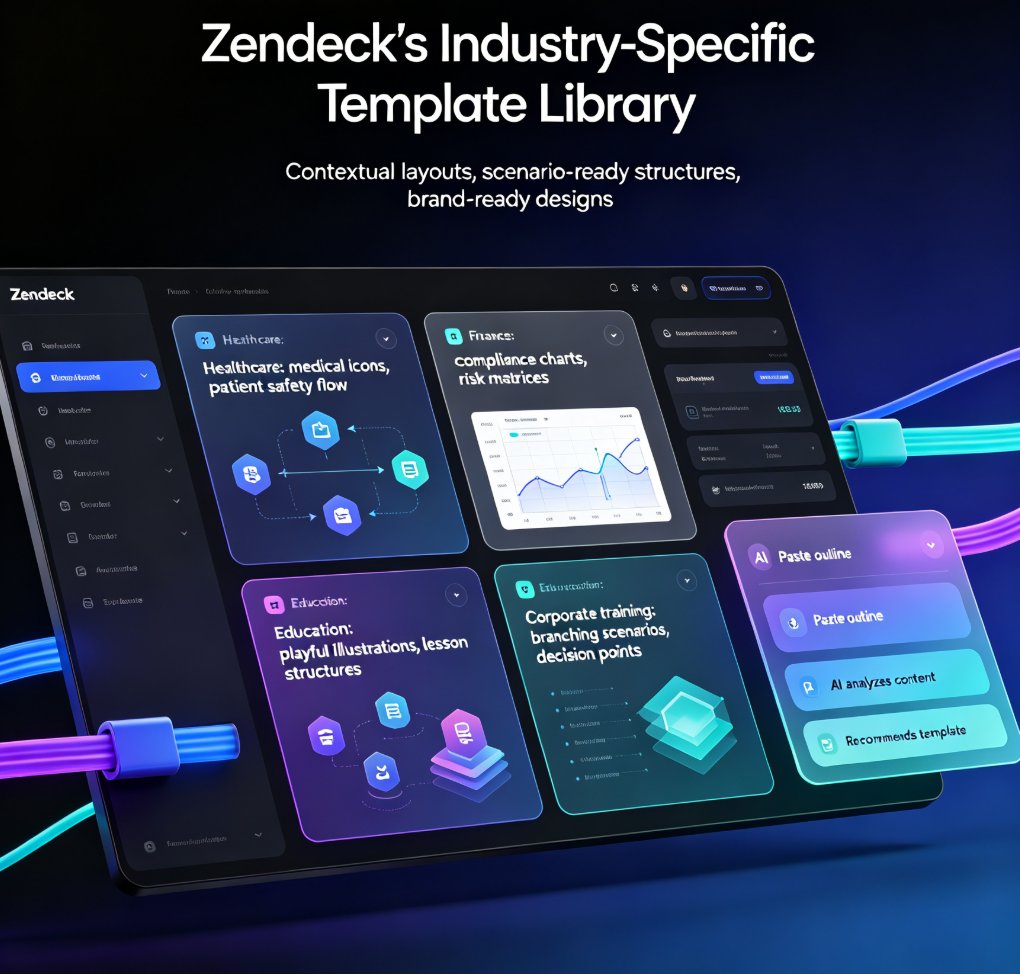
This is where Zendeck changes the game. Zendeck's template library isn't a random collection of pretty slides. It's a curated set of industry-specific, scenario-based templates designed for education, corporate training, and HR.
Zendeck's templates are built for your context, not for everyone. Whether you're creating a compliance training deck for a financial institution, a sales onboarding program, or a classroom lesson on critical thinking, there's a template that matches your scenario.
What makes them different?
- Contextual layouts: Each template is designed with the visual language of your industry—medical icons for healthcare, charts for finance, playful illustrations for education.
- Scenario-ready structures: Many templates include branching scenario layouts, decision points, and outcome slides, so you can build interactive training without starting from scratch.
- Brand consistency: With Zendeck's brand kits, you can apply your company's colors, fonts, and logos across any template, ensuring your deck looks on-brand while staying contextually relevant.
And because Zendeck uses AI, it can even suggest the best template based on your content. You paste in your outline, and Zendeck recommends a template that fits your industry and audience. It's like having a design consultant who knows your field. Check out how Zendeck's AI template selection works.
04. How to Choose the Right Template
Choosing the right template is more than picking a color scheme. It's about matching the template to your learning objectives and audience.
Here's a simple process:
- Define your scenario: What situation are you training for? A customer service conflict? A safety incident? A leadership challenge?
- Identify your audience: Are they new hires, experienced professionals, students? Their level of expertise changes the complexity of the scenario.
- Match the template to the outcome: If you want learners to practice decision-making, look for branching scenario templates. If you're presenting data, choose a template with strong chart layouts.
- Customize with Zendeck: Once you've picked a template, use Zendeck's AI to adjust the tone, add your content, and ensure brand consistency.
Zendeck's AI template selection can help you with step 3. It analyzes your content and suggests the most appropriate template from its library, saving you the guesswork. For more on how templates adapt to industry and audience, see why AI templates now adapt to industry, audience, and tone.
05. Generic vs. Scenario-Based Templates: A Comparison
| Feature | Generic Template | Zendeck Scenario-Based Template |
|---|---|---|
| Context | No industry context | Designed for specific industries (education, healthcare, finance, etc.) |
| Audience relevance | Low—same for everyone | High—speaks to your audience's world |
| Engagement | Passive—learners read slides | Interactive—learners make decisions |
| Learning outcome | Knowledge transfer | Decision-making and skill application |
| Brand alignment | Often off-brand | Fully customizable with brand kits |
| Time to customize | High—you rebuild everything | Low—structure is already there |
| Visual appeal | Generic stock photos | Industry-specific icons and imagery |
The difference is night and day. With a scenario-based template, you're not just presenting information—you're creating an experience.
06. Real-World Impact
The benefits of scenario-based learning are well-documented. According to Rued Riis, "Scenario-Based Learning works better than fact-based learning in most modern jobs." Learners are more engaged, retain more information, and are better prepared to apply their skills in real situations.
When you combine scenario-based learning with industry-specific templates, you get a double win. The template provides the context, and the scenario provides the practice. Your audience sees themselves in the material, which boosts motivation and relevance.
For example, a hospital training team used Zendeck's healthcare templates to create a patient safety scenario. Instead of a bullet-point list of protocols, they built a branching scenario where nurses had to decide how to respond to a medication error. The result? Higher completion rates and better performance in follow-up assessments.
If you're interested in building interactive training, check out our guide on branching scenarios in AI presentations.
07. Tips for Maximizing Your Templates
- Don't just fill in the blanks. Use the scenario structure to create meaningful choices. Add consequences for each decision.
- Incorporate interactive elements. Zendeck's asset library has icons, charts, and illustrations that can make your scenarios more vivid. You can even add interactive charts to your slides.
- Use branching scenarios for deeper learning. If you're training on complex topics, consider building a branching scenario where learners explore multiple paths. Zendeck supports this with its interactive features.
- Keep it visual. Use images and diagrams to reinforce the scenario. A picture of a hospital ward is more effective than a text description.
- Test your deck. Run through the scenario yourself to ensure the logic flows and the outcomes are realistic.
For more on adding interactive charts, see how to add interactive charts to your AI slides.
08. Conclusion
Generic templates are a shortcut, but they're a shortcut to mediocrity. If you want your presentations to resonate, you need templates that speak to your audience's world. Zendeck's industry-specific, scenario-based template library gives you the relevance and impact you need—without the design headache.
Stop settling for generic. Start creating scenarios that matter. Explore Zendeck's template library today and see the difference for yourself. For more insights on courseware design, visit our courseware design category.
FAQ
What is scenario-based learning? Scenario-based learning is an instructional strategy that places learners in realistic, context-driven situations where they make decisions and see outcomes. It promotes experiential learning and is more effective than passive fact-based learning for modern jobs.
How does Zendeck's template library differ from generic templates? Zendeck's templates are curated for specific industries and scenarios, such as education, corporate training, and HR. They include contextual layouts, scenario-ready structures, and brand customization options, making them more relevant and engaging than generic templates.
Can I customize Zendeck's industry templates? Yes. Zendeck allows you to fully customize any template using its AI tools and brand kits. You can adjust colors, fonts, content, and even add interactive elements to match your specific needs.
Do scenario-based templates really improve engagement? Yes. Research and industry practice show that scenario-based learning increases engagement and retention because learners are actively involved in decision-making. When combined with industry-specific visuals, the effect is even stronger.
How do I choose the right template for my training? Start by defining your scenario and audience. Then, use Zendeck's AI template selection to get a recommendation based on your content. You can also manually browse the library by industry or use case.