Word to PPT Import Breaking Layout? Zendeck Fixes It in One Click
Here's the scene: it's 4:47 PM on a Thursday, and you've just put the finishing touches on a 30-page Word report. Your manager wants it as a presentation by tomorrow morning. You copy the first section, paste it into PowerPoint, and watch the formatting collapse like a house of cards. Headings shrink to random sizes. Tables spill off the slide edge. Bullet points nest three levels deep for no reason at all. You've been here before, and you know exactly what's coming: two hours of manual cleanup.
The real problem isn't your document. It's that most Word-to-PPT tools treat conversion as copy-paste with extra steps. They don't read your document's structure — they just dump text onto slides and call it a day.
That's the gap Zendeck's AI-driven Word import was built to close. Instead of reformatting your content, it rebuilds it: it reads the outline, extracts the core message, and generates clean, branded slides that actually look designed. No layout surgery required.
01. The Word-to-PPT Nightmare We All Know
Let's be honest about what happens when you use Word's built-in export or a free online converter. You drag in your .docx file, hit convert, and get back something that looks like a text file wearing a PowerPoint costume. Headings become slide titles, but everything else — body text, tables, images — gets dumped in whatever order the parser happens to read it.
The pain points are predictable:
- Tables break. Columns misalign, rows get cut off, and numbers end up floating in white space.
- Images disappear or stretch. That carefully placed chart? It's now the size of a postage stamp — or blown up to fill the entire slide.
- Tracked changes create chaos. If your document went through review cycles, the converter doesn't know what to do with insertions and deletions.
- Bullet hierarchy collapses. A three-level outline becomes a wall of identical dots.
The outcome? You spend more time fixing the deck than you would have spent building it from scratch. That's not conversion — that's a tax on your afternoon.
02. Why Word's Built-In Export Fails You
Word's native "export to PowerPoint" feature sounds convenient, but it has a fundamental limitation: it maps headings to slide titles and calls it a day. It doesn't rewrite your content into slide-sized chunks, it doesn't handle tables gracefully, and it certainly doesn't apply any design thinking.
Here's what actually happens with each approach:
| What you get | Word built-in export | Free online converters | Zendeck AI import |
|---|---|---|---|
| Reads document structure | Partial — headings only | Rarely | Yes — full outline extraction |
| Rewrites content into slide copy | No | No | Yes |
| Handles tables and images | Text-only files only | Often breaks | Yes, rebuilt cleanly |
| Applies your branding | Generic themes | No | Logo, colors, fonts on every slide |
| Editable output | Yes | Often images or watermarked | Yes, fully editable |
| Time to a usable deck | 3–4 hours of fixes | 2–3 hours of fixes | Under 10 minutes |
The core issue is that Word's export and most free converters are format-shifters, not content designers. They move text from one container to another without asking whether it makes sense on a slide. A slide isn't a page — it needs one idea, one visual anchor, and minimal text. That's a design decision, not a formatting one.
03. What Zendeck Does Differently: Structure-First Conversion
Zendeck's approach starts where the others stop: it actually reads your document. When you upload a Word file, the AI dissects the structure — headings, subheadings, paragraphs, tables, key data points — and maps them into presentation logic. It identifies the core message of each section, surfaces the supporting data, and decides what belongs on each slide.
This is the difference between reformatting and rebuilding. Zendeck doesn't just move your text; it transforms it. A dense 500-word section becomes three slides with clear headings, concise bullet points, and a visual anchor. A data-heavy table becomes a clean chart. A long narrative becomes a logical flow that your audience can actually follow.
The result is a deck that looks like a designer built it — because the AI is applying design principles, not just text placement. And since it's all editable, you keep full control. If you want to tweak a slide, swap an image, or adjust the layout, you can do it directly in the editor. Can I manually edit AI-generated slides in Zendeck? Yes, here's how
04. The One-Click Workflow: From Word to Deck in Five Steps
Let's walk through the actual process, because "one click" is only useful if the steps around it are painless too.
Step 1: Upload your Word file. Drag in your .doc or .docx. Reports, proposals, SOPs, business plans, courseware — any Word document works. If you have a PDF instead, the platform handles that too.
Step 2: Set your preferences. Tell the AI how many slides you want, what language, and who the audience is. This shapes both content depth and visual style. A boardroom deck gets a different treatment than a training course.
Step 3: Generate. Click convert. The AI dissects your document, extracts core messages, surfaces supporting data, and maps everything into slide logic. This is where the magic happens — no reformatting, just rebuilding.
Step 4: Preview and polish. View the deck immediately in slideshow mode. Clean, editable slides with logical sections, smooth transitions, and emphasized key points. No paragraph dumps. If something needs adjusting, tweak it right in the editor.
Step 5: Share anywhere. Export as .pptx, share a link, or turn it into a narrated video for training. Turn your deck into a narrated video
05. Zendeck vs. the Alternatives: The Numbers Don't Lie
To put this in perspective, let's look at the time cost. For a typical 40-page report that needs to become a 25–30 slide deck:
If you convert Word documents to slides more than once a month, the time savings alone justify switching to an AI-driven approach. At six hours saved per conversion, that's roughly 72 hours a year — nearly two full work weeks.
06. Brand Consistency Without the Manual Grind
Here's another thing that breaks during manual conversion: your brand. When you copy-paste from Word, you inherit whatever formatting the document had — which is usually a mix of five different fonts and three shades of blue that someone added over the years.
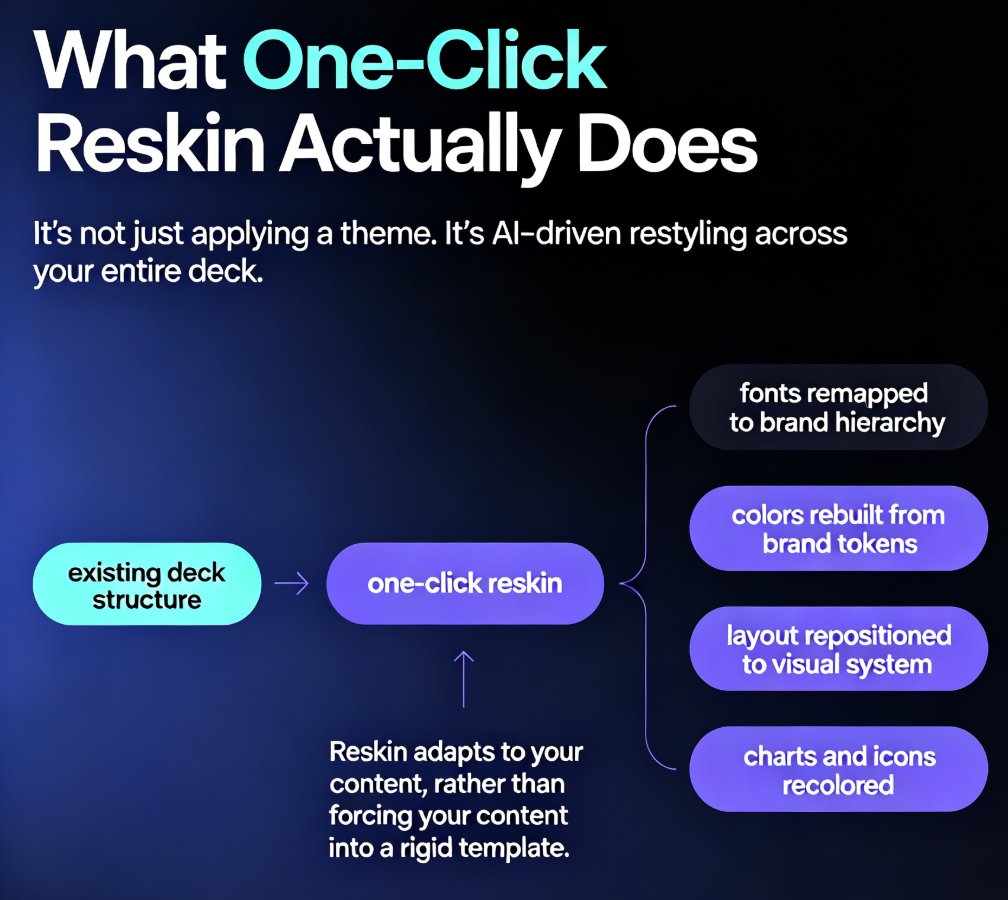
Zendeck solves this with brand kits. Set up your logo, colors, and fonts once, and every generated deck follows the same rules. No more hunting for the right hex code or manually adjusting every title to match your template. How to set up brand kits in Zendeck
This matters more than you might think. Inconsistent branding isn't just an aesthetic issue — it erodes trust. When every slide looks like it came from a different department, your audience spends mental energy on the formatting instead of your message. A unified deck signals that you've got your act together.
07. Where Word-to-PPT Saves You the Most
Some use cases benefit more than others. Here's where the time savings really add up:
- Courseware and training materials. Converting a training manual into a slide deck used to take a full afternoon. With AI, it's a coffee break. Explore AI courseware workflows
- SOPs and compliance documents. These are dense, structured, and full of tables — exactly the kind of content that breaks in traditional converters.
- Business reports and proposals. Monthly reports, quarterly reviews, pitch documents — all of them follow the same pattern: Word in, deck out.
- Conference talks and keynotes. If you've written your talk as a Word document, you can turn it into a visual deck without starting from zero.
The common thread? Structured documents with clear headings convert beautifully. And if your document is more of a brain dump, the AI can handle that too — just paste it in and let it organize the content into a logical flow. How to turn a brain dump into a structured presentation
FAQ
Q: Does Zendeck support both .doc and .docx files?
A: Yes. Zendeck's Word import accepts .doc, .docx, and even PDF files. The AI reads the structure regardless of format, so you get the same clean conversion whether your document is old-school .doc or modern .docx.
Q: What happens to tables, images, and tracked changes in my Word document?
A: Zendeck handles all of them. Tables are rebuilt as clean, readable layouts; images and charts are placed sensibly; and tracked changes are resolved into final content. The AI doesn't just preserve these elements — it redesigns them to fit slide format.
Q: Can I edit the slides after Zendeck generates them?
A: Absolutely. Every slide is fully editable in Zendeck's built-in editor. You can swap text, change images, adjust layouts, add slides, or fine-tune anything else. The AI gives you a strong starting point, but you keep complete control.
Q: Can I apply my company's brand colors and fonts automatically?
A: Yes. Set up a brand kit with your logo, colors, and fonts, and Zendeck applies them to every generated deck automatically. This ensures consistency across all your presentations without manual formatting.
Q: How long does the conversion actually take?
A: For a typical 30–40 page document, the AI generates a complete deck in under ten minutes. Most of that time is the AI processing — your actual involvement is just uploading the file and clicking convert.