From PDF to Polished Deck: Zendeck OCR Document Import Workflow
You've got a 40-page PDF report sitting on your desk, and your boss wants a 10-slide deck by lunch. Sound familiar? Copy-pasting text, reformatting tables, and hunting for the right chart is a grind that eats your morning. But what if you could turn that PDF into a polished presentation in minutes? That's exactly what Zendeck's OCR document import workflow does.
Let's be real: most of us have been there. You open a PDF, highlight a paragraph, paste it into a slide, then spend ten minutes fixing the alignment. Repeat that twenty times, and you've lost half your day. The problem isn't the content—it's the manual labor. Zendeck's OCR changes the game by reading your document, extracting the key information, and turning it into a structured, visually consistent deck. Here's how it works and why you'll never go back to copy-paste again.
01 Why OCR Is the Missing Link in Presentation Creation
Manual document-to-deck conversion eats up to 60% of your prep time—and most of it is wasted on formatting, not thinking.
Think about the last time you built a presentation from a report. You probably spent more time wrestling with text boxes and bullet points than actually analyzing the data. That's because traditional workflows force you to be a designer, a copy editor, and a data analyst all at once. OCR (Optical Character Recognition) changes the equation by automating the extraction and structuring of content.
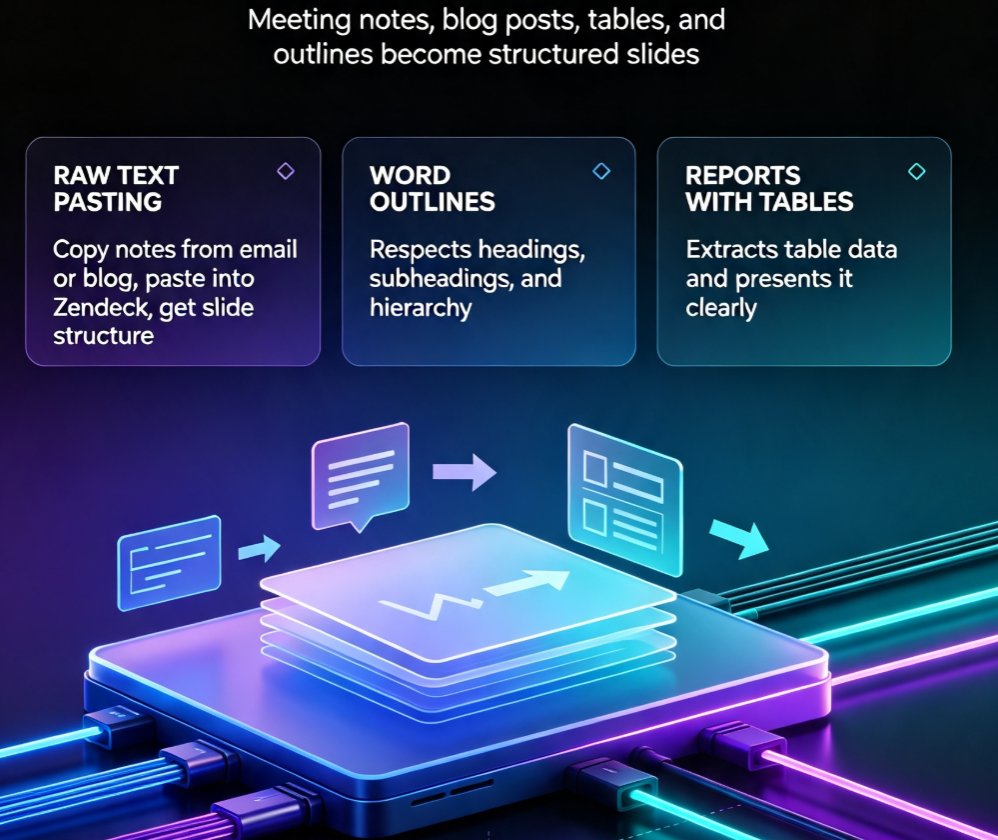
When you upload a PDF to Zendeck, the OCR engine doesn't just scan the text—it understands the hierarchy. Headings become slide titles, paragraphs become bullet points, and tables become clean data visualizations. The result? You skip the busywork and jump straight to refining your message. For anyone who regularly converts reports, whitepapers, or meeting notes into presentations, this is a massive productivity boost.
02 Step-by-Step: Importing a PDF into Zendeck
The process is surprisingly simple. Here's the exact workflow I use every time:
- Upload your document – Drag and drop your PDF, image, or even a scanned file into Zendeck. The platform accepts multiple formats, so you're not locked into one file type.
- Let OCR do its magic – Zendeck's OCR reads the document, extracts text, and identifies structural elements like headings, lists, and tables. It even handles low-quality scans with rotated or skewed text—no need to pre-clean your files.
- Review the extracted content – You'll see a preview of the text and structure that Zendeck pulled out. This is your chance to catch any errors or adjust the hierarchy before generating slides.
- Generate your deck – One click and Zendeck's AI turns the extracted content into a polished presentation. You can choose from a template library or apply your brand kit for a consistent look.
- Edit and refine – The generated slides are fully editable. Tweak the wording, swap images, or add interactive charts from the asset library. You're in control.
That's it. From raw PDF to presentation-ready deck in under five minutes. No more copy-paste marathons.
03 What Zendeck's OCR Does Behind the Scenes
Zendeck's OCR doesn't just read text—it understands structure, so tables, lists, and headings survive the journey.
Here's what happens under the hood when you upload a document:
- Multi-format support – PDF, PNG, JPEG, TIFF, BMP, and even Excel files are all fair game. You can import almost anything.
- Layout preservation – Tables, columns, and visual structure are maintained. Your data doesn't get scrambled into a wall of text.
- Entity detection – Names, dates, amounts, and other key fields are automatically recognized. This is a lifesaver for financial reports or client-facing documents.
- Handwriting transcription – Got handwritten notes or signatures? Zendeck can convert them into editable text, so you're not stuck with unreadable scans.
- 70+ languages – Global teams can work with documents in multiple languages without missing a beat.
These features mean you're not just getting a text dump—you're getting a structured, machine-readable version of your document that's ready for presentation. The AI then takes that structure and builds slides that flow logically, with proper visual hierarchy.
04 From Raw Text to Polished Deck: How Zendeck Structures Your Content
Once the OCR extracts your content, Zendeck's AI takes over. It analyzes the text, identifies the key points, and organizes them into a narrative arc. This isn't just a random collection of slides—it's a deck with a clear beginning, middle, and end.
For example, if you upload a quarterly business report, Zendeck will automatically group revenue figures into a chart, highlight the top takeaways, and create a summary slide. If you're working with a technical whitepaper, it'll break down complex concepts into digestible bullet points. The AI even suggests visual elements like icons and charts from the asset library to make your deck more engaging.
This is where Zendeck shines. It's not just about converting text—it's about transforming raw information into a compelling story. And because the AI understands your brand kit, every slide stays on-brand without you lifting a finger. If you're curious about how AI can turn a brain dump into a structured presentation, check out our guide on brain dump to structured presentation.
05 Tips for Getting the Best OCR Results
While Zendeck's OCR is robust, a little preparation goes a long way. Here are some tips I've picked up:
- Use clean, high-resolution scans – If you're scanning a physical document, make sure the text is sharp and the page isn't folded. This helps the OCR read accurately.
- Avoid heavy watermarks – Watermarks can confuse the OCR, especially if they overlap text. If possible, use a clean version.
- Check the preview – After OCR extraction, always review the text preview. It's easier to fix errors at this stage than after the slides are generated.
- Leverage the brand kit – Apply your brand kit before generating slides to ensure consistency. Zendeck's AI will automatically use your fonts, colors, and logo.
These small steps ensure you get the best possible output. And if you ever need to fix something manually, Zendeck gives you full control—you can edit any slide after generation. For more on that, see our article on manually editing AI-generated slides.
06 Manual vs Zendeck: A Side-by-Side Comparison
Let's put the numbers on the table. Here's a typical scenario: converting a 20-page PDF report into a 10-slide presentation.
| Task | Manual Workflow | Zendeck OCR Workflow |
|---|---|---|
| Text extraction | 30 min (copy-paste) | 1 min (automatic) |
| Formatting & layout | 45 min (adjusting text boxes) | 2 min (AI-designed slides) |
| Data visualization | 20 min (creating charts) | 3 min (auto-generated charts) |
| Brand consistency | 15 min (matching fonts/colors) | 0 min (brand kit applied) |
| Total time | 110 minutes | 6 minutes |
That's a 95% reduction in time—and you get a more polished result. The chart below visualizes the difference:
The takeaway? Zendeck doesn't just save you time—it frees you to focus on the strategic thinking that actually moves the needle.
FAQ
What file formats does Zendeck's OCR support for document import?
Zendeck's OCR supports a wide range of formats including PDF, PNG, JPEG, TIFF, and BMP. It can read both digital and scanned documents, and even handles low-quality scans with rotated or skewed text. This means you can import almost any document and have it converted into editable slide content.
Can Zendeck preserve the layout of tables and columns from my PDF?
Yes. Zendeck's OCR is designed to preserve the visual structure of your source document. Tables, columns, and lists are recognized and carried over into the slide layout, so you don't lose the logical organization of your data. This is especially useful for financial reports, research papers, and technical documents.
How long does it take to convert a PDF to a presentation in Zendeck?
The entire workflow—uploading, OCR processing, and AI slide generation—typically takes under five minutes for a standard 20-page document. The exact time depends on the file size and complexity, but you'll save at least 80% of the time you'd spend manually copying and formatting content.
Can I edit the slides after Zendeck generates them from my PDF?
Absolutely. Zendeck gives you full control over the generated slides. You can manually edit text, swap images, adjust layouts, and apply your brand kit. The AI does the heavy lifting, but you have the final say on every element. Check out our guide on manual editing for more details.
Does Zendeck's OCR work with handwritten notes or signatures?
Yes, Zendeck's OCR includes handwriting transcription capabilities. It can convert handwritten notes, forms, and signatures into editable text. This is a game-changer if you're working with meeting notes, feedback forms, or legacy documents that were never digitized.
Ready to stop copy-pasting and start presenting? Try Zendeck's OCR document import today and see how quickly a PDF becomes a polished deck. For more workflow ideas, explore our PPT tutorial category or learn how to turn a blog post into a slide deck. Your next presentation is just a drag-and-drop away.