Can Zendeck Generate an Investor-Ready Pitch Deck from a Text Prompt?
Thursday afternoon, a term sheet conversation on Tuesday, and your "pitch deck" is a title slide with a tagline you've been polishing for a week. The other ten slides are a blank grid waiting to happen. Sound familiar? Founders are brilliant at the product and genuinely lost when it comes to the deck that has to win the money.
That is the exact question I keep hearing from early-stage teams: can an AI tool actually produce a pitch deck I'd be willing to show an investor? So this week I took Zendeck on a real test — not a marketing demo. A plain-text outline, the kind you'd type into a notes app at 11pm, fed straight into its prompt-to-deck pipeline. Here's what actually happened.
01. First, let's define "investor-ready" — because almost nobody agrees on it
Every investor I've ever sat across from has a three-minute skim ritual: cover, problem, solution, traction, ask. If those five things aren't findable inside 60 seconds, the rest of your deck is wallpaper. Your beautiful timeline slide may as well not exist.
The good news? The expected structure barely varies across funds, stages, or industries. Fundraising guides and AI deck generators alike converge on a familiar spine: cover, problem, solution, market size, product, business model, traction, competition, team, financials, and the ask. Most successful decks land at 10–15 slides — long enough to carry the story, short enough to survive the skim. The same structure powers tools like TextDeck and presentations.ai, both of which generate a 10–14 slide deck from a single prompt.
A pitch deck isn't a design project. It's a communication protocol with an 11-slide grammar — and you should judge any AI pitch tool against that grammar, not against how pretty the slides look.
So my test had a simple bar: does Zendeck follow the protocol without me micromanaging every section? Not "does it make something colorful," but does it know where traction goes and why the ask closes the deck.
02. The test: a sleepy text outline in, a structured deck out
I wrote a deliberately mediocre outline — the kind founders actually draft in a hurry, not the polished case study version:
Problem: It takes founders weeks to source warm intro leads.
Solution: A referral network that matches startups with investors.
Market: B2B SaaS, seed stage, 2025.
Traction: 40 pilot teams, 3 paying, NPS 61.
Team: Two ex-ops operators.
Ask: 1.2M raise.
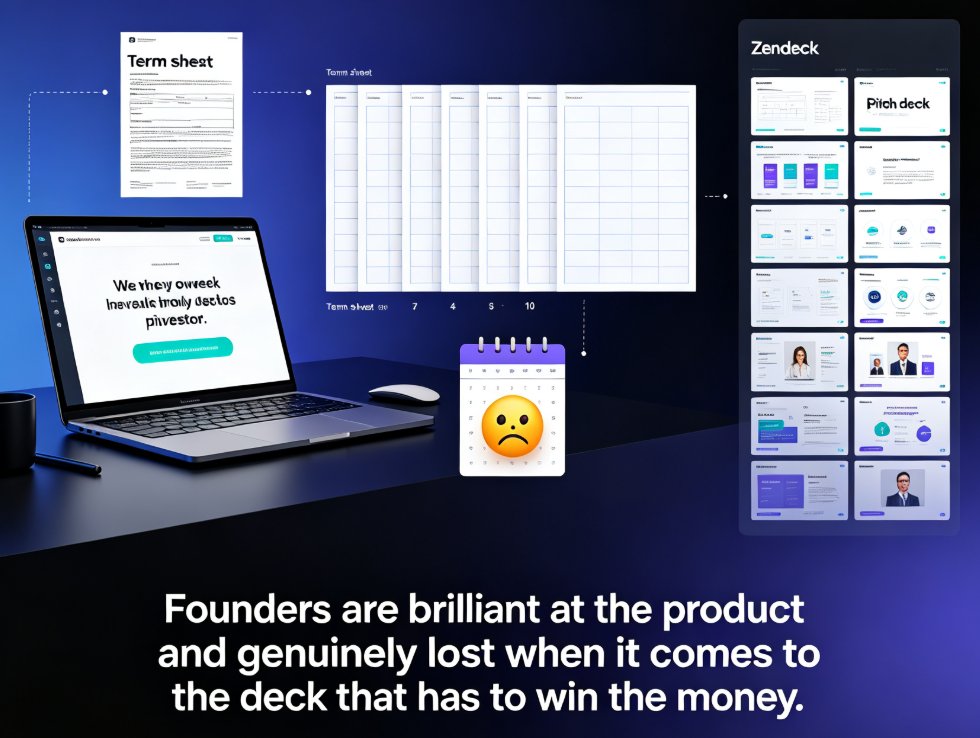
Zendeck takes a Word outline or pasted Markdown/TXT and generates a structured deck, applying its smart layout system automatically. Within about a minute I had a first draft with the standard pitch sequence in place. No blank slides, no staring matches over what belongs on each page, no font decisions made at 1am.
The part that genuinely surprised me: most AI deck tools drop you into a rigid template grid. Zendeck does what I'd call context-aware structure — it reads each outline block and maps it to the section it belongs to, then reskins the whole deck into one consistent visual system. That's part of the broader shift I've been tracking, where AI deck tools are moving beyond templates into context-aware design. Worth a read if you're tired of fighting template constraints.
03. What actually landed — running the output against the investor checklist
I ran the generated deck against the standard investor checklist, slide by slide, and graded honestly. Here's the breakdown:
| Investor expects | Zendeck's first draft | What I had to touch |
|---|---|---|
| Clear problem slide | Generated from my outline's problem block | Tightened the one-liner to one sentence |
| Solution + demo framing | Structured as a slide with layout applied | Added a product screenshot |
| TAM/SAM/SOM market size | Section generated with placeholder space | Dropped in a chart from the asset library |
| Business model | Slide created from outline | Refined the pricing line |
| Traction / metrics | Generated with room for KPIs | Pasted real numbers |
| Competition matrix | Slide + suggested layout | Filled in competitor names |
| Team credibility | Slide with photo placeholders | Added headshots |
| The Ask | Final slide generated | Specified the round size and use of funds |
In about 45 minutes total, I had a 13-slide deck that followed the investor protocol, used one consistent visual system, and required zero design work from me. The structure question — is this an investor deck? — was answered yes in the first 60 seconds. The finish question was a different story, and that's the honest part of this review.
If you want a step-by-step on the whole pipeline mechanics, I covered the full prompt-to-deck workflow in a separate guide.
04. Where AI still hands the work back to you
Let's be real: an AI-generated pitch deck gets you to the table; it doesn't close the room. Zendeck won't know that your seed VC cares about market size, your angel cares about your founding story, and your strategic investor cares about synergies. You'll still adapt the narrative per meeting. That's not a bug; that's the actual job of fundraising.
Where Zendeck earns its keep is compressing the revision loop. One-click reskin keeps fonts, colors, and layout unified after you swap blocks, so nothing breaks when someone pastes in a 6pt paragraph. Data slides are painless too — the asset library has charts you can drop straight onto your TAM/SAM/SOM numbers without opening a separate analytics tool. And when you finally rehearse, the PPT-to-video pipeline can turn the deck into a narrated walkthrough, so you practice telling the story instead of rereading bullets on a screen.
Founders who use AI decks well treat the first draft as a rehearseable foundation, not a deliverable. The unfixable 20 percent — your story, your numbers, your ask — is exactly the part no tool can fake.
For teams building pitch variants across multiple partners, a custom brand kit keeps every version visually on-brand while you swap messaging per audience. Export to PPTX, adjust for the VC, the angel, and the strategic, and you're done.
05. The 45-minute workflow I'd hand any founder
Here's the exact sequence I used, timed from a real session:
- Paste your outline into Zendeck — 5 minutes. Raw notes are fine; the AI sorts the structure.
- Generate and review the section order — 10 minutes. Move blocks if the outline was messy.
- Sharpen each slide's story — 15 minutes. One idea per slide, cut the rest.
- Drop in charts and data — 10 minutes. Real numbers beat placeholders every time.
- Reskin, export PPTX, build investor variants — 5 minutes. One deck, three versions.
FAQ
Can Zendeck build a pitch deck from just a text prompt?
Yes. Paste a plain-text or Markdown outline into Zendeck and it generates a structured first draft that follows the standard investor pitch sequence — problem, solution, market, product, traction, team, and the ask. Your job shifts from creating everything from nothing to refining and personalizing a professional foundation.
How many slides should an investor pitch deck be?
Most successful pitch decks are 10 to 15 slides, and Zendeck generates a standard 10-14 slide structure you can expand or trim based on the meeting context. That is long enough to carry the story and short enough to survive an investor's three-minute skim.
Can I customize the same Zendeck deck for different investors?
Yes. Export to PPTX and adjust for each meeting — VCs care about market size, angels care about the team, strategics care about synergies. Zendeck's one-click reskin keeps fonts, colors, and layout consistent while you swap the narrative per audience.
Does Zendeck handle financial projections and charts in a pitch deck?
Yes. The asset library includes charts, icons, and data visualizations you can drop into TAM/SAM/SOM and financial projection slides. Pasting real numbers into the AI-generated placeholders takes minutes instead of a design session.
Do I still need a designer after using an AI pitch deck tool?
Probably not for the visual layer — Zendeck handles layout, fonts, color, and consistency. But the story, the numbers, and investor-specific messaging are on you. AI gives you a rehearseable foundation; you still have to close the room.
If you're about to build your first fundraise deck, start with the full AI pitch deck guide, then come back here and copy the 45-minute workflow. The deck won't raise the round by itself — but it will get you to the conversation faster than any design tool ever could.