AI Presentation Market Soars to $54B: 2026 Trends for Content Teams
The Sunday-night deck ritual is dying — and the market data proves it.
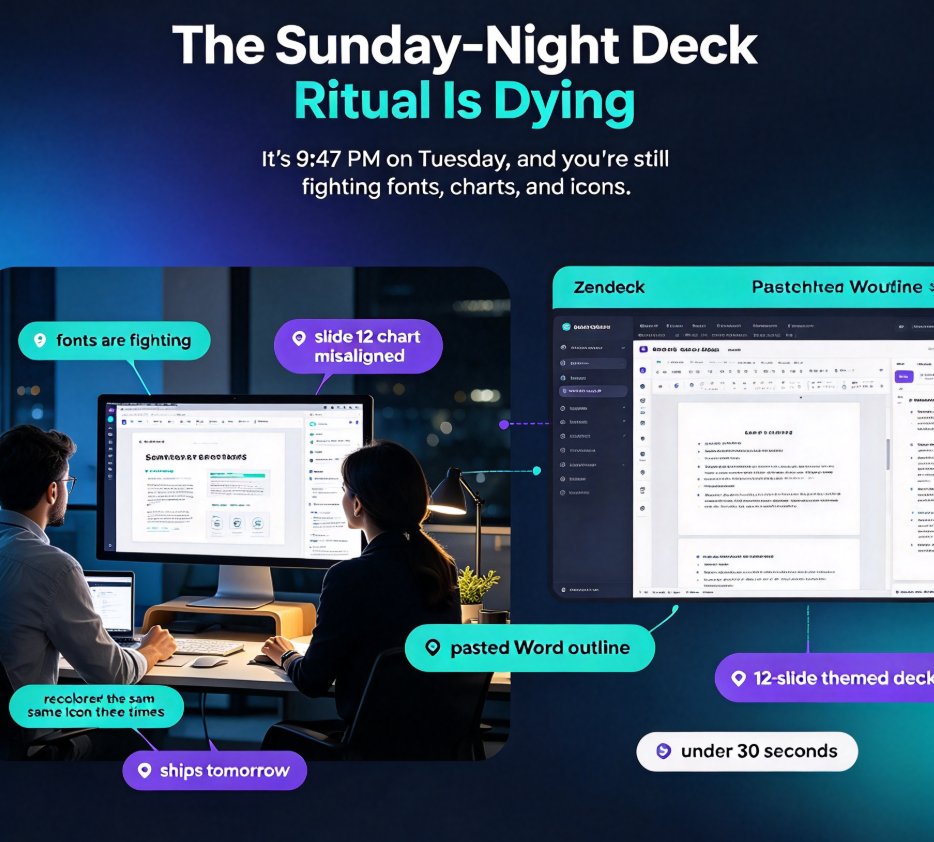
It's 9:47 p.m. on a Tuesday, and you're on slide nine of a 24-slide deck that ships tomorrow. The fonts are fighting each other, the chart on slide 12 is misaligned, and you've recolored the same icon three times. You tell yourself this is just how content work goes.
Except it isn't anymore. The ground beneath content teams shifted hard this year, and the numbers are impossible to ignore.
01 The market just crossed a line — and it's accelerating
Let's start with the numbers, because they set the tone for everything else.
According to industry data, AI presentation tools now generate an estimated 47 million business decks every month globally, up from roughly 11 million in 2024. That's a four-fold jump in two years. The market itself reached $4.7 billion in annual revenue in 2026 — a 52% year-over-year increase from $3.1 billion in 2025.
Volume is only half the story. Enterprise adoption has crossed 60% for the first time, with mid-market companies leading at 68%. When you break it down by vertical, the fastest movers are exactly who you'd expect: consulting, education, and SaaS, all sitting above 75% adoption.
The analysts put it bluntly: "The question is no longer whether AI can make good presentations. It is whether your organization can afford to make them any other way."
What's behind the jump? It's not that people suddenly got lazier. It's that the tools stopped being a novelty and became the default production line for teams that ship weekly content.
02 The paradigm flip: from assistant to creator
This is the shift everyone's talking about, and it's more than marketing.
For the past few years, "AI presentation" meant a prompt-and-edit loop: type a topic, get a draft outline, then spend an hour fixing layouts, swapping templates, and nudging text around. The AI was your assistant; you were still the operator.
In 2026, that model flipped. The dominant paradigm is now the autonomous presentation agent — an AI that researches, outlines, designs, and exports a complete deck without step-by-step prompting. We covered this evolution in AI Presentation Agents: How Autonomous Decks Reshape Workflows in 2026, and the numbers back it up: API and MCP integrations now account for 31% of all AI-generated presentations, up from just 8% in 2024. Businesses aren't opening a tool and clicking around anymore — they're embedding slide generation directly into their internal workflows.
The result is almost absurdly fast. Leading platforms now average 22 seconds to produce a complete 12-slide deck, including template matching.
The arc here is simple: what used to take a designer a day now takes a machine half a minute. What used to require a design system now requires a single document outline.
03 What this means for educators, trainers, and content operators
Let's make this concrete for the people this actually affects day to day.
For educators, trainers, and content operators, deck production has historically been the silent time-sink — the hours stolen from actual teaching, actual course design, actual strategy. The adoption data reflects that pain: education and training verticals are already above that 75% mark, and it's not hard to see why.
Think about a typical training team. They maintain a dozen courses, each needing updates every quarter. Under the old model, that's a full-time job just for slides — re-aligning layouts, re-applying brand colors, regenerating charts, exporting in multiple formats. Under the agentic model, the same team pastes an updated Word outline, the system generates the deck in under 30 seconds, applies the brand kit, and the team spends its time reviewing content instead of re-drawing boxes.
The shift also changes what "production" means. A deck is no longer the end of the line — it's a stepping stone to a full micro-course. Tools like AI PPT-to-video turn that same slide deck into a narrated video, which is rapidly becoming the 2026 standard for corporate training. For those building entire course libraries, the bigger picture is covered in agentic AI in education: autonomous workflows are reshaping everything from outline to published course.
04 The full-stack answer: outline → slides → narrated video
So what's the practical response to all this market motion?
The platforms winning in 2026 aren't the ones with the biggest template library. They're the ones that connect the whole production chain. That's the philosophy behind Zendeck's full-stack workflow: you start with a Word outline or raw Markdown, and the system generates a structured, visually consistent deck. One click re-skins it to your brand. Then the same deck becomes a narrated micro-course via PPT-to-video.
The winning workflow in 2026 is a single continuous line: document → deck → video — not three separate tools and three separate round-trips.
This matters for a specific reason tied to the market data: speed is no longer the differentiator — 22 seconds is table stakes. What separates teams is how far the pipeline goes. Can the deck become a video? Can the video get auto-generated subtitles? Can quizzes and polls be dropped in without touching a designer?
Zendeck's answer is yes to all of the above, which is why it lands naturally in our AI courseware category. You don't need design skills. You need an outline and a willingness to let the machine do the layout work.
05 Five practical moves to ride the 2026 wave
Let's close with actionable moves, because knowing the market is $4.7 billion doesn't help you if you can't apply it on Monday.
- Audit your production time. Track how many hours your team spends on layout versus content. If it's more than 20%, you're paying the old tax.
- Adopt an outline-first workflow. Stop starting from blank slides. Start from a Word or Markdown document — it's cleaner, more portable, and it feeds directly into AI generation.
- Standardize your brand once. Build a custom brand kit so every generated deck is on-brand without manual fixes. Your future self will thank you.
- Think one step past the deck. Plan for the video version from day one. If your tool chain can't go deck → video → subtitles, you're leaving a whole channel on the table.
- Review, don't design. The human role is shifting from operator to editor. Spend your saved time on message, structure, and story — the things AI is worst at.
One friend-to-friend tip: don't try to adopt all five at once. Pick the two that sting the most, wire them into one course or one pitch deck, and let the win sell the change internally.
FAQ
How big is the AI presentation market in 2026? The market reached $4.7 billion in annual revenue in 2026, up 52% year-over-year from $3.1 billion in 2025. AI tools now generate about 47 million business presentations per month globally, and industry projections point toward roughly $54 billion by 2032 as autonomous agents and API integrations drive further adoption.
What exactly is an AI presentation agent? An autonomous AI system that handles the entire deck production chain — researching, outlining, designing, and exporting — without step-by-step human prompting. In 2026 they became the dominant paradigm, with API and MCP integrations accounting for 31% of AI-generated presentations, up from 8% in 2024.
Will AI replace human designers and slide builders? It replaces the mechanical layout work, but not the judgment. The human role shifts from operator to editor: reviewing content, refining the narrative, and ensuring the message lands. Teams that adopt this split report faster output and higher quality, since effort goes into story rather than re-drawing boxes.
Where does Zendeck fit in the 2026 trend? Zendeck connects the full production chain in one workflow: import a Word outline, generate a consistent deck, re-skin it to your brand, then convert it to a narrated video with auto-subtitles. That's the outline → deck → video pipeline that defines the winning tools of 2026.
How fast can a team produce a deck with modern tools? Leading platforms average about 22 seconds for a complete 12-slide deck, with many tools delivering professional output in under 30 seconds including template matching. The bottleneck is no longer design — it's deciding what to say.